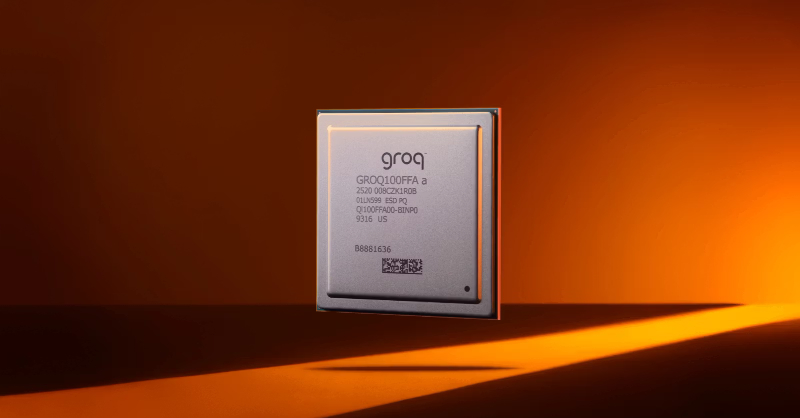
- Groq is seeking an $8 billion valuation for a Series B round, Bloomberg reports.
- That is about 2.5 times the $3.15 billion pre-money valuation it set in August.
- Chairman Alex Davis told investors he expects revenue to grow eightfold in 2027.
Groq lost its founder, its president and much of its senior team to Nvidia in December 2025. Less than a year later, its chairman is asking investors to value what remains at $8 billion.
Groq is seeking a Series B at an $8 billion valuation, according to documents Bloomberg saw. Executive chairman Alex Davis has approached investors about the round. Groq and Disruptive, the investment firm Davis founded, declined to comment.
In August, Groq raised $350 million at a $3.5 billion valuation. The new ask comes as investors pull back from listed neocloud companies that rent out AI computing capacity, citing heavy borrowing and doubts about how long AI infrastructure spending can last.
From chipmaker to inference cloud
Jonathan Ross and Douglas Wightman, both former Google engineers, founded Groq in 2016. Ross helped develop Google’s Tensor Processing Unit before building Groq’s own inference chip.
In December 2025, Nvidia signed a non-exclusive licensing agreement for Groq’s technology, reportedly worth $20 billion. It hired Ross, president Sunny Madra and other employees. Groq has since rebuilt itself as an inference cloud, renting the computing power that runs trained AI models, with a focus on cybersecurity applications, according to Bloomberg.
Funding came fast. Groq raised $650 million in June, led by Disruptive and Infinitum, then $350 million in August. The company says it runs 13 data centres for more than six million developers and plans to grow capacity from 54 megawatts to more than 200 in 2027.
Davis wears two hats. He chairs Groq and runs Disruptive, which led or co-led its rounds in September 2025, June and August. Those rounds put Groq at $6.9 billion, then $3.5 billion, and now, if investors agree, $8 billion.
Davis pitches a neocloud without leverage
In a letter to investors, Davis argues that Groq can grow margins without leverage. He wrote that rivals’ dependence on debt limits “their ability to thrive as truly successful businesses” and that they are “simply acting as industry facilitators with massive unmet obligations.”
The new money would help Groq meet “substantial demand for its inference compute through short- and medium-term contracts,” the letter says.
Davis expects revenue to grow eightfold in 2027 and earnings before interest, taxes, depreciation and amortisation (EBITDA) to reach $2 billion by 2028. Groq is private and has published no accounts, so neither forecast can be tested.
The pitch lands in a nervous market. Elon Musk wrote on X on October 25 that “200+ neoclouds are going to see guppy-level death and consolidation,” and in the same post said SpaceX had closed $40 billion in GPU debt.
Musk is not a neutral voice. SpaceX is borrowing to buy its own chips and said it will not buy any neoclouds. On October 14, Gartner forecast that more than 80% of neocloud providers will cease independent operations by 2030, including mergers, sales, and failures.
Can an $8 billion mark hold against rivals with disclosed revenue?
Groq’s peers have given investors more to measure. Together AI raised $800 million at an $8.3 billion valuation in July and reports annual bookings above $1.15 billion. Fireworks AI raised $1.505 billion at $17.5 billion the same month and says it has passed $1 billion in annualised revenue. Bloomberg reported that Lambda is in talks to raise up to $3 billion at $12 billion or more and expects more than $1.5 billion in revenue in 2026. Groq’s $8 billion excludes new capital, so the comparisons are not exact.
Debt is the other test. CoreWeave, which listed in 2025, took $1 billion in equity from Jane Street in April, alongside an agreement for Jane Street to spend about $6 billion on its cloud services. Nebius announced $4.5 billion of convertible notes in August, and its shares fell 13%.
Demand is not in doubt. Grand View Research values the global AI inference market at $113.5 billion in 2025 and projects $421.8 billion by 2033, an 18% compound annual growth rate from 2026.
Avoiding debt could protect Groq if lenders stay cautious, but running AI infrastructure still takes hardware, power and data centre capacity. Nvidia is a licensee, a planned investor in the August round and a hardware rival, having unveiled an inference system built on the technology it licensed from Groq. If investors pay $8 billion, are they buying a rebuilt inference business, or a place beside Nvidia?