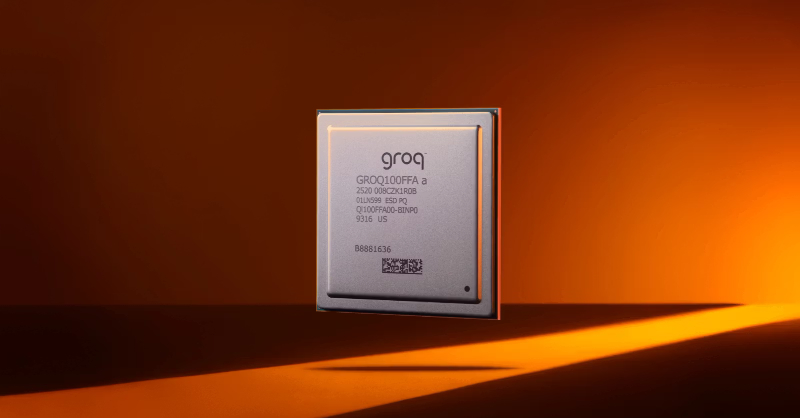
- Groq raised $350 million at a $3.5 billion valuation, half its September 2025 mark.
- Nvidia is set to invest in Groq, months after hiring away its founder and engineering team.
- The round brings Groq’s funding to $1 billion since June 2026, as inference demand grows.
In September 2025, Groq was an independent chip company valued at $6.9 billion, built to challenge Nvidia’s grip on AI hardware. As of August 2026, it is worth half that amount, and the investing company is Nvidia itself.
Groq has closed a $350 million Series A at a $3.5 billion valuation, led by Disruptive, with Nvidia expected to participate. It follows the $650 million Groq raised in June 2026, bringing its recent fundraising to $1 billion in roughly two months.
“We are building Groq into the world’s leading AI inference cloud. Inference will without a doubt become the largest and most critical layer of AI infrastructure,” said Alex Davis, Groq’s executive chairman and founder of Disruptive.
This $350 million round, and the valuation cut that comes with it, is the market pricing in what was lost and what remains. On one side: 13 data centres, more than six million developers, and a plan to scale capacity from 54MW to more than 200MW by 2027. On the other hand, not the founder, and not the team that built the technology in the first place.
A company rebuilt around the deal that broke it
Jonathan Ross, a former Google engineer who helped build the company’s Tensor Processing Unit, founded Groq in 2016. For nearly a decade, it positioned its Language Processing Units as a faster, cheaper alternative to Nvidia’s GPUs. That bet looked vindicated in September 2025, when Groq raised $750 million at a $6.9 billion valuation, led by Disruptive, with BlackRock, Neuberger Berman, and Deutsche Telekom Capital Partners joining in.
In December 2025, Nvidia agreed to pay a reported $20 billion to license Groq’s inference technology and hire Ross, president Sunny Madra, and roughly 90% of the engineering team that built it. Groq kept operating, minus the people who invented its core product.
Inference is becoming the bigger AI trend
Groq’s pitch now rests on a single argument: that running AI models in production will eventually dwarf the scale and spending of training them. It is not alone in making that case, and it is no longer the best-funded name making it.
Together AI raised $800 million at an $8.3 billion valuation in July 2026 to build out its own open-model inference cloud. Fireworks AI went further still, closing a $1.5 billion Series D at a $17.5 billion valuation that same month, backed in part by Nvidia.
That leaves Groq competing less on technology, since its edge now sits inside Nvidia, and more on operational scale and its existing developer base. It remains an Nvidia Cloud Partner, certified to run Nvidia’s accelerated computing under Nvidia’s own reference architecture.
That makes the relationship less a rivalry than a supply agreement with an unusually large investor attached, a pattern Tech Funding News has tracked across other chip challengers Nvidia has absorbed rather than fought.
The unresolved question is whether Groq can rebuild a defensible position after licensing away the technology that made it distinctive. The answer will show whether Nvidia’s capital turns Groq into a genuine platform, or simply a well-capitalised, dependent supplier of the compute Nvidia itself sells.