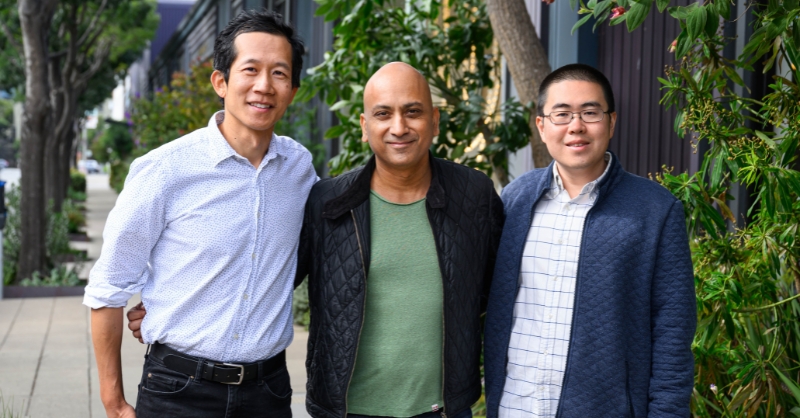
- Together AI raised $800 million at an $8.3 billion valuation, with Aramco Ventures leading the round.
- The startup claims customers can cut inference costs by up to 60 times compared with closed-model rivals.
- Annual bookings have topped $1.15 billion as enterprises shift toward open-source AI.
Together AI has raised an $800 million in Series C funding led by Aramco Ventures, valuing the company at $8.3 billion, up from $3.3 billion in February 2025. Vista Equity Partners, General Catalyst, Emergence Capital, Nvidia, March Capital, Pegatron, and S Ventures also joined the round.
The San Francisco-based company has never built a proprietary foundation model. Instead, it built the cloud infrastructure that lets enterprises run other companies’ open-source models cheaply and at scale, a bet that has pushed its annual bookings past $1.15 billion.
“Intelligence is becoming a foundational resource… Our mission is to ensure that intelligence is abundant, not expensive,” says Vipul Ved Prakash, the company’s co-founder and chief executive.
Why the cost of intelligence is up for debate
As OpenAI and Anthropic pour billions into frontier models, a growing number of enterprises are asking whether they need to pay premium prices for that intelligence at all. Together AI is betting the answer is no, and its bookings growth suggests plenty of customers agree.
The company claims its customers see between six and 60 times lower inference costs than comparable closed-model deployments, while matching or beating performance in terms of quality. Decagon, one of its customers, reportedly cut its inference costs sixfold after switching to the platform.
Prakash founded the company in 2022 alongside Ce Zhang, Percy Liang, and Tri Dao, believing that running frontier-quality AI in production didn’t need to mean paying frontier-lab prices. The founders had spent years working on the infrastructure problems beneath large-scale AI before setting out to build a cloud platform designed around one idea: open-source models could run well, match proprietary ones on performance, and cost a fraction as much.
The startup provides enterprises with a unified cloud environment to deploy multiple open-source models, including DeepSeek, Nemotron, MiniMax, and Kimi, rather than locking them into a single proprietary provider. It now serves more than one million developers and thousands of enterprise customers, including Cursor and Cognition.
A crowded race to make AI cheaper
Together AI isn’t the only company chasing this opportunity, and the field has moved fast. Fireworks AI raised $250 million at a four-billion-dollar valuation in October 2025, also betting on open-source inference infrastructure. Groq took a different path: it licensed its chip technology to Nvidia for around $20 billion in December 2025, before raising $650 million of its own in June 2026 to rebuild as an AI inference cloud provider.
What distinguishes Together AI from both is its singular focus. Rather than building chips or splitting attention across proprietary and open models, the company has bet everything on giving enterprises a single, flexible layer to run whichever open-source model fits their needs.
Nearly three in four organisations expect to increase their use of open-source AI over the next several years, according to McKinsey. Together AI is positioning itself as the infrastructure layer that captures that shift, regardless of which individual model wins out. That shift is part of a broader surge in AI investment: AI captured close to half of all global venture funding in 2025, according to Crunchbase.
“Together has built the platform that makes open-source models genuinely usable at enterprise scale,” says Abhishek Shukla, managing director of Prosperity7 Ventures US, the diversified venturing program of Aramco Ventures.
“Open-source AI is becoming the default for companies that want to scale without losing margin,” added Joe Floyd, general partner at Emergence Capital.
Together AI plans to use the new capital to expand its inference platform, launch new products, and scale its compute infrastructure by roughly 50 times over the next five years. The company has raised more than $1.1 billion over its funding history, with backers including Kleiner Perkins, Lux Capital, and Salesforce Ventures, as well as the investors named above.