- Groq has raised $650 million to scale its AI inference cloud — months after its founder, Jonathan Ross, and most of its senior engineering team departed for NVIDIA in a $20 billion licensing deal.
- Led by Disruptive and Infinitum, the round backs a reconstituted Groq under interim CEO Adam Winter as it bets the inference market will dwarf AI training.
- The global AI inference market is projected to grow from $106 billion in 2025 to $255 billion by 2030, according to MarketsandMarkets
In December 2025, Jonathan Ross — the engineer who co-developed Google’s tensor processing unit and founded Groq in 2016 — agreed to join NVIDIA as part of a $20 billion licensing deal. He took Groq’s president, Sunny Madra, and approximately 90% of the company’s engineering team with him. Six months later, the company he left behind has raised $650 million to build the AI inference cloud he originally envisioned.
The round was led by Disruptive, the Austin-based firm founded by Alex Davis — whose prior bets include Airbnb, Databricks, Palantir, Spotify, Stripe, Slack, and Shield AI — alongside Infinitum, led by founder and chief investment officer John Yetimoglu. Existing investors also reinvested.
Groq’s previous raise was $750 million in September 2025, which valued the company at $6.9 billion. By February 2026, the NVIDIA licensing deal had already returned $7.6 billion to shareholders — roughly $64 per share, about twice the price investors paid in that September round. In a single payout, investors received more than Groq’s entire peak private valuation. The $650 million now being deployed funds what is, in effect, a second act.
Why inference could be the biggest infrastructure market in technology
Groq’s bet is straightforward. Most AI infrastructure was built for training — teaching models to understand language, images, and code. As enterprises move AI into production, the compute required to serve those applications in real time will far exceed what it took to build the models in the first place. Groq estimates the ratio at 15 to 20 times more compute for inference over time. According to MarketsandMarkets, the global AI inference market is forecast to grow from $106 billion in 2025 to nearly $255 billion by 2030, at a compound annual growth rate of 19.2%.
At NVIDIA’s GTC 2026 conference, Jensen Huang unveiled the LPX inference platform — incorporating Groq’s licensed technology — alongside a projection that the total AI infrastructure market could reach $1 trillion by 2027. That announcement validated what Groq has been arguing since 2016: inference, not training, is where the real compute demand will land.
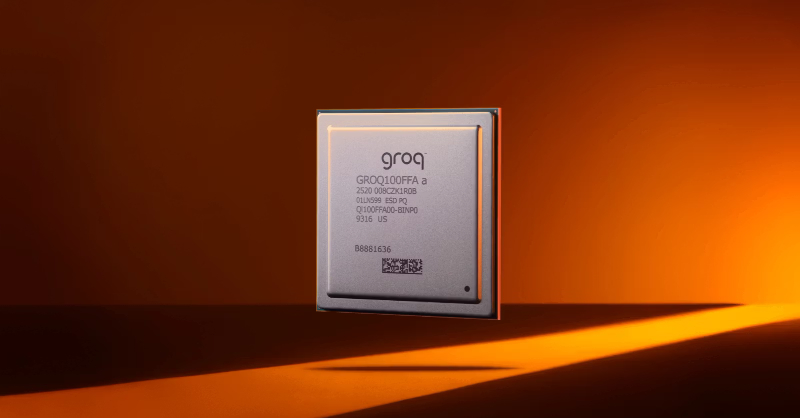
The startup runs AI models on its language processing unit — known as an LPU — custom silicon designed specifically for inference rather than training. Unlike general-purpose GPUs, which handle parallel computation across many tasks, the LPU is optimised for the low-latency demands of serving AI outputs in real time. An enterprise running a customer-facing AI assistant needs responses in milliseconds. That is a performance bar that GPU-based cloud infrastructure often struggles to meet consistently under load.
Today, Groq operates 13 data centres across North America, Europe, the Middle East, and Asia-Pacific, serving more than five million developers and thousands of AI-native companies processing trillions of tokens each week. The new capital will fit out that existing footprint with its latest inference systems — including NVIDIA’s LPX inference platform, which incorporates Groq’s own licensed technology — and push total capacity toward 200 megawatts by the end of 2027.
Rebuilding from the inside: new leadership, same infrastructure
The central question hanging over this raise is execution. Ross and the core engineering team that built Groq’s LPU are now at NVIDIA. What remains is the infrastructure, the developer base, and a leadership team of company veterans.
Interim chief executive Adam Winter and chief financial officer Matt Eng have spent years scaling Groq’s technology and commercial operations. Joining them as chief operating officer is Alan Rice, who previously ran data centre operations at xAI and Meta, after an earlier career in United States Navy nuclear submarine operations — a background that speaks to the operational discipline Groq will need to scale its infrastructure reliably.
Starting in July, Sinclair Schuller joins as chief technology officer and Rakesh Malhotra as chief product officer. The pair previously co-founded Nuvalence, a digital transformation firm acquired by EY in 2024, after working together at enterprise cloud platform Apprenda — which Schuller founded and later sold to Atos. Malhotra also spent nearly a decade at Microsoft leading cloud infrastructure and data centre products.
The competitive landscape is well-established. NVIDIA dominates AI infrastructure globally, and now carries Groq’s own technology inside its next-generation inference platform. Fireworks AI, Cerebras, and SambaNova compete directly for enterprise inference workloads. The hyperscalers — Microsoft, Amazon, and Google — are each building custom inference silicon of their own. Newer entrants like Featherless.ai are attacking the market from below, offering flat-rate inference across tens of thousands of open-source models.
Groq’s differentiation rests on its purpose-built LPU architecture and, it argues, the only engineering team in the world with hands-on experience operating LPUs at production scale — a claim that carries weight if the new hires can sustain it without Ross.
What investors are backing
“We believe inference will become the largest infrastructure market in technology. As AI moves from experimentation to production, demand for reliable, cost-efficient inference will continue to grow exponentially. Groq has the rare combination of differentiated technology, operating expertise, and global scale required to capitalise on that opportunity,” said Yetimoglu.
Davis added that Groq has “a proven global platform” and “a clear strategy focused on one of the most important opportunities in technology: AI inference at scale.”
The AI training boom created NVIDIA’s trillion-dollar market cap — and then NVIDIA absorbed the very founder who was meant to challenge it. Whether the infrastructure, the developer base, and $650 million of fresh capital are enough for Groq to build the foundational inference layer without its inventor is the most interesting unanswered question in AI infrastructure right now.