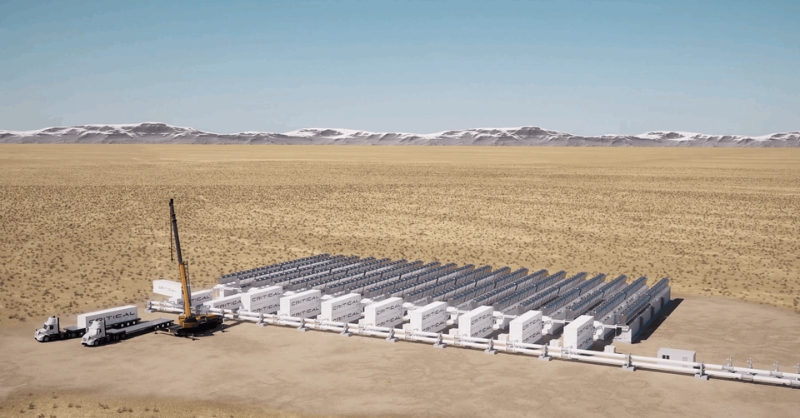
- Critical Energy, founded by ex-SpaceX engineer Spencer Jackson, has secured $22 million in seed funding to mass-produce modular geothermal turbines in factories rather than building them on-site.
- This funding comes at a time when AI infrastructure is driving electricity demand to new highs, highlighting a key weakness in clean energy: solar and wind can’t provide power around the clock.
- Fossil fuels still accounted for 82% of U.S. energy use in 2023. Critical Energy says this gap will persist unless we have reliable, always-on clean power that can be deployed in weeks rather than years.
The AI boom faces a power challenge. Data centers need constant electricity, but solar and wind, which make up over 90% of new global power capacity, can’t always deliver. Fossil fuels still supplied 82% of U.S. energy in 2023, and that number isn’t dropping quickly.
Critical Energy believes the problem is that building geothermal power plants takes years and is very expensive. The company just raised $22 million to change this.
Based in Los Angeles and founded in 2024 by Spencer Jackson, Critical Energy just closed a seed round led by Susa Ventures and Upfront Ventures. Other investors include MaC Venture Capital, Susquehanna Sustainable Investments, Humba Ventures, Scribble Ventures, Underground Ventures, and Silicon Valley Bank, which provided venture debt.
From rocket engines to geothermal turbines
Jackson worked at SpaceX for seven years before founding Critical Energy, where he contributed to Falcon Heavy structures, Starship’s thermal protection, and Raptor engine parts. This experience shapes his view of power plants—not as custom engineering projects, but as products that should be built in factories like cars.
Critical Energy designs modular geothermal turbines. These are container-sized units built in-house that turn heat into electricity using a closed-loop fluid system and custom machinery.
The company says it can reduce deployment times from years to weeks by building most of the system off-site. It has already built a pilot facility in Los Angeles and is moving toward larger commercial projects.
“Everyone talks about solving climate change, but the reality is we need massive amounts of always-on energy to do it. Today, the only energy source we’ve been able to scale quickly enough to meet that demand is natural gas. We’re building a zero-emissions alternative that can match that reliability, and be deployed anywhere,” Jackson notes.
A different bet in a crowded sector
The company’s main competitors are tackling the same challenge in other ways. Fervo Energy, which raised $462 million in a Series E round in December 2025 and is preparing for an IPO of up to $1.33 billion, focuses on enhanced geothermal systems. They use horizontal drilling and fiber-optic sensing to access resources where traditional geothermal doesn’t work.
Quaise Energy, a spinout from MIT that has raised over $120 million, is working on millimeter-wave drilling technology to reach much deeper and hotter areas than standard rigs can.
While those companies focus on underground technology, Critical Energy is concentrating on what happens above ground: the turbines and surface equipment that turn heat into electricity, no matter who drills the well or how it’s done.
This approach could make Critical Energy a supplier to the wider geothermal industry, instead of a direct rival to enhanced-geothermal drillers. However, it’s still unclear if the market will grow enough to meet the company’s needs.
The investors and the money
Seth Berman, General Partner at Susa Ventures, which has also backed Robinhood and Flexport, described the investment as addressing one of the biggest challenges in the energy transition.
“Clean energy doesn’t just need to be abundant, it needs to be dependable. What stood out to us about Critical Energy is its focus on solving one of the most difficult challenges in the energy transition: delivering always-on, zero-emissions power at scale,” he says.
The funding will go toward expanding engineering and manufacturing capabilities, accelerating turbine development, and supporting initial commercial deployments in the U.S. and internationally. Its long-term target is to deliver more than 300 gigawatts of new installed power generation per year by 2045, an ambition that puts it in competition with natural gas peakers and baseload nuclear, not just other geothermal startups.
What comes next
The AI energy crunch can’t wait for new policies or cheaper batteries. It needs power right now, especially in places that can’t wait years for new plants.
If Critical Energy can make geothermal systems as repeatable as an assembly line, the industry’s future could change. If not, the gap between clean energy’s promise and reality will remain.