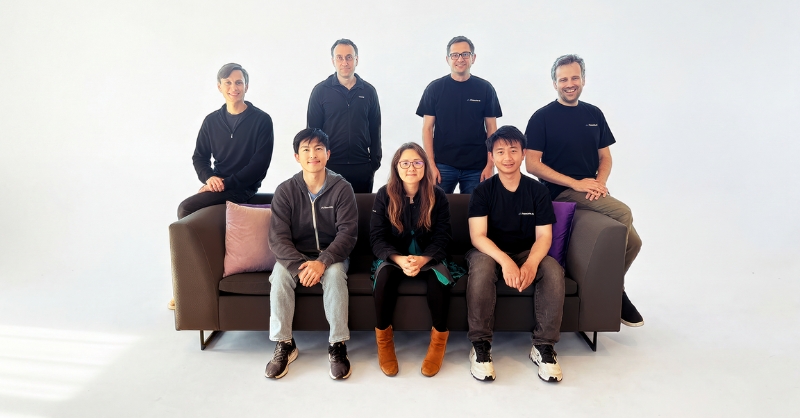
- Fireworks AI raises $1.505 billion Series D at a $17.5 billion valuation, led by Atreides Management, Index Ventures, and TCV, with NVIDIA, Lightspeed, and Evantic also participating.
- The round arrives as the company crosses $1 billion in annualised revenue — up fivefold year-over-year — and daily token volume grows from 15 trillion to more than 40 trillion.
- Founder Lin Qiao led over 300 engineers at Meta to build PyTorch, the open-source framework that now underpins AI development at OpenAI, Google, and Meta itself.
When Lin Qiao left Meta in 2022, she walked away from one of the most senior AI engineering roles in the world. As Senior Director of Engineering, she had spent 7 years — from July 2015 to September 2022 — leading over 300 engineers to build and deploy PyTorch, the open-source framework that now underpins most of the AI industry, including models from OpenAI, Google, and Meta itself. She helped build the plumbing that made the current AI boom possible. Then she left to bet against it.
The company she founded, Fireworks AI, has just raised $1.505 billion in a Series D at a $17.5 billion valuation, led by Atreides Management, Index Ventures, and TCV, with NVIDIA, Lightspeed Venture Partners, and Evantic also participating. The full investor list also includes 20VC, Bessemer Venture Partners, Insight Partners, Lone Pine Capital, Menlo Ventures, Ontario Teachers’ Pension Plan, and others. The round arrives as Fireworks crosses $1 billion in annualised revenue, up fivefold year-over-year, and daily token volume on its platform climbs from 15 trillion to more than 40 trillion.
“There are two paths forward for AI. In one, intelligence belongs to a few big labs, and everyone else rents it. In the other, every company in the world builds specialised intelligence of its own, shaped by the domain only it understands. We are building towards the second,” said Lin Qiao, co-founder and CEO, Fireworks AI.
What Fireworks actually does
Fireworks enables enterprises to fine-tune and serve open-source AI models on their own proprietary data, rather than relying on a general-purpose system from a frontier lab. A bank, for instance, could fine-tune an open model on years of internal compliance documents so it understands regulatory language a generic assistant would not, then run that model on Fireworks’ infrastructure with guaranteed latency. Of the tokens processed on the platform today, 95% come from models customers have customised on their own data — not off-the-shelf frontier models. Its enterprise base includes Uber, Shopify, Revolut, and Doximity.
Qiao co-founded the company alongside 5 others, all former Meta engineers — among them Dmytro Dzhulgakov and Dmytro Ivchenko, two Ukrainian engineers who had been PyTorch core maintainers at Meta before relocating to the US and joining the founding team. The name Fireworks traces directly to that PyTorch origin: torch carries the fire.
A customer concentration risk the company has had to outrun
The round also arrives with a notable backstory. As of last year, roughly half of Fireworks’ revenue came from a single customer: AI coding startup Cursor. That concentration risk became acutely relevant in June, when SpaceX announced a $60 billion all-stock deal to acquire Cursor — a transaction not yet closed, with regulatory approval expected in Q3 2026 — and Cursor began scaling its Composer model on SpaceXAI’s Colossus compute infrastructure, reducing its dependency on third-party inference providers like Fireworks. Qiao has said the company is “much more diversified right now,” and the enterprise roster of Uber, Shopify, and Revolut supports that. But the fivefold revenue growth looks different depending on how much of it Cursor drove, and any future S-1 will tell the full story.
A crowded field getting more expensive
Fireworks is operating in one of AI infrastructure’s most heavily capitalised corners. Together AI raised $800 million at an $8.3 billion valuation just 2 weeks earlier. Baseten raised $300 million at a $5 billion valuation from IVP and CapitalG, with NVIDIA contributing $150 million. Groq raised $650 million in June 2026 after licensing its chip technology to NVIDIA. Microsoft Azure and AWS are folding managed open-model hosting directly into their own platforms — doing what Fireworks does, bundled into existing cloud contracts.
That last point is the sharpest long-term question facing Fireworks. NVIDIA is simultaneously an investor and a company actively expanding into inference through its own acquisitions. Microsoft is a partner and a platform competitor. Fireworks is staking its position on customisation depth — the claim that most enterprises need models reshaped around their own data, not just models served faster — but whether that differentiation holds once hyperscalers start bundling the same tools for free is the question the next year of enterprise AI spending will answer.
The global generative AI market was valued at $22.2 billion in 2025 and is projected to reach $324.7 billion by 2033, according to Grand View Research. Fireworks is using the new capital to fund global compute expansion, engineering hires, and deeper partnerships with Microsoft and NVIDIA. Headcount is expected to grow from around 200 to 600 by end of 2026.
This is Fireworks’ fourth funding round — from $552 million at Series B in July 2024, to $4 billion at Series C in October 2025, and now $17.5 billion at Series D. For the woman who spent 7 years building AI’s most important open-source framework, the trajectory is either proof the bet was right, or the setup for a more complicated story once the hyperscalers decide to take the market seriously.