- Vocca raised a $20 million Series A led by Norrsken VC, taking total funding to $25 million.
- It serves 15,000 medical practitioners, up from 2,000 at its September 2025 seed round.
- Vocca says its agents resolve 70% of conversations without a human; top customers exceed 85%.
Healthcare businesses in the US employ an estimated quarter of a million people to answer phone calls from patients and members, according to consultancy Oliver Wyman.
Vocca, a Paris and New York startup founded in July 2024, wants to take a large share of that work, and a group led by Norrsken VC has backed the attempt with $20 million.
The Series A also drew Heal Capital, Speedinvest and Firstminute Capital, plus angel investors including the founders of Alan, the French health insurer, and Datadog, the cloud monitoring company. Speedinvest and Firstminute co-led Vocca’s $5.5 million seed round in September 2025. The company says total funding is now $25 million.
Eliott Hoffenberg and Hugo Danet, Vocca’s CEO and CTO, built the company around one product: an AI phone assistant that answers patient calls, books appointments, explains exams and consultation preparation, and handles administrative requests.
“Practices don’t ask us about price. They ask how fast we can deploy and how we handle their edge cases. Doctors want an AI that works like their best scheduler, follows the rules of their specialty to the letter, and fills more appointments without compromising on quality,” said Hoffenberg.
Why the phone is healthcare’s weak link
US health spending reached $5.3 trillion in 2024, up 7.2% and equal to 18% of gross domestic product, according to the Centers for Medicare & Medicaid Services. Oliver Wyman estimated that administrative costs made up 25% of total US health spending from 1999 through 2019, and Vocca argues that much of that work still happens on the phone.
The people answering are stretched. In 2022, 45.6% of US health workers said they felt burnt out often or very often, up from 31.9% in 2018, according to a Centers for Disease Control and Prevention survey that included 325 health workers in 2022. Many calls go unanswered: a 2023 TrackableMed analysis that Vocca cites found 42% of 7,000 calls to 22 US practices went unanswered during business hours. The sample is small.
Vocca frames its pitch as the second wave of healthcare AI. The first was documentation, where ambient scribes, AI tools that write clinical notes from consultations, became standard within a few years, as Vocca tells it. Stockholm’s Tandem Health, whose AI scribe is used by 10,000 care organisations, raised a $100 million Series B in September 2026. The second wave, Vocca argues, is conversation, and it spreads faster because patients keep calling and staff keep their existing tools.
Growth, and the resolution rate behind it
Behind the voice sits a scheduling engine built on a library of specialty-specific models, so the assistant follows the booking rules of dentistry, ophthalmology, medical imaging, general practice and other fields. It connects to the software practices already use, which Vocca says lets them go live in days rather than months.
Vocca hosts data separately in the US and the EU, says it is built to meet HIPAA requirements, the US health privacy law, and operates as a HIPAA business associate, the legal status for vendors that handle patient data for US providers. Its infrastructure partners hold SOC 2, ISO 27001 and HDS certifications, the last being the French standard for hosting health data.
Vocca now serves 15,000 practitioners across 1,500 practices and more than 20 specialties in the US and Europe, up from 2,000 practitioners at its seed round. Conversation volume has grown tenfold to more than 1 million a month from inbound calls alone, and revenue has grown sevenfold. Vocca did not disclose revenue.
On average, Vocca says it resolves 70% of conversations end to end with no human involvement, and its most mature customers exceed 85%. Vocca uses different terms for the two figures, requests then and conversations now, and the new average spans about 7.5 times as many practitioners.
A crowded race for the front desk
Vocca enters a field that is filling quickly. New York’s Prosper AI raised a $30 million Series A led by Andreessen Horowitz in June 2026, taking total funding to about $35 million after a $5 million seed. Its agents handle scheduling, insurance verification and billing, and it says it reaches more than 150,000 healthcare providers.
San Francisco’s Vapi, a voice AI infrastructure company that Tech Funding News covered at its $20 million Series A in December 2024, raised a $50 million Series B led by Peak XV in May 2026, with Kleiner Perkins also participating, taking total funding to $72 million. Vapi says its agents have handled more than 1 billion calls across industries including healthcare. In April 2026, San Francisco’s TriFetch raised a $1.9 million pre-seed round led by Nexus Venture Partners for an automation platform covering the front, mid and back office of specialty care.
Europe has its own hospital-administration cohort. Paris-based Parallel raised a $20 million Series A led by Index Ventures in March 2026 to automate hospital paperwork, and Munich-based calliora raised $6 million in pre-seed funding in October 2026 to cut hospital billing errors. Investors are paying up for voice AI more broadly: ElevenLabs doubled its valuation to $22 billion with a $300 million employee tender, TFN reported on October 1, 2026.
Where Vapi sells voice infrastructure to developers and Prosper AI is extending from scheduling into insurance verification and billing, Vocca’s pitch is narrower: patient access, and the booking rules of each specialty.
Norrsken VC is a Stockholm-based impact fund that invests across climate, energy, biotech, AI and health tech. It closed a €320 million second fund in May 2024, and its first fund backed Einride and 1KOMMA5.
“We’ve rarely seen customer love like this in healthcare. After speaking with Vocca’s customers, we knew we had to back this company,” said Alexander Danielsson, a partner at Norrsken VC.
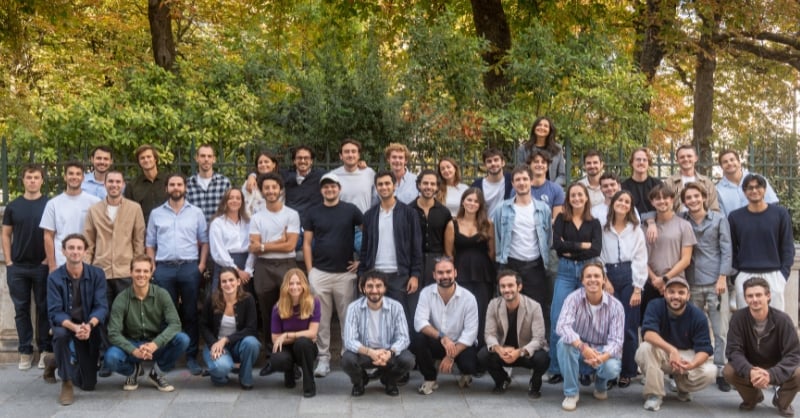
Vocca will use the money to build deeper scheduling infrastructure, add channels beyond voice, cover more specialties and more complex scenarios, and expand its presence in the United States. It has about 40 employees in New York and Paris and plans to hire 40 more across both cities by the end of 2026.
The test is whether Vocca’s 70% average climbs toward the 85% its best customers report as it adds specialties, or slips as the cases get harder. In the US, where it wants a deeper presence, Prosper AI and Vapi are already established.