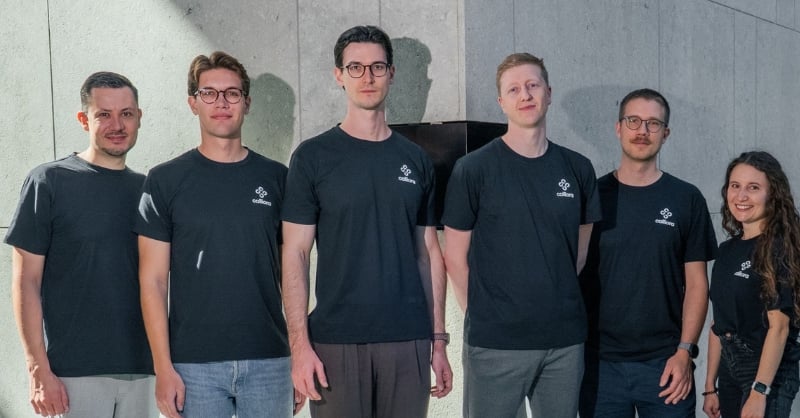
- Munich’s calliora raised $6M pre-seed, led by Bertelsmann Healthcare Investments and redalpine.
- From 2027, insurers may have up to 100% of a hospital’s invoices audited if many are rejected.
- calliora says its AI more than halved effort per case, but names no customer hospitals.
From 2027, a German hospital with enough rejected invoices could see insurers send up to 100% of its bills for audit. Munich-based calliora has raised $6 million in pre-seed funding to catch the errors behind those rejections before an invoice leaves the building.
Bertelsmann Healthcare Investments (BHI) and redalpine led the round. Angel investors from hospital management and AI joined, including Dr Ulrich Wandschneider, former CEO of Asklepios and Mediclin AG; Sara Siegel of Deloitte; Peter Sarlin, founder of Silo AI and behind PostScriptum, NestAI and Qutwo; and Frank Hutter of Prior Labs. calliora will use the money to expand its AI, engineering and product teams and to extend the platform across more stages of a hospital case.
“Some of the best-trained people in a hospital spend a large part of their day carrying information from one system to the next. AI should take over that work, the way a good surgical assistant works: it knows the procedure, knows what comes next, and hands over the instrument before the surgeon asks for it,” said Dr Frederik Träublee, co-founder and CEO of calliora.
“calliora does that for coding and medical controlling. It puts the missing diagnosis or the missing evidence in front of the team exactly when it is needed. It does not make the incision. That stays with the professionals,” he added.
The audit rules hospitals can see coming
The Statutory Health Insurance Contribution Rate Stabilisation Act, passed in July 2026, ties the number of invoices insurers can have audited to the quality of a hospital’s billing. The Medical Service is the insurers’ review body.
Until the end of 2026, the audit cap runs from 5% to 15%. From 2027, a hospital whose audited invoices are rejected more than 35% of the time can face audits of up to 40% of its invoices. If the Medical Service rejects more than half, the cap disappears and up to 100% is possible. Only hospitals where at least 80% of audited invoices pass cleanly stay at the lowest cap of 5%, according to hospital-controlling software firm BI.healthcare.
The measuring has started already. Audit results from the third quarter of 2026 will set the cap for the first quarter of 2027, BI.healthcare says, so hospitals are being judged before the law takes effect.
calliora’s argument is that an error costs least before the invoice exists. A missing detail takes minutes to add then. In an audit, it costs a repayment, a penalty surcharge and hours of work at the hospital, the insurer and the Medical Service.
An error nobody notices means the hospital is never paid for care it delivered. The company says that in logistics the delivery note travels with the pallet, while in a hospital the paperwork for an invoice is often pieced together after the patient has been discharged.
An AI layer over the case
calliora was founded in 2023 by Träuble and Jonas Wildberger, AI researchers who, the company says, earned PhDs at the Max Planck Institute for Intelligent Systems after studying at Cambridge and Oxford and working in the AI units of Amazon Web Services and GSK.
Their advisers include Prof. Dr Bernhard Schölkopf of the Max Planck Institute for Intelligent Systems, who supervised Wildberger’s doctoral research, according to his LinkedIn profile, and Dr Andreas Stockmanns, managing director of hospital billing consultancy Kaysers Consilium, with more than two decades of experience in medical controlling and hospital management.
The company says it processes data only in Germany, in line with EU data protection rules (GDPR). Its website lists ISO 27001 certification and a BSI C5 cloud security attestation.
“In the US, error-free real-time billing is becoming the key to more financially sustainable hospitals. calliora is now bringing this principle to Europe and tackles errors at the source instead of correcting them after the fact,” added Maximilian Boner, Europe lead at BHI.
“Administrative inefficiency costs the healthcare system billions every year, most of it down to fragmented software and regulation that keeps shifting. Frederik, Jonas and their team combine exceptional AI expertise with a real understanding of how to earn trust in healthcare, and we’re excited to back them in giving hospital staff back the time to focus on care,” noted Mira Kamp, partner at redalpine.
The hospital AI race
calliora enters a European field where startups are using AI to cut hospital paperwork.
Paris-based Parallel raised a $20 million Series A led by Index Ventures in March 2026, less than a year after a $3.5 million seed. Its agents run on top of existing hospital software, started with medical coding and are set to expand into billing and admissions. Health Force, whose agents already work inside Italian private hospital groups including Humanitas and Gruppo San Donato, raised €4.2 million in seed funding led by LUMO Labs on September 17, 2026, and plans to expand into Germany, France and Spain.
Berlin-based Recare, which began with discharge management, raised up to €37 million in January 2026, including a €7 million option, in a round led by DNV. Stockholm-based Tandem Health raised a $100 million Series B led by EQT’s Scaleup Europe Fund for an AI clinic operating system that links billing codes with clinical documentation. Berlin’s Aiomics raised €2 million pre-seed for AI documentation with automated coding.
calliora’s route is narrower and tied more closely to Germany’s audit rules: it targets the point where clinical documentation, coding, audits and hospital economics meet. It also has an evidence gap. Every outside voice on its case is a backer or an adviser, and the hospitals that use it stay unnamed.
The first real test arrives in early 2027, when the new audit caps start to apply. That is when calliora’s central claim, that checking cases before invoicing cuts rejections, meets real audit data.