


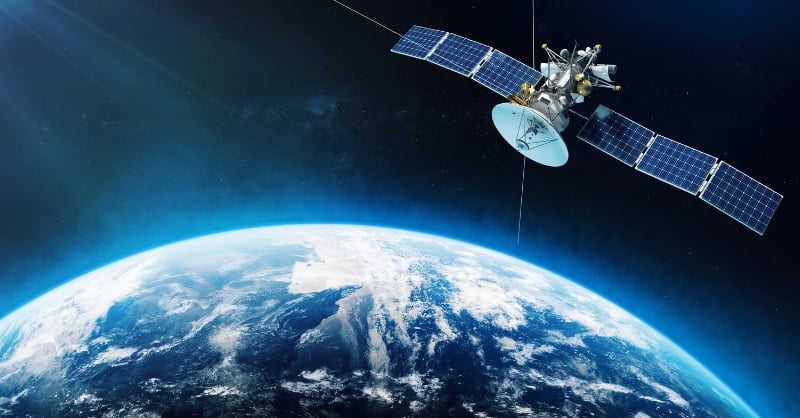
- Google’s Project Suncatcher test satellite launched on October 1 with four AI chips on board.
- Rivals Starcloud and Cowboy Space are valued at $4.3 billion combined.
- Google’s research says orbital computing needs launch costs near $200 per kilogram to compete.
Google has put roughly one server’s worth of computing power into orbit. The company launched a prototype satellite for Project Suncatcher carrying four of its AI chips, known as Tensor Processing Units, aboard SpaceX’s Transporter-18 rideshare mission.
Here are five things to know about the test, and about the startups that got there first.
The first satellite is a one-server test
Google built the satellite with Planet, a satellite operator, and launched it from Vandenberg Space Force Base in California. Travis Beals, a senior director at Google, wrote in a blog post that the team “has confirmed contact with the satellite and it is operating as expected.”
The New York Times reported that the four chips carry about the computing power of one data centre server.
Google frames the mission as one basic question: can its AI hardware survive and work in space? It will collect in-orbit data in the weeks after launch on how the chips handle launch stress, radiation, and extreme temperatures, and has published a peer-reviewed paper on the research in Joule.
Radiation looks manageable, but memory is the weak spot
On the ground, Google says its Trillium chips tolerated more radiation in a proton beam at the University of California, Davis, than a five-year mission would deliver.
Brendan Burke, a research director at analyst firm Futurum, puts the margin at about 20 times for the main processing die, based on Google’s paper. He flags memory as the weak spot: the high-bandwidth memory showed irregularities at a lower dose, though it was still nearly three times the mission requirement.
These are Google’s own results, Burke notes, and still need in-orbit proof.
Heat is the harder problem, and Google is keeping expectations low
A vacuum has no air or water to carry heat away, so chips can only shed it through radiators, and Google is testing heat pipes and radiators for the job.
According to Futurum’s summary of New York Times reporting, the satellite draws about one kilowatt from its solar panels, runs short queries in roughly 15-minute windows before shutting down to cool, and is designed to operate for a year.
James Manyika, Google’s senior vice president for research, told the New York Times the company does not expect anything “usefully operational” in the next few years, and compared the effort to its early driverless car work.
The next test comes in 2027, when Google plans to put two satellites in orbit to try high-bandwidth laser links between them.
Startups are already in orbit, and investors are paying up
A startup, Starcloud, flew an NVIDIA H100, a chip built for data centres, in November 2025. Formerly Lumen Orbit and based in Redmond, Washington, it says it has since trained an AI model and run a Google language model in orbit. Adi Oltean, Philip Johnston, and Ezra Feilden founded it in 2024.
Tech Funding News reported its $170 million Series A in March 2026 at a $1.1 billion valuation, led by Benchmark and EQT Ventures, with Benchmark general partner Chetan Puttagunta joining the board. On August 21, Starcloud added a $250 million extension at a $2.3 billion valuation, led by Manhattan West, with NVIDIA and Cisco Investments joining as new investors. Johnston said the capital will let Starcloud launch more of NVIDIA’s most advanced GPUs into space.
The company has raised $450 million since its founding and has filed with the US Federal Communications Commission for a constellation of up to 88,000 satellites.
Cowboy Space, formerly Aetherflux, is taking a different route. Robinhood co-founder Baiju Bhatt founded it in 2024, and it raised a $275 million Series B at a $2 billion valuation in May 2026, led by Index Ventures. Its first satellite, due later in 2026, will test beaming solar power to Earth rather than computing, and Quartz, citing Bloomberg, reports the first rocket launch is targeted before the end of 2028.
Europe is a small player here. In a November 2025 report, the European Space Policy Institute counted nearly €70 million of private capital invested in space data centre ventures worldwide since 2020, across 13 deals, and found the US invests almost 10 times more private capital in the field than Europe does.
Starcloud’s August extension alone was larger than that whole tally. Finnish satellite maker ReOrbit, led by founder and CEO Sethu Saveda Suvanam, received a €4.6 million Business Finland grant in June 2026 to build OrbitCloud, a network meant to run AI inference in space. Johnston has argued that Europe lacks risk capital and ambition rather than talent.
Launch costs decide who wins
The real gate is the price of getting hardware to orbit. Google’s paper says orbital computing reaches cost parity with data centres on Earth only if launch falls to about $200 per kilogram, a level its analysis says launch could reach by the mid-2030s.
In its September report, Futurum put the price on a reusable Falcon 9 at roughly $3,600 per kilogram. It also estimated orbital infrastructure costs about $72.1 billion per gigawatt, excluding compute, against $16.2 billion for off-grid terrestrial sites.
Starcloud’s numbers are more optimistic and use a different yardstick, so they aren’t directly comparable. Johnston has said its Starcloud-3 spacecraft becomes cost-competitive if commercial Starship launches reach about $500 per kilogram, which he expects in 2028 or 2029.
Both Google and Starcloud depend on SpaceX for launch, and Futurum notes SpaceX has filed for a constellation of up to 1 million satellites and, after acquiring xAI, is a possible competitor as well as the launch provider.
So the money is running ahead of the proof. Investors have put $450 million into Starcloud and $275 million into Cowboy’s latest round, while Google’s own research chief does not expect anything useful to run in orbit within a few years.
Watch whether Google’s chips keep working through the mission, and whether commercial Starship pricing gets anywhere near $500 per kilogram.


