


- Genesis AI has raised $500M in a Series A at a $3.5B post-money valuation.
- Funding will accelerate development and deployment of its general-purpose robot, Eno.
- Its full-stack approach combines robotic intelligence, hardware and real-world training data.
What if robots could do more than repeat a single programmed task? Imagine a machine that can pack a box, replenish shelves and prepare orders in the same shift. Genesis AI is betting that general-purpose robotics can make this possible.
The Paris- and Palo Alto-based robotics company has raised $500 million in Series A funding at a $3.5 billion post-money valuation. Bloomberg reported in July that talks valued the company at about $3 billion before the new money.
The round was co-led by Premji Invest, Khosla Ventures and Eclipse, with participation from Durable Capital Partners, T. Rowe Price Associates, Bpifrance, HSG, NVIDIA, AMD Ventures, Zoom, Samsung Next and Ericsson.
Individual investors include former Google CEO Eric Schmidt, Zoom CEO Eric Yuan, former Yahoo CEO Jerry Yang, French entrepreneur Xavier Niel and former Tesla CFO Zach Kirkhorn.
The funding follows Genesis AI’s $105 million seed round in July 2025, co-led by Eclipse Ventures and Khosla Ventures.
Building robots that learn like humans
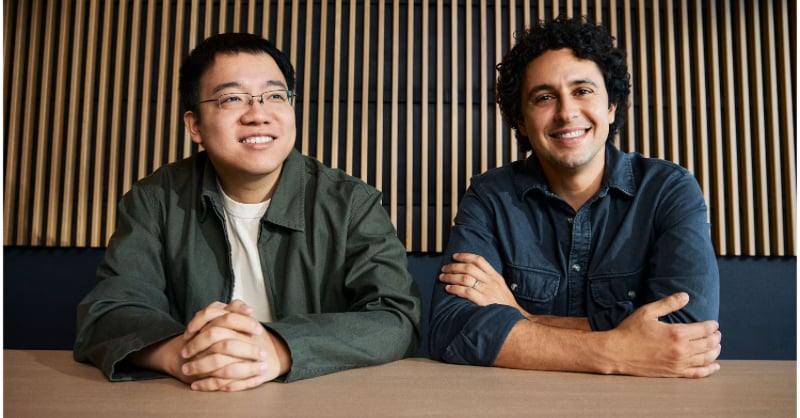
Genesis AI was founded in 2024 by Zhou Xian and Théophile Gervet, who met while studying at Carnegie Mellon University. The founders are pursuing a full-stack approach, developing the robot’s intelligence, physical hardware and deployment together rather than relying on separate systems.
The company argues that reliability is the bottleneck. A robot that succeeds at each step 99% of the time has only an 82% chance of completing a 20-step workflow without error, according to Genesis, so the weakest part of the system sets the limit.
Its first general-purpose robot, Eno, unveiled in June, is designed for manufacturing and logistics, with plans to expand into services, hospitals, homes and outdoor environments. Unlike conventional humanoids, Eno prioritises physical capability over human appearance, combining compact mobility with dual-arm manipulation.
The strategy centres on a continuous learning loop: data from human experience trains the model, a smarter model makes the robot more capable, and deployments reveal failures that feed back into development. “We want to build a platform, not an empire: shared intelligence and versatile robots that anyone can teach and make their own,” the founders wrote in the announcement.
Four technologies powering Genesis AI
Genesis is developing four connected technologies to make this approach work.
GENE is its robotic foundation model, designed to learn complex manipulation skills and transfer them across tasks.
The company says it approaches human-level dexterity and can perform some of the most complex tasks yet achieved by robots with minimal task-specific data.
Its dexterous robotic hand and data collection system are designed around a 1:1:1 mapping between human hands, gloves and robotic hands. This allows the system to learn from human movements and touch data.
Genesis World, its simulation platform, runs robots through millions of virtual scenarios, which the company says exposes failures that physical testing cannot cover. Finally, Eno brings the intelligence into real-world environments, generating further training data through customer operations.
Competition in the general-purpose robotics race
Genesis AI is entering a crowded field of companies working to make robots more capable and versatile.
Generalist AI reached a $3 billion valuation with a $200 million round and develops foundation models that let robots perform complex tasks across different hardware. Humanoid raised a $152 million Series A to build general-purpose robots for industrial and commercial environments. Agile Robots raised a $500 million Series F at an $8.5 billion valuation for robotic arms, mobile robots, humanoids and AI software. Dream Labs raised $90 million to build a shared AI brain that can operate robots from different manufacturers.
The commercial opportunity extends beyond humanoid machines. According to Grand View Research, the global industrial robotics market was valued at approximately $18.5 billion in 2025 and is projected to exceed $44 billion by 2030, driven by automation demand, labour shortages and advances in AI-powered manufacturing.
What’s next?
Genesis will use the new capital to accelerate the development and deployment of its robots, starting in manufacturing and logistics, and to bring together more researchers and engineers. Its master plan moves from factories and warehouses to services, hospitals, homes and the outdoors as robots become more capable and affordable.
Its challenge now is to prove that its robots can perform reliably beyond controlled demonstrations and deliver commercial value at scale.



