


- Path Robotics raised a $300M Series E led by Georgian at a $2.45B valuation.
- Annual recurring revenue grew 17-fold in 18 months, the company says.
- The money will fund a push beyond welding into new tasks and robot types.
Path Robotics has raised $300 million at a $2.45 billion post-money valuation as manufacturers turn to AI-powered robots to expand production capacity. Georgian led the Series E round, with existing investors Addition, Drive Capital, IronArc Ventures, Tiger Global and Yamaha Motor Ventures participating. D. E. Shaw Ventures and NAVER Ventures joined as new investors. Georgian partner Emily Walsh will join the company’s board.
The round follows fast commercial growth. Path says annual recurring revenue has grown 17-fold over the past 18 months as it scales major industrial customers in North America.
The Columbus, Ohio-based company has now raised more than $610 million since its 2018 founding. The new capital will fund a move beyond welding, more AI model training and compute, and new robotic form factors.
“We believe Path Robotics is well positioned to become one of the defining companies in industrial physical AI,” said Walsh.
From difficult welds to factory-wide automation
Andy Lonsberry and Alex Lonsberry co-founded Path Robotics in 2018. The company began with welding, a complex manufacturing task that traditional robots often struggle to perform when parts and conditions vary.
Its Obsidian model combines machine learning and computer vision to help robots identify weld joints, plan and execute welds, and adapt in real time. The company describes the technology as physical AI for manufacturing.
“We started with welding because it is one of the hardest jobs on the factory floor to automate, and we’ve proven that our technology can succeed in real production environments. Path Robotics’ ARR is up 17x in 18 months: why Georgian is backing its $300M Series E,” said Andy Lonsberry, CEO and co-founder.
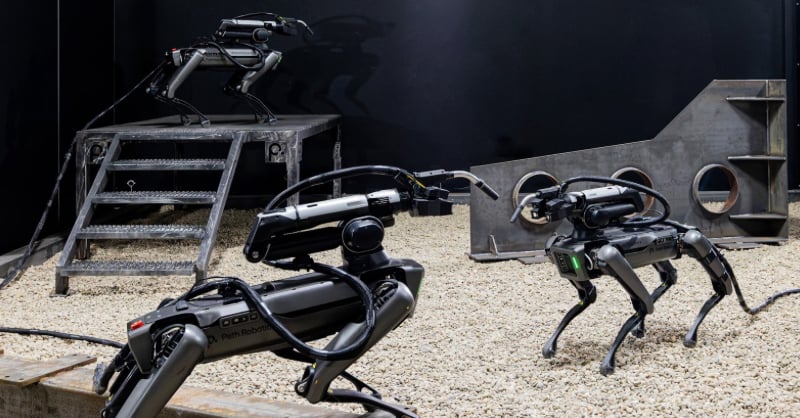
Path is also extending Obsidian to new robot types. Its Rove system pairs the model with a quadruped robot, bringing mobile welding to places where moving a part to a fixed robotic cell may not be practical.
Customers are buying capacity, not just robots
Path’s customers include shipbuilder HII, Lockheed Martin and Saronic, alongside mid-sized manufacturers such as EK Machine, Millerbernd Manufacturing Company, TransAmerican Power Products and TYCROP.
Earlier this year, it announced a $600 million performance-based production agreement with HII to accelerate physical AI deployments across US Navy shipbuilding programmes. Path is targeting shipbuilding and defence, heavy equipment and energy infrastructure.
“As demand for critical defense systems continues to grow, scaling production requires innovative approaches,” said Chris Moran, vice president and general manager at Lockheed Martin Ventures.
Eric Chewning, HII’s executive vice president of maritime systems and corporate strategy, added: “[W]e are focused on execution and improving throughput to deliver the ships and technologies our nation needs.”
Path says its workforce grew 97% year-over-year, with plans to reach 400 employees by year-end.
Physical AI is attracting bigger cheques
Path is entering a market where automation demand is rising. The International Federation of Robotics reported that a record five million industrial robots now operate in factories worldwide, and forecast global installations to rise 9% to 655,000 in 2026. It points to labour shortages, the relocation of manufacturing, and advances in AI and machine vision as drivers.
Other robotics companies are also raising large rounds. Apptronik secured a $520 million Series A extension in February 2026, backed by returning investors including Google and Mercedes-Benz, to scale its Apollo humanoid robot. New York-based Standard Bots, whose AI-native robot arms handle welding among other tasks, raised $200 million in Series C funding at a $1 billion valuation in June 2026, co-led by General Catalyst and RoboStrategy. Belgian computer vision company Robovision raised $42 million in Series A funding in March 2024 to expand in the US.
The approaches differ. Path’s vision, which Walsh backs, is that its proprietary models and production data can create a powerful advantage in complex tasks, starting with welding.
If Path can make its intelligence work across the factory floor, is welding just its entry point or the foundation of a much larger industrial AI business?



