- Lute raised $20 million in pre-seed and seed funding.
- OTB Ventures and FORWARD.one co-led the seed round.
- Lute is already deployed at a European distributor with $6B in revenue.
Warsaw-based physical AI startup Lute has raised $20 million in pre-seed and seed funding to develop foundation models that help robots interact with the physical world.
OTB Ventures and FORWARD.one co-led the seed round, while Seedcamp and Credo Ventures co-led the pre-seed. Inovo VC, ff Venture Capital, Borusan Ventures and investor Naval Ravikant, founder of AngelList and an early backer of Twitter, Uber and Notion, also joined.
Lute officially started in January 2026. It was founded by Paweł Budzianowski and Krzysztof Walas, and is building a new family of foundation models based on tactile input. The company believes that giving robots a sense of touch could help them handle everyday objects more reliably in retail stores, warehouses and third-party logistics (3PL) sites.
Ten months after it started, Lute says it is deployed at what it describes as the largest automotive retail distributor in Europe, which has $6 billion in annual revenue. Its models also work in hospital corridors, and it is working with some of the world’s largest retailers at their sites.
Why robots need a sense of touch
Most current robotics systems and physical AI models rely heavily on cameras and visual information to understand their surroundings. However, vision alone cannot always tell a robot how firmly it is holding an object, whether something is slipping from its grip or how soft or fragile it is.
Lute believes touch is the missing signal that will let robots handle real work reliably. Its main bet is on scaling up tactile data and empowering system integrators.
The company and one of its partners co-designed compact, elastomer-based tactile sensors and built them into a custom portable data-collection setup. This lets Lute collect touch-rich data at scale.
Introducing Lute-0
Alongside the funding announcement, Lute has introduced Lute-0, its first video-action model, which learns from video how scenes change and turns that into robot actions.
According to Lute, it pre-trained Lute-0 on far less data than the leading open-source robot model π0.5, used only a quarter of its training steps and matched its performance on dexterous tasks. These are company-reported results, and TFN has not seen independent validation.
Lute builds frontier physical intelligence and deploys it in retail, warehouses and 3PL logistics. Its website says it also provides monitoring and remote support alongside its software.
“Many system integrators want to deploy AI-driven robots, but few have the machine learning expertise to do it. Lute removes that barrier. It guides integrators without in-house AI teams through selecting the right hardware, defining the task and retraining the robot on site, so they can put physical AI to work for their customers,” said Kris Pałucki, investment director at OTB Ventures.
“I hear the word ‘urgency’ in almost every pitch. With Paweł and Krzysztof, you feel it as soon as you walk into their lab. That extreme sense of urgency put Lute’s models onto real retail and logistics sites within months, because every hour on the shop floor teaches a model something no lab can, especially through touch. In physical AI, the slow and the perfect will both lose,” added Boy de Jonge, investment manager at FORWARD.one.
Who founded Lute, and who backs it?
Budzianowski is co-founder and CEO. He previously co-founded K-Scale Labs, which built affordable open-source humanoid robots, and led the machine learning team at PolyAI. He holds a PhD from Cambridge, where he worked on long-term conversational agents.
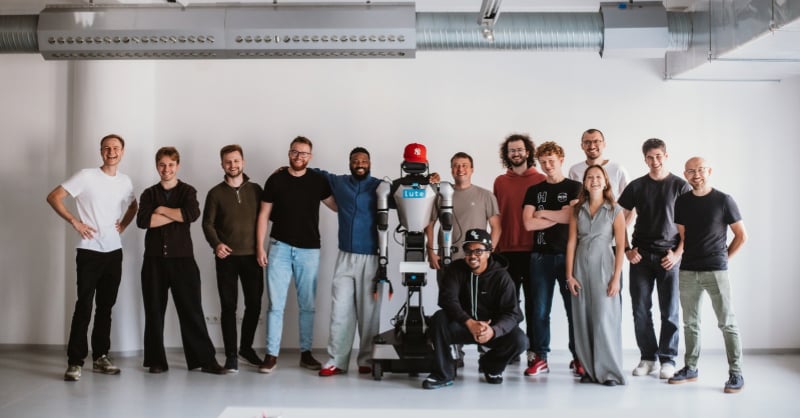
Walas is co-founder and CTO. He was previously an associate professor at Poznań University of Technology, headed the Physical Interaction Robotics team at IDEAS NCBR, advised robotics startup Nomagic and served on the board of the European AI-Data-Robotics Association. The team has 16 people, including four PhDs.
Seedcamp was an early backer of Revolut, Wise and UiPath, while Credo Ventures has backed ElevenLabs and UiPath.
Who is competing in physical AI and robotic dexterity?
Lute is entering a growing physical AI market in which startups are developing models, sensors and software to help robots perform tasks in real-world environments.
Zurich-based Enact Intelligence is the closest comparison. It emerged from stealth on October 22, 2026 with $30 million in pre-seed funding from redalpine, Notion Capital and firstminute capital to build robots that sense force and touch. Zurich-based mimic raised $16 million in a round led by Elaia in November 2025 to develop AI models for robotic hands trained on data from skilled workers.
Stuttgart-based Sereact raised a $110 million Series B led by Headline in April 2026, after a €25 million Series A led by Creandum. Boston-based UNIT AI raised $12 million in July 2026 to build modular warehouse automation for retailers and 3PL providers. Italy’s Adaptronics raised €3.15 million in November 2025 for robotic grippers that combine electrostatic adhesion with tactile sensing.
Lute’s stated focus is building foundation models around tactile data and putting them in the hands of integrators.
What comes next?
Lute will use the funding to scale its data acquisition, improve its models and scale deployments with customers. It is hiring across research, engineering and deployment in Warsaw and the Bay Area, and has offices in Warsaw and San Mateo, California.
The next challenge will be proving that tactile foundation models can generalise across different robots, objects and working environments. Can Lute make touch the missing layer that takes physical AI from promising demonstrations to everyday commercial use?