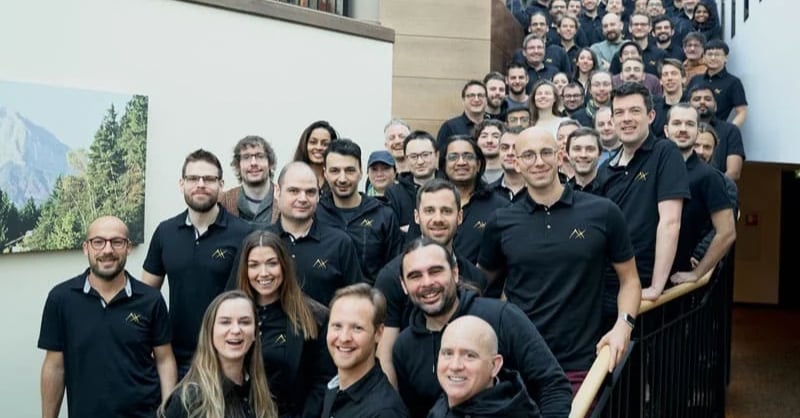
- Dutch chipmaker Axelera AI is reportedly in talks to raise $400M.
- It is also seeking several hundred million euros in EU subsidies.
- BlackRock and Samsung Catalyst already back it; no new investors are named.
Dutch AI semiconductor startup Axelera AI is in talks to raise an additional $400 million to expand its chip development and strengthen its position in the AI inference market, according to people familiar with the matter cited by Bloomberg.
The Eindhoven-based company is also seeking several hundred million euros in subsidies through the European Union’s Important Projects of Common European Interest (IPCEI) programme, which supports strategically important industrial technologies.
The talks come as Europe looks to cut its dependence on US and Asian suppliers for AI infrastructure chips. The discussions are ongoing, and neither a valuation nor the investors in the proposed round has been reported.
Building chips for AI inference
Axelera AI was co-founded in 2021 by Fabrizio Del Maffeo and Evangelos Eleftheriou. It makes specialised processors for running AI models, a process known as inference. Training teaches a model from large datasets. Inference is when the trained model answers questions and performs tasks.
Its chips aim to make inference cheaper and more energy-efficient. They target industrial manufacturing, robotics, retail, security, defence and agriculture, where processing data locally cuts latency, power use and reliance on the cloud.
Axelera has moved beyond its original edge focus with two platforms. Metis targets edge AI, while Europa handles heavier workloads on enterprise servers. Its third-generation Titania architecture, unveiled in November 2026, is aimed at data centres and supercomputers.
Titania uses a chiplet-based design and digital in-memory computing to improve performance while cutting power and cooling needs. The company says it has more than $300 million in confirmed customer commitments, with production targeted for the third quarter of 2027.
Previous $250M funding round
The talks follow Axelera’s announcement of more than $250 million in additional funding in February 2026. European venture capital firm Innovation Industries led the round, with BlackRock and SiteGround Capital joining as new investors.
Existing investors Bitfury, Verve Investments, Samsung Electronics’ Catalyst Fund, the European Innovation Council Fund, Invest-NL and Belgian government-backed SFPIM also took part.
The money went to manufacturing for the Europa chip, software and commercial operations. The February round took total funding to more than $450 million across equity, grants and venture debt.
In September, Axelera said it had more than 600 customers and had signed supply contracts worth tens of millions of dollars for AI factories. It is working with Dell and systems integrator E4 on European AI infrastructure projects.
Europe’s race to challenge Nvidia
Axelera is one of several European startups chasing the AI inference market. Dutch peer Euclyd raised more than €200 million in September 2026, backed by Samsung and others, to build purpose-built inference processors.
UK-based Fractile raised $720 million in November at a reported $7 billion valuation. Founded by Walter Goodwin and Yuhang Song, it is building processors that stack memory directly on top of logic. OXMIQ takes a different route, licensing chip architecture instead of manufacturing.
The approaches differ, but all of these companies want to loosen Nvidia’s grip on AI hardware.
For Europe, backing Axelera is also about technological sovereignty. The region has strong chip research and manufacturing expertise but still buys advanced AI processors from overseas.
A $400 million round and EU subsidies would give Axelera more room to move from product development to volume production. It still has to prove its chips can compete on performance, cost, software compatibility and reliability.