


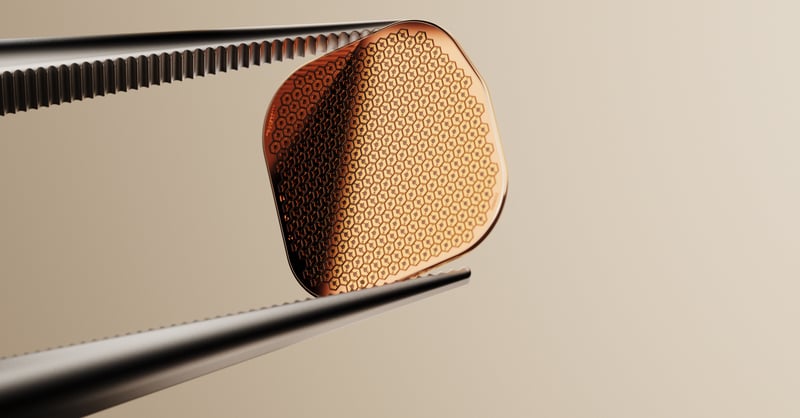
- Science Corporation has raised $400M in a Series D, taking total funding beyond $900M.
- The funding will accelerate European rollout of PRIMA and support its US regulatory pathway.
- It will also invest more in biohybrid interfaces that pair engineered neurons with brain circuits.
Restoring sight to people blinded by advanced retinal disease is no longer just a research ambition. Science Corporation, the medical technology startup founded by former Neuralink president Max Hodak, has raised $400 million in a Series D. According to its blog post, the funds will accelerate the commercialisation of its vision-restoring implant and advance its next generation of neural interfaces.
The round attracted participation from Khosla Ventures, the Ackman Oxman Institute, Tenet Healthcare, 885 Capital, Y Combinator, and PLC Neurotech, among others. The company says the financing brings total capital raised since its 2021 founding to more than $900 million.
TechCrunch reported that the round values Science at $3.5 billion, although the company has not disclosed a valuation. That would more than double the $1.5 billion valuation reported at its $230 million Series C in March.
PRIMA brings artificial vision closer to patients
Science’s immediate commercial focus is PRIMA, a brain-computer interface-based retinal implant designed to restore form vision in people blinded by certain types of late-stage macular degeneration. The round comes a few months after PRIMA’s European commercial launch, and Science says it is the first brain-computer interface to be CE marked to restore form vision, meaning the ability to read letters, numbers and words.
The system combines a tiny implant placed beneath the retina with camera-equipped glasses. The glasses capture visual information and transmit signals to the implant, which stimulates the remaining retinal cells. This allows the brain to interpret visual patterns, helping patients recognise letters, numbers and words.
Science is now preparing to expand access across Europe while pursuing US approval through the Food and Drug Administration’s Humanitarian Device Exemption pathway.
Science is also investigating the technology for other conditions. When it announced its Series C in March, it said it would expand its clinical programme to inherited retinal diseases such as Stargardt disease and retinitis pigmentosa.
From Neuralink to a new generation of neural technology
Science was founded in 2021 by Max Hodak, Alan Mardinly and Emma Zhou. Hodak co-founded Neuralink and served as its president before setting out to build technologies that could interact with the brain and extend the limits of biology. He leads Science as CEO, and Mardinly was previously part of Neuralink’s leadership team, according to Crunchbase.
While PRIMA provides a near-term commercial opportunity, Science’s longer-term ambition goes beyond vision restoration. Its biohybrid programme is developing a neural interface that integrates engineered neurons with the brain’s own circuits.
The company is exploring how this approach could establish more direct biological connections with the brain. It is also preparing for initial human trials in collaboration with Yale neurosurgery professor Murat Günel, according to TechCrunch.
A crowded race to connect with the brain
Science operates in an increasingly competitive neurotechnology market, where companies are developing different approaches to restoring or enhancing communication between the brain and machines.
Precision Neuroscience raised $250 million in September 2026 to advance its minimally invasive Layer 7 brain-computer interface. Synchron is developing an endovascular implant that can be delivered through blood vessels to help people with paralysis control digital devices. Meanwhile, Paradromics is developing high-bandwidth neural interfaces designed to restore communication for people with severe motor impairments.
These companies are not direct substitutes for PRIMA’s vision-restoration system, but they illustrate the growing investment and technical competition across brain-computer interfaces.
According to The Business Research Company, the global BCI market was valued at approximately $2.36 billion in 2025 and is projected to reach $4.66 billion by 2030, a compound annual growth rate of 14.4%. That estimate covers the wider BCI ecosystem rather than retinal implants alone, but it shows the expanding opportunity for medical neural interfaces.
Scaling from vision restoration to biohybrid systems
“We’ll use the new capital to accelerate PRIMA’s availability across Europe and to prepare for its launch in the United States,” Science said in the announcement. It will also expand its research, manufacturing and operational infrastructure and make substantial further investments in its biohybrid programme.
With more than $900 million raised, Science is building a platform that spans medical devices, retinal implants and advanced neural engineering. Its next challenge is to translate that ambition into regulatory approvals, wider patient access and successful clinical outcomes.
Can Science turn its early progress in restoring vision into a broader platform for connecting engineered technology with the human brain?



