


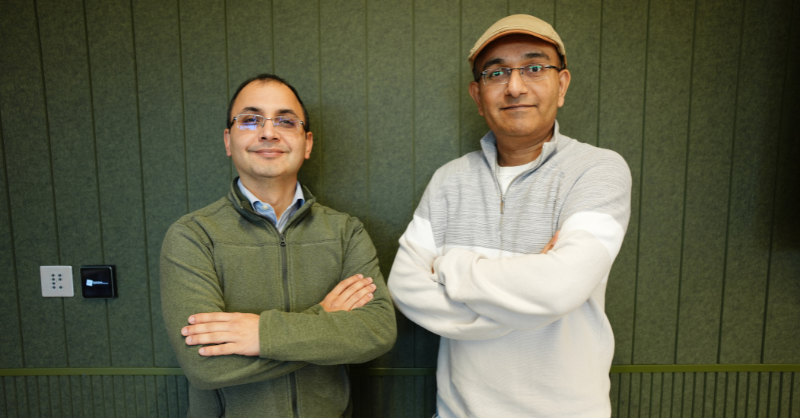
- Niro Intelligence has raised €1.65 million in a funding round led by Voima Ventures and Maki.vc.
- Nilay Oza and Niraj Aswani had previously built and sold Klevu.
- In Niro’s own tests, its AI model reduced costs by 67% and made five times fewer tool calls.
Nilay Oza and Niraj Aswani built Klevu, an e-commerce search company, over more than 10 years and have seen firsthand how software systems can outgrow their users. With Niro Intelligence, they’re now up against a much bigger challenge: AI-generated code is being produced far faster than it can be reviewed.
Based in London, the company raised €1.65 million in a round led by Voima Ventures and Maki.vc. Angel investors in the round include Heikki Nousiainen, Santeri Kangas, Elias Aalto, Oskari Pétas, Johannes Korpela, Lauri Vuornos, and others.
No single party has complete visibility
Niro points out that as codebases grow and spread across services, it becomes increasingly difficult to verify changes. AI costs go up as agents search for context, and it takes longer to trace incidents.
Niro addresses this by providing ground truth: a map of code behaviour that both engineers and AI agents can use to validate changes.
“AI now writes code faster than anyone can understand it. No person and no agent holds the whole picture anymore. The answer is ground truth, a live map of what the code really does that people and agents can check any change against. That is what we are building at Niro,” says Oza, CEO and co-founder of Niro Intelligence.
According to the company, the benchmark used 42 real developer queries across three production codebases. They ran the queries through both Claude Opus 4.6 and Claude Code. The total cost dropped from $14.61 to $4.82, and tool calls fell from 914 to 169. Each setup was run once, and as this is niro’s own study, the results should be independently verified.
A competitive landscape, a distinct approach
Competitors in the AI code generation space have deep pockets. CodeRabbit raised $143 million at a $1.5 billion valuation for AI code review. Meticulous in London raised $15 million to test every change prior to deployment. Resolve AI, a site reliability-focused startup, announced a $125 million Series A at a $1 billion valuation in February.
Niro works at the foundational layer, providing a single code graph for engineers and agents. In January 2025, Klevu merged with Searchspring to form Athos Commerce.
“Europe’s critical systems increasingly run on code that no single person has fully read. That makes the reliability of AI-written software an infrastructure question, as important to Europe’s resilience as energy security or supply chains. Nilay and Niraj have already built Klevu together and taken it to an exit, so they know how systems outgrow the teams running them,” said Inka Mero, managing partner at Voima Ventures.
“Cutting cost by 67% and tool calls fivefold is a strong early signal that ground truth changes how AI agents work. We’re excited to back Nilay and Niraj as they build it,” added Pirkka Palomäki, founding partner at Maki.vc.
Three-phase rollout begins
The funding will go towards a three-phase rollout. Niro Local is already out there and can be installed with a single command. The next stage is team pull request review.
The final stage will be for Niro to connect its code graph to commits, logs and production telemetry so you can trace an incident all the way back to its root cause.



