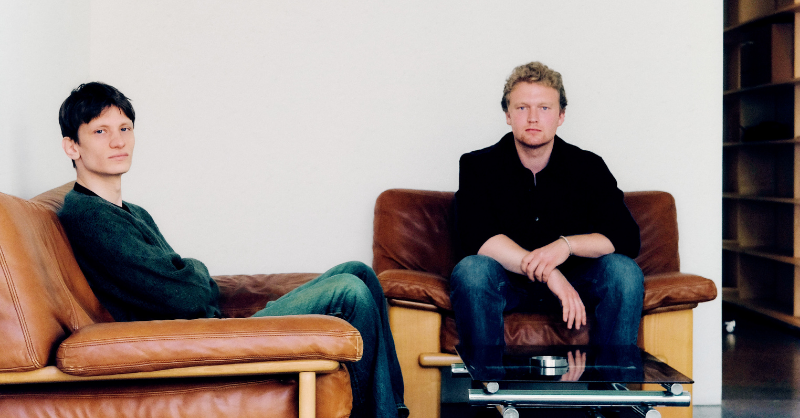
- F13 has raised $5 million in pre-seed financing to develop AI that produces accurate, editable vector graphics.
- Credo Ventures and Point Nine Capital led the funding round, which was completed in just three weeks and did not require a pitch deck.
- Gregory Janik, the founder, describes today’s AI as still being in what he calls the “dial-up internet era”.
When Gregory Janik gave up his degrees in mathematics and physics, remaining at university seemed to him the least effective way to spend his time, as he was already working full-time.
He then developed flight-control software for a drone company that was later acquired by Helsing, took charge of credit-risk models at an FCA-regulated bank, and secured a $5 million pre-seed round for his third startup without using a slide deck.
Credo Ventures and Point Nine Capital led the pre-seed round, with angel investors such as Carles Reina of Baobab Ventures and Jack Richardson of Mainframe also participating.
According to Janik, the whole process, from his first conversation with an angel investor in San Francisco to the finalisation of the round, took around three weeks, and no pitch deck was used.
“That’s something which fundamentally doesn’t occur in Europe. You just talk to a stranger, and he says, ‘That’s very cool, here’s a check,’” he tells Tech Funding News.
From Poland to Berlin
Janik moved from Poland as a teenager and lived in both London and Milan before finally settling in Berlin, where he has lived for more than ten years. Inspired by his father, he taught himself to code as a child and had previously attempted to set up two companies: a startup focused on machine-learning infrastructure in his twenties and another bank backed by venture capitalists and holding a regulatory licence.
Later, he worked on flight controllers and onboard intelligence for autonomous drones at a company that Helsing later acquired. He then took up the position of director of engineering at an edtech company, where he met Ingimar Tomasson, co-founder of F13 and a mathematician who studied at UCL.
The experiences in question led to the idea of F13. “Accurate visuals do represent a real problem since you can’t generate them using AI. In fact, AI is the antagonist when it comes to accurate visuals… people dislike AI-generated images and don’t want anything to do with them because they’re always misleading,” Janik tells TFN.
Focusing on a specialised approach instead of competing with big labs
The argument put forward by F13 is straightforward: Janik illustrates the concept of vector graphics with common examples such as labels on water bottles, icons in browser toolbars, and images in phone operating systems. These images remain clear at any zoom level because they are based on numbers rather than pixels.
“Designers still have to produce the diagrams themselves because you won’t ask AI to do it for you,” he says. For example, when a student is shown a diagram of a human skeleton, it has to be accurate rather than just plausible.
Janik does not regard other vector-graphics startups as direct competitors, citing Quiver, a company that provides more expressive, artistically rich graphics for illustrators.
In Janik’s view, the true competition comes from frontier labs such as OpenAI and Google, which develop general-purpose models at a high cost. While Recraft, which has raised $42 million to fund brand-consistent vector and raster tools, and Ideogram, which has raised $96.5 million for raster text-to-image generation, operate in a field similar to F13’s, they are not considered direct rivals.
What comes next
The team consists of seven members, the majority of them having PhDs, and Janik has no intention of expanding much at this stage. The funds are intended for training and launching the first model.
Janik stresses that they did not need a $100 million mega-round to gain an advantage in computing power. While frontier labs charge between $60 and $70 per million tokens, F13 aims to provide graphics generation at “a cent… or even less.”
Matěj Míček, Credo Ventures’ tech partner, said, “Gregory and Ingimar have a strong track record of finding solutions to deeply technical problems, but what sets them apart is taste. Together, they bring state-of-the-art machine learning research, deep roots in the fashion and design world, and a proven history of founding and scaling companies.”
Pawel Chudzinski, partner at Point Nine, added, “Every company deals with a tremendous amount of visuals: graphic design, charts & diagrams, marketing assets, etc. And yet this is exactly what today’s AI still gets wrong. There is a reason why software engineers are using agents for everything, but designers still rely on manual workflows.”
The seven-member team at F13 is currently working to determine whether their specialised method can beat the resources of the frontier labs, or whether it will eventually be taken in once vision technology becomes as common as text.
“We’re still in the phase that I would describe as the dial-up internet era. The iPhone moment for AI has not yet come about—definitely not there yet,” Janik concludes.