


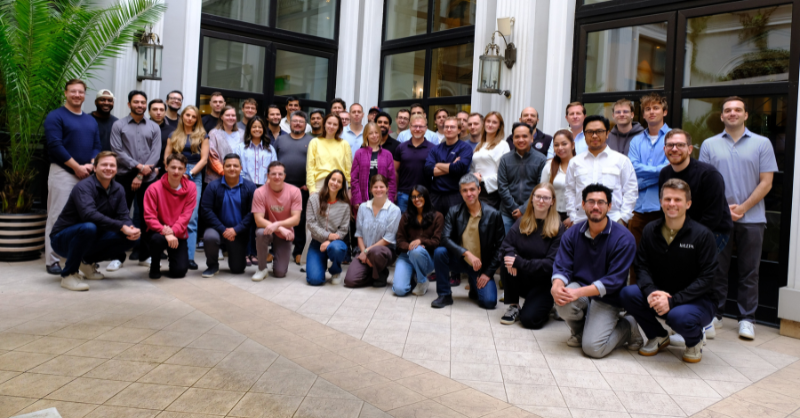
- Kalepa raised $75 million in a Series B at a $470 million valuation, led by Updata Partners.
- The New York-based insurance AI start-up previously closed a $14M Series A in 2021.
- Kalepa reports it has been cash flow positive for over two years.
Kalepa waited five years between funding rounds and has been cash flow positive for over two years. The New York-based company just announced a $75 million Series B at a $470 million valuation, led by Updata Partners.
This round comes as AI-focused companies took in 99.1% of insurtech funding in Q2 2026.
Founded by Paul Monasterio and Daniel Hillman, Kalepa’s software helps insurers, MGAs, reinsurers, and program administrators with underwriting, pricing, and portfolio decisions. The company operates in over 10 countries.
From nuclear science to insurance underwriting
Monasterio has a PhD in nuclear science and engineering from MIT. Before founding Kalepa, he worked at Applied Predictive Technologies, which Mastercard acquired for $600 million in 2015, then at Mastercard and Facebook. Hillman went through the sales ranks at the same analytics firm and at Mastercard.
Monasterio says his ‘outsider’ perspective is an advantage,antage but he also recognises the value of industry expertise. He explains that Kalepa’s demos have no slides – they invite the prospect to ‘send us a risk that’s just come to your desk’.
Kalepa names backers including former US Commerce Secretary Penny Pritzker, Carta CEO Henry Ward and Lead Bank CEO Jacqueline Reses. Gokul Rajaram, on the boards of Coinbase, Pinterest and The Trade Desk, is also listed.
The pitch: AI does the work, but humans sign off
Kalepa says its platform manages and coordinates the entire operation, from underwriting and pricing through to portfolio management. Dedicated software orients the AI agents to carry out multi-step tasks.
The platform’s autonomy level is based on the complexity and risk of the task at hand. People are brought in when their expertise or their approval is required, and everything is traceable and auditable.
For instance, when an underwriter at a specialist insurer receives a submission from a broker for a new policy, Kalepa brings all the research, data, and guidelines together in one workspace and flags any information gaps, as shown in a Kalepa case study on Bowhead Specialty.
Insurers using Kalepa report over 58% higher premium per underwriter, and quotes are delivered 30-60% faster. The combined ratio has also improved by 960 b.p., a 9.6pp reduction in the proportion of premium spent on claims and expenses.
“Insurance runs on the judgment of experienced professionals, and our Professional Grade AI is held to that same standard. That means insurers can look at each task and ask who does it best, and at what cost. Sometimes that’s AI, and sometimes it’s a person,” said Monasterio.
A crowded field of underwriting AI
Updata Partners, a growth equity firm based in Washington, DC, previously led the CData $140 million Series B in 2021 and the Nerdio $117 million Series B in 2022. IA Ventures and Inspired Capital, which led the 2021 Series A, are also participating again.
Kalepa has raised $91 million in total, according to the company. The fund aims to expand its AI product offering, enter new markets, and double its team by 2027.
Rivals have also raised significant capital. Federato, an AI-native underwriting platform, raised $100 million in a Series D in November 2025, led by Goldman Sachs Alternatives, and has raised over $180 million in total. Six, which offers an ‘AI Underwriter’ based on autonomous agents, raised $30 million in a Series B in January 2026. Tech Funding News reported in February that London’s Artificial Labs raised $45 million for their digital underwriting software.
Sixfold‘s proposition is that it handles underwriting end to end. Kalepa takes a different view, arguing that autonomy should be task-specific. Technavio expects AI in the insurance market to grow by $30.07bn between 2024 and 2029.
Kalepa believes insurers will continue to value human oversight and an audit trail at every stage. If the competition can show that agents can underwrite with less supervision, then it’s not clear the carriers will keep paying for Kalepa’s model.



