


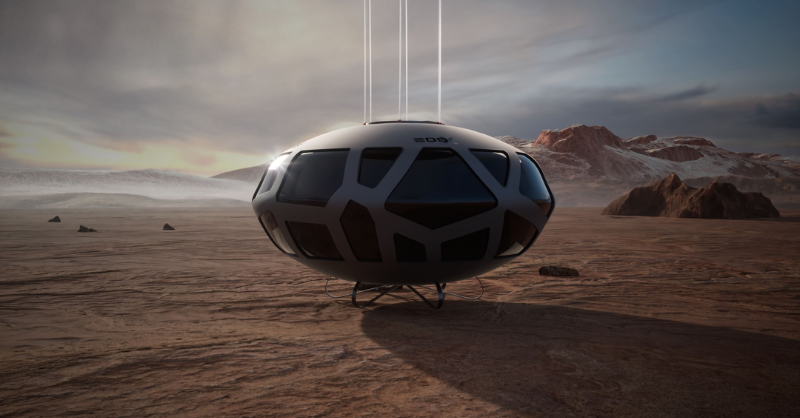
- EOS-X Space has raised €110m from GEM, taking the company to a pre-commercial launch valuation of $1.2bn.
- The Spanish-based company raised $260m in 2026 and plans a dual listing in New York and London.
- If all the revenue came from ticket sales, reaching the $675m figure would mean running over 400 flights a year.
When EOS-X Space launched the project in 2020, it aimed to fly its first commercial flight in 2023. They now expect to fly commercially by the end of 2026, with a $1.2 billion investor valuation.
Global Emerging Markets led the $120 million funding round, according to Expansión. The funds will expand EOS-X in the US, increase its industrial capacity, and develop both civil and military tech. This follows the $140 million Series D raised in May, bringing total 2026 funding to $260 million. Dealroom has this round in the 96th percentile of late-stage Spanish travel deals.
EOS-X, short for Edge Of Space Xperience, offers five-hour flights in a helium balloon capsule which takes you up to around 40 kilometers. The capsule holds eight to nine people, including the pilot, and costs about $200,000 per flight.
The key difference between EOS-X and Blue Origin or Virgin Galactic, which offer rocket flights that last only a few minutes, is that you’re in the balloon for five hours.
A $1.2B valuation built on forecasts
EOS-X’s valuation has risen rapidly. In July 2025, after acquiring its US rival, it valued itself at over $230 million. After the acquisition, it cited an implied pro forma valuation of more than $650 million in a presentation to the NYSE.
GEM’s $1.2 billion valuation is some five times higher than the July 2025 figure and, as Dealroom would have it, is pre-integration of the European and US operations. EOS-X is looking to list at $4.5 billion.
Revenue projections have also changed. In June 2024, EOS-X was forecasting $353 million for 2025. At its NY presentation, it targeted well over $500 million and positive EBITDA in 2026.
The figures show just how big the challenge is. At $200,000 per ticket, that $675 million equates to some 3,400 passengers a year. At seven or eight people per capsule, that’s over 400 flights a year, or more than one per day. EOS-X also says ticket sales aren’t their only revenue source.
In June 2024, they valued the space tourism market at well over $9 billion. Grand View Research estimated the market at $1.05 billion in 2024, growing to $9.7 billion by 2030.
The founder who bought his struggling rival
Kemel Kharbachi, founder and CEO of EOS-X, is a Spanish entrepreneur with a long history in tourism. EOS-X acquired the capsule from Space Perspective, a Florida company which it bought in July 2025 for an undisclosed amount.
Kharbachi’s flight plans have evolved. In June 2024, EOS-X said it would launch flights from Seville and Abu Dhabi in the third quarter of 2025. Kharbachi has now confirmed that the next commercial flights will launch from a US capsule, and European flights from Spain will begin in 2027.
This market is clearly aimed at defence and space. Tekever in Lisbon completed the first stage of its $580 million Series D at a $6.4bn valuation in September following a £400 million UK drone deal. Open Cosmos secured €300 million to expand European satellite manufacturing.
EOS-X’s listing would be in a very active market. SpaceX is already listed, and Dronamics is going public via a $400 million SPAC merger.
The key milestone is whether a paying customer will fly prior to the end of 2026. Until then, the $1.2 billion valuation and the $4.5 billion listing target are predicated on a timeline that has moved from 2023 to 2025 and is now set for 2026. EOS-X investors will have to consider what happens to the listing plan if the timeline moves again.



