


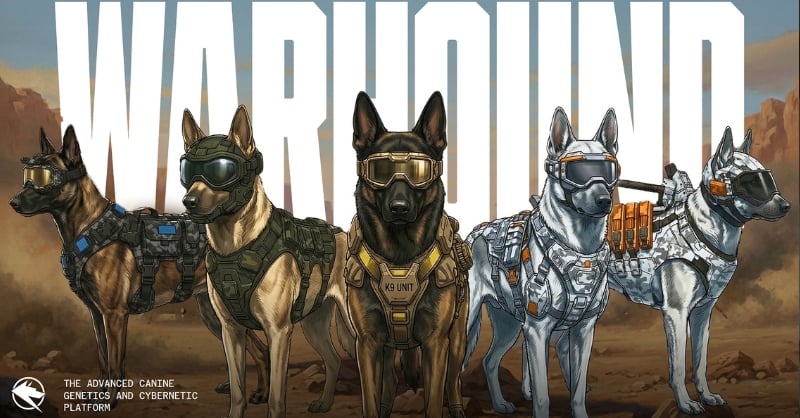
- Warhound raised $200 million in seed funding at a $1.2 billion valuation, TechCrunch reported.
- The Texas startup plans to clone and gene-edit US military working dogs.
- By its own figures, more than 80% of those dogs come from Europe.
Warhound says fewer than half of the working dogs the US military buys ever qualify for service, and that more than 80% of them come from Europe. The Texas startup believes it can fix both problems by cloning and gene-editing dogs of its own.
Warhound came out of stealth on October 22 with $200 million in seed funding at a $1.2 billion valuation, TechCrunch reported. The dogs it plans to sell do not exist yet. The idea came from Ben Lamm, co-founder and chief executive of Colossal Biosciences, and Palmer Luckey, founder of Anduril Industries. “Every day, we ask dogs to put their lives on the line to protect ours,” Lamm said in the launch announcement.
Sequoia Capital, In-Q-Tel, ARK Invest, Franklin Templeton, 8VC, and Lux Capital are among the backers, alongside USIT, Bob Nelsen, Breyer Capital, CAZ Investments, Neogenesis, and Builders VC. The company has not named a lead investor. In-Q-Tel is a venture firm funded by the CIA and other US intelligence agencies.
Cloned dogs, Anduril gear, and no price yet
Colossal takes cell lines from top-performing Belgian Malinois and German Shepherds and stores them in a biobank. Its scientists then edit the genes, adding traits that help dogs perform and removing variants linked to problems such as hip dysplasia and muscle atrophy, Lamm told TechCrunch. Viagen, another company Colossal owns, will do the cloning. Anduril supplies protective vests, eye protection, and software that tell handlers more about what is happening around the dog. Lamm said that equipment goes on the dog, not in it.
“Colossal has spent years pioneering breakthroughs in genetics, cloning, and animal biology, and now we’re applying that science to give these dogs the best possible chance at a long, healthy life and a successful mission. If we’re going to ask man’s best friend to protect America, we owe it to them to use every tool at our disposal to protect them, too,” said Ben Lamm.
“Man’s best friend deserves man’s best tech,” said Palmer Luckey.
The first batch of dogs is about to be cloned and incubated, with births expected in early 2027 and service within two years, Lamm told TechCrunch. Warhound has not set a price. It expects to sell to the Department of Defense, military service groups, police forces, and first responders. Luckey holds no equity, Lamm said. Colossal owns the stake and licenses its technology to the company.
David Spirk, a former US Marine, runs Warhound as chief executive. He was the Pentagon’s first chief data officer, held senior intelligence roles at US Special Operations Command, and joined Palantir Technologies as a senior counsellor in 2022. A February 2025 board announcement from drone maker PDW also listed him as an advisory board member at Colossal. “Our long-term goal is simple: healthier dogs, better-prepared teams, and more service members and first responders coming home safely. Leading Warhound in, and strengthening America’s working-dog capabilities is an opportunity to apply my experience to a mission I care deeply about: protecting people and helping the animals who support them,” Spirk said. “My focus is building a team that can turn scientific advances into capabilities that work in the field.”
Defence money keeps getting bigger
Warhound’s seed round is small next to what other defence startups are raising. According to S&P Global Market Intelligence, defence-focused startups raised $29 billion through funding rounds in 2025, nearly triple the 2020 total. Shield AI raised $2 billion on March 26: a $1.5 billion Series G at a $12.7 billion valuation, plus $500 million of preferred equity from Blackstone funds. Anduril raised a $5 billion Series H at a $61 billion valuation on May 13, led by Thrive Capital and Andreessen Horowitz. Since October 13 it has let employees sell shares at a price implying about $90 billion, TFN reported.
Europe sits on both sides of this story. It supplies more than 80% of US military working dogs, the company says, and it is also producing Anduril rivals. Tekever reached a $6.4 billion valuation in September with a $580 million round, and TFN reported in May that Destinus was seeking €200 million at a €5 billion valuation.
Warhound’s cap table reads like the overlap of two portfolios. Five of its 12 named backers, In-Q-Tel, USIT, Breyer Capital, Bob Nelsen, and Builders VC, have backed Colossal in earlier rounds. Two more, 8VC and Lux Capital, back Anduril, and Lux closed a $1.5 billion fund in January. Colossal raised a $200 million Series C at a $10.2 billion valuation in January 2025 and has raised just over $555 million in total, Lamm told Pulse 2.0 in October 2025.
“Palmer, Ben and the Warhound team are exceptional. Sequoia is proud to back them,” said Shaun Maguire, a partner at Sequoia Capital. The comment says nothing about how many dogs Warhound can deliver or at what price. Those numbers will decide whether $1.2 billion holds up.
The welfare test
Cloning and gene-editing working animals invites obvious objections, and Warhound has lined up outside voices early. American Humane Society will guide welfare standards and training certification. Retired dogs are meant to enter its Military Working Dog Reunification Program, Lamm told TechCrunch.
“Working dogs are extraordinary animals whose courage and loyalty save lives,” said Dr. Robin Ganzert, President and CEO of American Humane Society. “We owe these dogs a commitment to their well-being that matches their service to us. What excites me about Warhound is the opportunity to make health, welfare, and exceptional care fundamental to a working-dog program from the very beginning. Success means helping these dogs thrive throughout their lives—from training and active service to the loving, dignified retirement every canine hero deserves.”
“Advances in biotechnology bring both opportunity and responsibility,” said Alta Charo, professor of law and bioethics at the University of Wisconsin–Madison. “What I find promising about Warhound is the opportunity to improve working dogs’ health and welfare while supporting their lifesaving work.”
Asked about civilian safety, Lamm said the dogs will be trained like any military working dog and managed by whoever buys them. On government approval, he said the company has briefed many government groups.
The test is easy to state and slow to run. If the first cloned litter arrives in early 2027 and far more than half of those dogs get through training, the $1.2 billion valuation will have been earned. If the pass rate looks like today’s, Warhound will have spent a lot of defence money relearning how hard it is to train a dog.



