


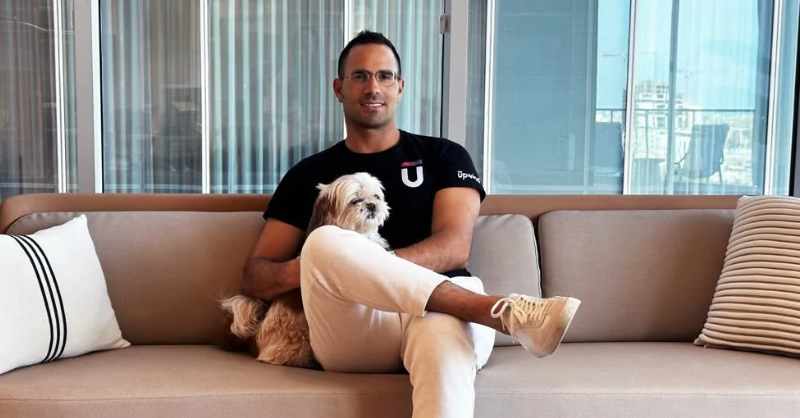
- Upwind has closed its $400 million Series C at a $3.8 billion valuation, with Bessemer leading the round.
- Founder Amiram Shachar sold his first company (Spot.io) to NetApp for $450M in 2020.
- The company has over $50m in recurring revenue, making the valuation nearly 76x.
Amiram Shachar sold his first company, Spot.io, to NetApp for $450 million in 2020. His second company, Upwind, has now closed a $400m Series C at a $3.8bn valuation.
The San Francisco-based cloud and AI security company announced the funding round, led by Bessemer Venture Partners. Canapi Ventures also joined the round, along with existing investors Cyberstarts, Greylock Partners, Craft Ventures, Salesforce Ventures and Picture Capital.
Valuation rose from $1.5 billion in January, when Upwind raised its Series B with Bessemer leading, to $1.6 billion. At that point, Upwind had raised $430m, and CTech had reported that Salesforce Ventures followed up with an investment at the $1.6 billion valuation.
From a $450M exit to a second start
Spot.io was born out of escalating cloud costs. At Ybrant Digital, Shachar saw his hosting costs balloon after moving to the cloud. He pitched his former army buddy Liran Polak the idea of building software to move workloads to cheaper spare server capacity. Polak walked out that day to join him. Lavi Ferdman, another ex-IDF Mamram unit veteran, also left to join the team.
Shachar, Polak, Ferdman, and Tal Zur, one of Spot’s original engineers, founded Upwind in 2022, with nearly all of Spot’s 60 people joining them. As of January, Upwind has over 300 employees and offices in the US, UK and Israel.
What Upwind sells, and who it faces
Upwind monitors their cloud software in real time rather than doing periodic scans. The company says security teams get an overwhelming number of alerts and struggle to figure out which vulnerabilities actually matter. Its platform brings all the cloud workloads, APIs and AI agents into a single view.
For example, if an AI agent accesses data it shouldn’t, Upwind’s tools will show what was accessed and trace that activity back to the code.
“AI is fundamentally changing both the scale of cyber threats and how organizations build and operate software. Context is key to managing internal and external risks, security teams need to understand how cloud workloads, APIs, and agents interact in real time. We built Upwind to unify those signals and eliminate complexity, helping organizations identify their most critical exposures, fix risks proactively, and detect attacks as they happen,” said Shachar, CEO and co-founder of Upwind.
Upwind says hundreds of organisations use its platform, including Siemens, Roku, Carvana, Nubank, Supabase, and ClickUp. It works with AWS, Azure, GCP and Oracle Cloud. Customers can also purchase it directly via the AWS console with unified billing.
The company claims it quadrupled its revenue in 2026. The Information reports that its annual recurring revenue rose from around $20 million at the end of 2025 to over $50 million, a 2.5x increase. At $50 million in ARR, the $3.8 billion valuation is a 76x multiple.
Wiz is the market leader in this space. Google completed its $32 billion acquisition of Wiz. Competition also comes from Palo Alto and CrowdStrike. Dell’Oro expects the market to hit $12.9 billion by 2030, growing at nearly 30% per year from 2025.
Other AI-focused security startups vying for similar budgets include Armadin, which raised $255.5 million at a valuation over $2.5 billion; Glow, a $1.2 billion AI endpoint security startup; and Harmonic Security, which focuses on securing employees’ use of AI.
The $4 billion question
Earlier this month, Datadog had made a nearly $4 billion offer for Upwind, which the company has rejected. If it was a real offer, it was only slightly above the $3.8 billion round valuation, meaning private investors paid almost exactly what a strategic buyer would have.
“Security needs to keep pace with environments that AI agents can change at a speed and scale that human teams alone cannot match. By combining real-time intelligence at runtime with the context needed to understand and remediate risk, we’re helping organizations move beyond alert management toward proactive security,” Shachar said.
The funds will accelerate capabilities and continue delivering the innovation customers need to secure cloud and AI infrastructure in the agentic era. The key question for 2027 is whether Upwind’s revenue will grow enough to justify its high valuation before another potential buyer emerges.



