


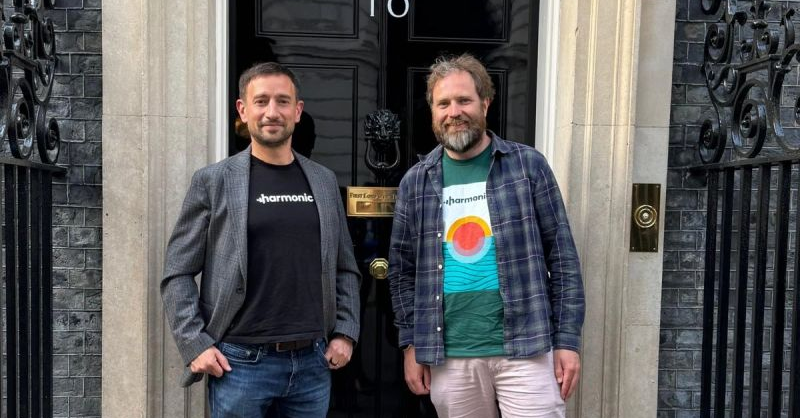
- Harmonic Security raised a $50 million Series B round, led by Crosspoint Capital Partners.
- The company’s CEO was also a co-founder of Digital Shadows, which sold for $160 million in 2022.
- Other companies such as Prompt Security and Aim Security have already been bought by larger security companies.
In July 2022, Alastair Paterson, co-founder of the threat-intelligence firm Digital Shadows, sold the company to ReliaQuest for $160 million. Now, he’s back with a new quest.
Harmonic Security, his new company, has now secured $50 million in a Series B financing round led by Crosspoint Capital Partners, just as two of its competitors have been acquired.
Zach Sivertson, a managing director who joined Crosspoint in 2024 and works in its early-stage practice, said in the announcement: “Security has too often slowed the adoption of new technology. As organizations embrace AI, they shouldn’t have to choose between moving quickly and maintaining control. Harmonic gives leaders the visibility and confidence to accelerate adoption, while empowering employees to use the tools that make them more productive, all with the right guardrails in place. We’re proud to partner with Alastair and the Harmonic team.”
Harmonic, which has headquarters in San Francisco and London, said the funding round was oversubscribed and involved existing investors, but it did not disclose their names or the company’s valuation. Total funding has now reached $76 million. Next47 headed the $17.5 million Series A in October 2024, and Ten Eleven Ventures led the $7 million seed round the year before.
Harmonic says its software is used by millions of employees across more than 100 companies, including large enterprises. According to SecurityBrief UK, Harmonic acquired around 100 customers in 2026 and achieved its annual target in September.
The team has grown from 30 people in October 2024 to more than 90 in both the US and the UK. The new funding will be invested in engineering, sales, and marketing in both regions.
From Digital Shadows to Harmonic
Paterson is heading up Harmonic together with his co-founder and chief technology officer, Bryan Woolgar-O’Neil, who was also the CTO at Digital Shadows. The data and machine learning team at Harmonic also came from Digital Shadows, and the company was established in October 2023 after consultations with over 50 security leaders, before work began.
Harmonic is by no means the only security company that has been run by a founder who has previously founded another company and yet has raised a large amount of money in October; according to Tech Funding News, Armadin, which was founded by Kevin Mandia of Mandiant, raised $255.5 million on October 1 at a valuation exceeding $2.5 billion.
Controlling AI use instead of blocking it
Harmonic’s software monitors how employees use AI tools and puts real-time controls in place. Instead of blocking AI altogether, the system lets security teams see which tools employees use, what data they share, and why.
The company states that its small language models examine each interaction within milliseconds, allowing them to distinguish between a developer referring to a schema and someone copying live credentials. The Usage Intelligence layer uses the same technology to help managers identify valuable AI use cases and plan future investments.
Paterson, chief executive and co-founder of Harmonic, said, “Every board I talk to is asking two questions: how do we reduce the risk of AI use and are we getting value? Most vendors struggle to answer the first, yet we address both. From the very start, we doubled down on our custom small language models, which means we can benefit from a unique insight into enterprise AI use.”
Harmonic is not the only one to have such access. Anthropic launched its Compliance API integrations on May 21, 2026, involving 28 security partners, such as Cloudflare, CrowdStrike, Netskope, Palo Alto Networks, and Zscaler, and later stated that the number had exceeded 100.
Will Harmonic Remain Independent?
According to Gartner’s June 2026 forecast, the security software sector, including AI security, is expected to amount to $15.6 billion in 2025 and rise to $37.6 billion by 2030, representing an annual growth rate of 18.5%.
Competitors have followed different strategies. SentinelOne acquired Prompt Security, a company that had raised $23 million, in a transaction that Calcalist put at around $250 million. Cato Networks has agreed to purchase Aim Security for an estimated $300 million to $350 million.
Unlike its rivals, Harmonic’s method begins by monitoring how employees use AI tools, although this distinction is narrowing as Harmonic expands its coverage of agents. Security teams are more concerned about agents with access to enterprise credentials.
Major developments are taking place in the security field. On October 12, IonQ agreed to purchase the zero trust company Elisity for up to $1.3 billion, roughly 18 times the amount Elisity had raised, as TFN reported.
Harmonic is now three years old, has raised $76 million, and is led by an experienced founder. It is not yet clear whether organisations will buy AI features from specialists or prefer to have them incorporated into their current platforms.



