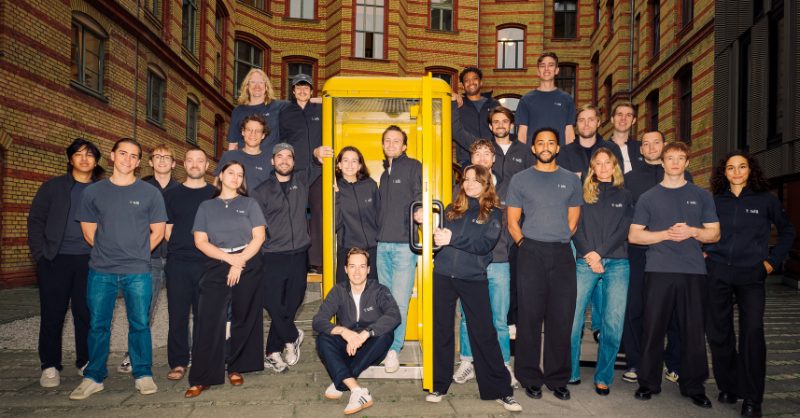
- Berlin-based telli has secured a $15 million seed round led by redalpine, bringing its total funding to $18.5 million.
- Two of the three founders grew Enpal’s heat pump sales team from 2 to 150 people in just one year. Now, they believe AI agents can do the same work as humans.
- telli says its revenue grew nine times year-over-year for clients like Sky and Enpal, but it has not shared the starting numbers.
The obvious pitch was sitting right there. Finn zur Mühlen and Philipp Baumanns, who is now his co-founder, once hired 150 people to scale Enpal‘s heat pump division in about a year. They could easily pitch telli as the tech that replaces that entire operation. Instead, zur Mühlen makes a more grounded argument: AI and humans working together, not one swapped for the other.
“We would have scaled more efficiently, but we still would have hired a lot of people,” zur Mühlen tells Tech Funding News when asked if having telli back then would have changed his approach.
Humans still handle relationships and product explanation, in his framing. AI takes on the first-touch, repetitive calls during peak hours that used to bury his old team. It’s a pragmatic read on where AI actually helps, from someone who lived the alternative.
telli, founded in 2024 by zur Mühlen, Baumanns and Seb Hapte-Selassie, builds AI agents that handle voice, WhatsApp, chat, and email conversations for B2C companies, backed by an AI coworker called Charlie that reviews calls and improves agent performance over time.
The company has now raised $18.5 million total, including this $15 million seed led by redalpine, with Cherry Ventures, Y Combinator, Mutschler, and unnamed angels also participating.
The trio who made 9x annual growth possible
The founding team splits cleanly along experience lines. Baumanns joined Enpal’s heat pump unit as employee number two and rode it to 150 staff in about a year, with zur Mühlen alongside him. Hapte-Selassie took the opposite path: a Stanford computer science degree, then software engineering roles at Pitch, N26 and BCG Digital Ventures. One half of the team lived the problem and the other built the fix.
Yet, telli isn’t trying to out-research the AI labs building the underlying models, either. “We are not a research company. We just want to give the best solution to the customer possible, and it doesn’t matter for us what model is underneath,” zur Mühlen says.
According to zur Mühlen, what justified a $15 million round just fifteen months after telli’s $3.6 million pre-seed was customer referrals, expansion inside existing accounts, and a Y Combinator batch that taught the team to move fast.
telli’s own materials claim 9x year-on-year revenue growth, and over 50% month-over-month growth back at pre-seed. redalpine, which has previously backed N26, Proxima Fusion, and 9fin, saw the real numbers and led anyway.
Where telli says it wins
zur Mühlen names Talkdesk and Aircall as the incumbent telephony platforms telli is up against, arguing an AI-first architecture built for a VP of sales or ops lets telli move faster than tools designed around human agents. Genesys and Five9, the larger contact-centre vendors building AI in-house instead of partnering with startups, get a lighter touch: the bigger threat, addressed the least directly.
telli’s agents already handle millions of conversations for enterprise clients including Sky, Viessmann, Enpal, and Vaillant, with Enpal’s own team now chatting with Charlie daily to refine its agents. The customer that was once his employer is now also his product’s proving ground.
“We’ve followed this space for quite some time and the telli founders are the most technically exceptional and complementary team we’ve encountered,” says Sebastian Becker, general partner at redalpine.
telli’s agents run on a cascading pipeline of transcription, language model, and voice generation, the same approach rivals like ElevenLabs and Cartesia use for voice cloning. zur Mühlen expects that to give way to speech-to-speech models within a year or two, opening up use cases that don’t work today.
Growth stays Europe-first for now, zur Mühlen says, before telli goes after a global business the same sequencing, he notes, that shaped his own path through Y Combinator and back to Europe.
The voice AI agent market is projected to grow from $2.54 billion in 2025 to $35.24 billion by 2033, and telli’s roughly 20-person team is wagering it can outrun rivals many times its size.
Whether that wager is paying off is the open question here — not because zur Mühlen dodged it, but because “quite happy” and “grown quite quickly” are sentiment, not evidence, and in a market this hot, that’s a thin foundation to raise $15 million on.
Between the Enpal customer relationship, the enterprise roster, and a fundraise that closed in well under a year and a half, telli’s early signals point in one direction. The next stretch will be about whether disclosure catches up to the momentum.