


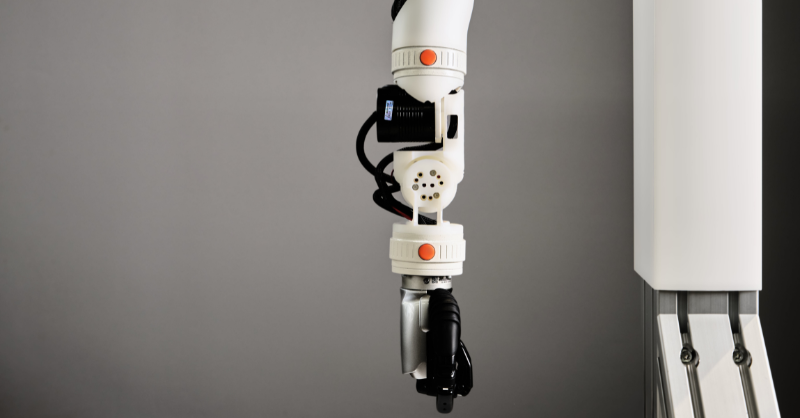
- O-ID has secured $1.2 million in pre-seed financing to develop modular humanoid robots for use in Japanese factories.
- A Tokyo-based startup with eight members is said to be in advanced talks with several manufacturing clients.
- The company’s founders aim to address Japan’s expected shortage of 11 million workers by 2040 by deploying an equal number of robots.
When a car tyre fails, it is replaced, and the vehicle keeps working, but if a humanoid robot’s arm breaks, the robot is generally sent back to the manufacturer, where it remains for months.
“It doesn’t make sense when you’re putting such robots into use,” says Simon Gormuzov, co-founder and chief technology officer at O-ID, to Tech Funding News. His answer is a robot made up of interchangeable parts. The company has raised $1.2 million in pre-seed funding to go from prototype to production.
O-ID’s humanoid robot is designed so a worn joint, limb, or onboard computer can be unlocked and replaced on the factory floor in about five minutes by any worker, eliminating offsite repairs.
“There are many impressive demos, robots doing backflips. But no real humanoid robots work alongside people yet,” Gormuzov says, attributing this gap to two main challenges: producing robots at scale cost-effectively and maintaining a large fleet.
“O-ID’s robots are built to work alongside existing staff, addressing these challenges before they become critical for factories and the industries Japan relies on,” adds Stian Jakobsen, co-founder and chief executive.
The math behind that urgency is clear. Japan’s working-age population is set to shrink enough to leave the country short of more than 11 million workers by 2040. Tokyo supports this with a national strategy targeting ¥10.5 trillion, or $65.1 billion, in public and private investment to get 10 million AI-equipped robots into factories, hospitals, and warehouses by that year.
The US faces a smaller version of the same problem: American manufacturers could need 3.8 million new workers by 2033, with 1.9 million jobs going unfilled.
A $1.2 million deal in a $100 million club
The most unusual thing about this funding is that humanoid robotics is one of the most capital-intensive areas for venture capital, the median amount disclosed being $145 million and top companies raising hundreds of millions or even billions: Figure AI has raised $2.34 billion at a valuation of $39 billion, London’s Humanoid raised $152 million at a $1.35 billion valuation for a wheeled robot, and Germany’s NEURA Robotics completed a $1.4 billion Series C.
According to Jakobsen, the situation in Japan is different: there are only a few local humanoid startups. O-ID’s strategy is to take over an existing supply chain rather than setting up a new one.
“We use the automotive supply chain, which is used for making cars, and adapt it for use in making robots. In that way we are able to compete with other countries and build a large number of robots quickly, entirely in Japan,” says Gormuzov.
A similar robotics venture focused on Japan, Integral AI, operates at a very different funding level, illustrating just how far outside the usual norms O-ID’s funding round is.
Japan-first supply chain, then the US
The round was led by Chicago’s TAWANI Ventures, an early-stage fund wholly financed by the Pritzker family, which typically writes checks ranging from $200,000 to $500,000 and has supported 13 companies since 2021. The Hustle Fund, Techstars Japan and a number of angel investors also took part.
“Modular humanoids are a generational opportunity to expand industrial productivity just as labour force declines present unprecedented challenges. O-ID will lead the transfer of decades of Japanese robotics expertise, learnings, and supply chain into an AI-native, adaptable platform,” said William Pritzker, a partner at TAWANI Ventures.
Yuki Shirato, managing director of Techstars Japan, added: “O-ID humanoid robots will be modular, designed for mass production and repairs, and made entirely in Japan. They have made tremendous progress since then, and this fundraise and joint research with Japanese manufacturers mark an important step forward in their mission of reshaping how we live.”
O-ID currently employs eight individuals, comprising both full-time staff and contractors, and states that the funds will be used to expand the team and develop a second-generation robot, which it intends to launch during the first quarter of 2027. The company also filed a provisional US patent for its modular connector design and is actively exploring the US market in collaboration with Japan.
It remains an open question whether $1.2 million is sufficient not only to get a humanoid robot onto a factory floor but also to compete with companies that have raised considerably more money.


