


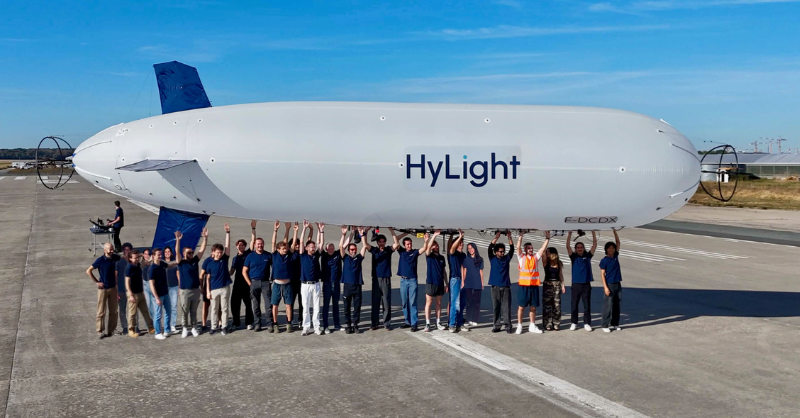
- The French company HyLight has raised 13 million euros in order to expand its business with hydrogen-powered inspection airships.
- Martin Bocken, 28, says helicopters are HyLight’s main competitors and adds that all contracts to date have been paid.
- In 2026, Enedis plans to carry out airship inspections over 15,570 kilometres, rather than 120,000 kilometres by helicopter.
HyLight, the French startup that builds a 12-metre hydrogen-powered airship, just raised €13 million. Rubio Impact Ventures, DRW, and Teampact Ventures are taking part in the funding round, alongside Y Combinator and Ring Capital.
Since the €3.7 million seed round Tech Funding News reported in April 2024, HyLight has raised approximately €16.7 million in total.
Martin Bocken, 28 and one of the co-founders and chief executives, considers helicopters his main rivals. “Helicopters are our competitors. If you think about it, it’s crazy that as late as 2026 we are still using helicopters to inspect power lines, pipelines and railways. A helicopter produces one ton of CO2 each hour. It’s expensive and dangerous,” he says to TFN.
From university project to commercial contracts
Bocken set up HyLight right after finishing university, based on a project they started there. He and co-founder Théo Hoenen founded the company in 2021 and flew the first prototype in November, as Airport Technology reported.
The original idea had been based entirely on hydrogen. In May 2026, Laporte told L’Usine Nouvelle that the team had first intended to use only hydrogen before changing their approach to build an airship capable of long flights. The team was part of Y Combinator’s summer 2023 batch, and Marc Tarpenning, who was an early mentor, backed the 2024 seed round.
Josef Rokůsek, now chief technology officer, and Thomas Laporte, chief business officer, joined the company shortly afterwards. Hoenen has since left the company.
HyLight operates the HyLighter, an autonomous airship 12 metres long that inspects power lines, pipelines, and railways at about 25 metres. The airship obtains lift from helium and is powered by a hydrogen fuel cell that drives its electric motors, according to AREC, the Île-de-France energy agency. The company manufactures and operates the aircraft itself. Each airship can carry up to 10 kilograms of sensors, such as LiDAR, cameras, and methane detectors.
Bocken highlights the airship’s capabilities, saying that “no one else has 10 hours of flight time, 350 kilometres of range, and 10 kilograms of payload.”
The company states that its imaging system attains a resolution of one millimetre per pixel at a distance of 25 metres and that its laser scans produce more than 1,000 points per square metre. The aircraft is certified for use in European operations and has been given permission to fly beyond visual line of sight over important infrastructure in rural, suburban, and urban areas.
The software used by HyLight analyses the data gathered, allowing it to identify and locate vegetation risks and more than 50 kinds of power-grid defects. Instead of receiving thousands of unprocessed images, maintenance teams get concise reports that include information about the risks, their locations, and visual evidence.
For instance, Téréga, which operates a natural gas network, is testing the HyLighter on a 107-kilometre section of pipeline running from Cazilhac to Claira in order to detect methane leaks. H2 Mobile says six flights are planned for 2026, subject to regulatory approval.
As examples of key clients, Bocken mentions Enedis for power lines, SNCF Réseau for railways, and NaTran and Téréga for pipelines. The company has accumulated more than 750 flight hours and has inspected thousands of kilometres in France and throughout Europe.
Helicopters still do most of the flying
HyLight claims that helicopters can emit up to one metric ton of carbon dioxide equivalent per flight hour. Révolution Énergétique states that the Airbus H125, which is a typical inspection helicopter, uses approximately 200 litres of kerosene per hour.
The company points out that due to climate change, tighter regulations and security risks, inspections need to be carried out more frequently. The introduction of renewable energy increases variability and strains ageing power grids. HyLight estimates that the total length of global linear infrastructure is over 80 million kilometres.
To boost its market share, HyLight intends to increase its fleet from four to a maximum of fifteen aircraft. The company has established a new production facility and plans to make more strategic components itself. Currently, the team consists of 42 people, up from 36 employed in mid-2026, according to Clubic.
The new funding will focus on three areas: improving the product, expanding operations in Europe, and investing in AI and automation. The initial target markets will be Germany and the Netherlands. In the long term, HyLight intends to create a platform that cross-references its data in order to predict risks and plan maintenance.
Bocken says HyLight has no direct competitors at the moment, even though other companies operate in the sector. Kelluu raised €15 million in Series A financing in April 2026, led by the NATO Innovation Fund, for 12-metre airships that use hydrogen for both lift and power. In August 2026, Spain’s FuVeX raised €3 million and has been carrying out inspections of more than 36,000 kilometres of power lines for utility companies such as Endesa
Japan’s Terra Drone raised $70 million in 2022, and the Swiss startup Tethys Robotics raised €3.5 million for an autonomous underwater inspection drone. In hydrogen aviation, the French startup Beyond Aero raised $20 million for hydrogen-powered business aircraft.
The market for inspection drones is worth $13.63 billion in 2026 and is expected to reach $25.82 billion by 2030, a compound annual growth rate of 17.3%, according to Research and Markets.
Who is backing HyLight
Bocken says he deliberately sought a wide variety of investors. Rubio Impact Ventures closed more than €70 million in commitments for its third fund in November 2025. Its portfolio includes Sympower, an Amsterdam cleantech startup that raised €22 million to work on Europe’s electricity grid, and cultivated meat company Mosa Meat.
Helmer Schukken, managing partner at Rubio Impact Ventures, said: “Today, powerlines, pipelines and railways are still inspected by helicopter, which is expensive, unsafe, polluting and — as workforces age — insufficiently available. HyLight offers a clean and scalable alternative that does the same work reliably, even over densely populated areas, and has the potential to deliver unrivaled cost savings.”
The €13 million will fund fleet expansion, 50 new hires, and a data platform, though no timeline is given for reaching 15 aircraft. The key challenge is whether utilities will sign contracts large enough to support 15 aircraft in operation. With airships currently covering only 8% of Enedis’ plan, helicopters remain dominant.
The real test will come in the second half of 2026. If prices increase, ScaleX said its next report will reflect this: “We would welcome it.”



