- NEURA Robotics has wrapped up a Series C funding round of up to $1.4 billion, led by Tether. Other backers include Amazon, NVIDIA, Qualcomm, Bosch, Schaeffler, and the European Investment Bank.
- This round makes NEURA the most-funded humanoid robotics company in Europe.
- So far in 2026, robotics companies have raised $55.8 billion, nearly double last year’s total. NEURA now stands out as Europe’s top contender in this field.
NEURA Robotics has a €1 billion order backlog and aims to produce 5 million robots by 2030.
Earlier this week, the German humanoid robotics company announced it had closed a Series C round of up to $1.4 billion. The round was led by stablecoin issuer Tether, with Amazon, NVIDIA, Qualcomm, Bosch, Schaeffler, and the European Investment Bank also participating.
“The future of AI will not only live on screens. It will move, interact, learn, and work beside us in the real world. We believe physical AI and cognitive robotics will become one of the largest technology shifts of the coming decades,” says David Reger, founder and chief executive of NEURA Robotics.
In 2026, robotics companies have already raised $55.8 billion, nearly double last year’s record. Most of this funding has gone to companies in the United States and China. Until now, Europe has had no clear leader in humanoid robotics. This funding round aims to change that.
What NEURA Robotics does
Reger started NEURA in Metzingen, Germany, in 2019 to solve a key problem: most robots could only follow set instructions and struggled when their environment changed. Today, NEURA employs about 1,200 people.
The company combines its own humanoid hardware with a custom AI layer called AURA and a training data platform known as the Neuraverse.
Most industrial robots follow fixed instructions. NEURA’s robots are built to sense their environment, adapt on the fly, and get better with each task. For example, a NEURA robot can pick up a new part, determine where it belongs, and place it correctly, all without requiring a human to reprogram it.
The main humanoid model, the 4NE-1, costs about €98,000. Large-scale shipments are expected to start in late 2026.
A cap table built like a platform strategy
Tether, Qualcomm, Amazon, NVIDIA, imec.xpand, Bosch, Schaeffler, the European Investment Bank, Lingotto Horizon, and InterAlpen Partners all took part in the round.
Former Qatari prime minister Sheikh Hamad bin Jassim bin Jaber al Thani also joined. Lingotto Horizon and InterAlpen Partners had already invested in NEURA’s Series B.
Each new investor brings a specific strategic angle.
Amazon’s involvement suggests NEURA robots could be integrated into its fulfilment network, which already uses hundreds of thousands of automated systems. In April 2026, NEURA announced a partnership with Amazon Web Services to expand the Neuraverse platform worldwide.
NVIDIA’s involvement could mean custom inference chips or edge-computing integration. Bosch and Schaeffler may become both key customers and manufacturing partners.
Paolo Ardoino, Tether’s chief executive and lead investor, described the investment as a bet on machine autonomy. “As robotics moves beyond scripted automation and into true autonomy, the infrastructure behind it must evolve as well,” he says.
Tether has previously invested in Northern Data Group and Bitdeer, both large-scale computing infrastructure companies.
NEURA’s two closest rivals both sit in the United States
Figure AI has raised over $675M and counts Microsoft among its backers; it runs live pilots inside BMW plants and focuses on narrow, high-value industrial tasks. Physical Intelligence, backed by Bezos Expeditions and Sequoia Capital, is building foundation models for physical manipulation, prioritising software over hardware.
While both rivals focus on specialised uses, NEURA is building its own hardware, AI, and data infrastructure all in-house, aiming to make the Neuraverse the platform for every robot in the future.
The new funding will support the worldwide rollout of humanoid robots, boost production capacity, and help further develop the Neuraverse. NEURA has not shared how many people it plans to hire after this round.
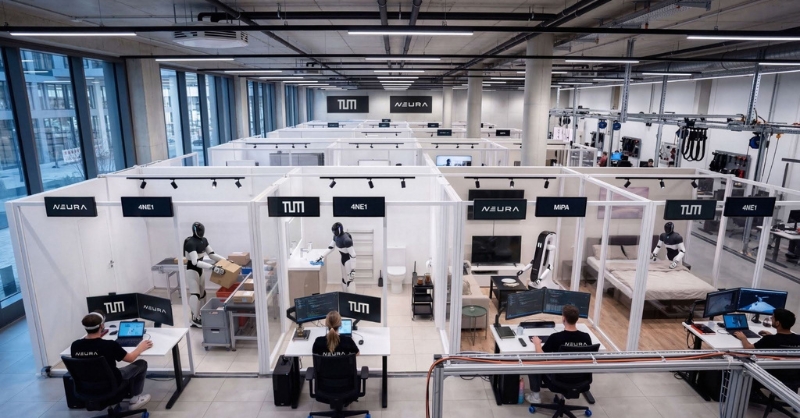
The company also plans to roll out its NEURA Gyms training sites more widely by late 2026. The first, called TUM RoboGym, is a 2,300-square-metre AI training centre at Munich Airport, built with the Technical University of Munich. Starting in mid-2026, a group of humanoid robots will generate real-world training data for the Neuraverse.
NEURA will receive the full $1.4 billion only if it meets certain undisclosed milestones, and the company has not said when it expects to receive the full amount. The robots still need to be shipped, and the Neuraverse must prove it can become the go-to platform, especially in a sector where the US and China have invested much more.