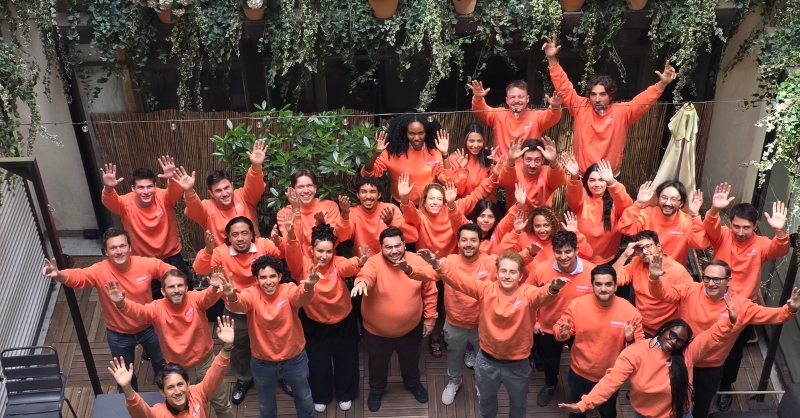
- French AI adoption startup Mendo has closed a €12 million Series A led by Ventech and Educapital, bringing its total funding to €15.5 million.
- The company was built on a simple observation: most people don’t use the technology their employers buy, and with agentic AI arriving at scale, that gap is about to become existential for enterprises.
- Mendo now supports over 100,000 employees across more than 100 major organisations, including PwC, Novo Nordisk, and Crédit Agricole.
Quentin Amaudry grew up in Madagascar and saw people use any technology they could find to improve their lives. This experience convinced him that the biggest challenge in business is the gap between what technology can do and how people actually use it.
“Since I was very young, I witnessed firsthand the power of how a great equaliser technology can be. Most people don’t like technology. It’s most of the time quite a big frustration in people’s jobs,” he tells Tech Funding News.
This idea led to the creation of Mendo. Today, the Paris-based startup has closed a €12 million Series A round to test its approach across Europe.
The round was led by Ventech and Educapital, with Tomcat and OVNI also participating. It follows a €3.5 million seed closed in October 2024, bringing total funding to €15.5 million.
A problem that remains unsolved
According to Gartner, 70% of enterprise AI and agentic projects never reach real deployment. While employers want maximum adoption, employees want to focus on their jobs. The result is expensive software that sits largely idle.
“There is always a very big gap between what technology offers and what is possible with it. And that’s the day-to-day of employees,” Amaudry says.
Founded in 2021 by Amaudry and Alexandre Pinon, Mendo embeds directly within the generative AI tools corporate employees already use, including Copilot, ChatGPT, Gemini, and Mistral AI, and guides them toward better use in real time.
The guidance appears directly within the chat window.
“They don’t need to go to a website. They just open their chat, and they will be directly guided,” Amaudry explains.
Mendo stands out because of its unique integration. Instead of using APIs or back-end systems, it has created its own layer that works with any generative AI chat interface and tracks usage in real time.
Mendo also includes an analytics engine that protects employee privacy. It shows where AI is truly adding value in an organisation and highlights where using agents would bring the best results.
“That combination of integrating in a unique way and capturing data in a very privacy-oriented way enables us to give recommendations at scale,” Amaudry says.
A larger shift is on the horizon
Digital adoption platforms like WalkMe (now part of SAP), Whatfix, and Spekit focus on general software onboarding. Mendo, however, is aimed at generative AI workflows, where much of today’s enterprise value is created and where current tools do not offer much support.
The timing is important. Enterprise AI is quickly moving from standalone productivity tools to agentic workflows that change how entire teams work. This shift makes the adoption challenge much more urgent.
“With agentics, AI changes status — it is no longer a tool that saves you a few hours a week, it becomes the layer that orchestrates and governs all of a company’s operations,” Amaudry says.
Teams that are already busy will soon need to rebuild their processes around autonomous agents. Managing this change will be a much bigger challenge than any previous software adoption.
Mendo currently supports over 100 major organisations, among them PwC, Novo Nordisk, Crédit Agricole, and Groupe Rocher, representing close to 100,000 employees across Europe. Early data from the company shows adoption rates running six times higher than with traditional methods.
How the funding will be used
The €12 million will fund three priorities: deepening the analytics layer to sharpen visibility into the return on investment of agent deployments; doubling headcount from 50 to 100 employees, with a focus on product, tech, and sales teams; and accelerating commercial expansion into Germany, the Nordics, and other major European markets.
Ventech, which has backed Vestiaire Collective and Speexx and operates across Paris, Berlin, Munich, Helsinki, and Stockholm, sees Mendo as the connective tissue its portfolio has been missing.
“The real problem with AI in the enterprise isn’t budget. It’s adoption. Mendo really is the missing piece at the European scale,” says general partner Audrey Soussan.
Educapital, Europe’s first fund dedicated to edtech and the future of work, with $200 million under management, frames it as a workforce readiness bet. Agentic AI will automate entire task categories, making continuous reskilling a business-critical function rather than an HR afterthought. “That is precisely Mendo’s mission,” says general partner Litzie Maarek.
The enterprise AI adoption market is growing quickly as organisations move from pilot projects to large-scale rollouts. Mendo raises an important question: can technology and people adapt at the same speed, or will the rise of agentic AI outpace what companies can handle?