


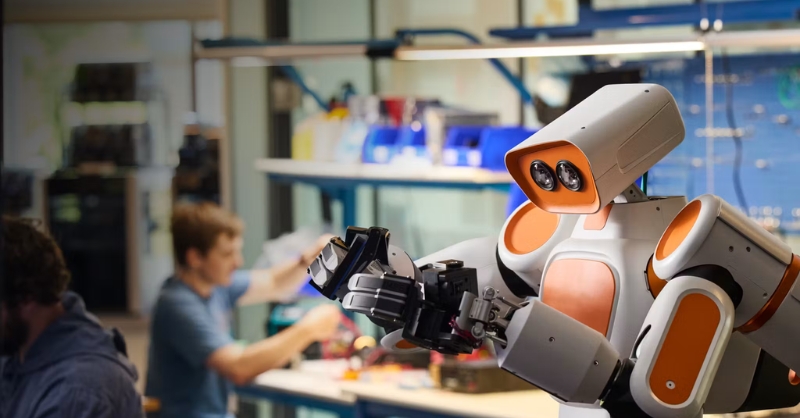
- Walden Robotics has emerged from stealth with $300 million in seed funding co-led by Toyota and Deviation Capital, valuing the company at $1.1 billion.
- Founded by former leaders from Toyota Research Institute, MIT, Stanford and Amazon, Walden is deploying general-purpose AI robots into live factories today rather than showcasing future prototypes.
- The company’s robots continuously learn while performing real manufacturing and logistics tasks alongside human workers, with customers already including Toyota.
Walden Robotics has emerged from stealth with $300 million in seed funding, valuing the Cambridge, Massachusetts startup at $1.1 billion.
The round, co-led by Toyota Motor Corp, Toyota Invention Partners and Toyota Ventures alongside Deviation Capital, also drew NVIDIA, Boeing, AE Ventures, Samsung Ventures, Prologis Ventures, CoreWeave Ventures, Calibrate Ventures, Colle Capital, Shine Capital, NextView Ventures, Squarepoint Capital, One Madison Group, KAS Venture Partners and Menlo Ventures.
Walden’s wheeled, upper-body humanoids are already working eight-hour shifts inside a Toyota plant in North America, loading and unloading car parts, cleaning machinery and kitting components for assembly, alongside human employees.
“Advances in Physical AI have made this transformation possible, but delivering real value requires a deep understanding of how manufacturing works today. The fastest progress comes from building alongside the people who know the factory floor best,” says Russ Tedrake, co-founder and chief executive of Walden.
From MIT lab to Toyota’s factory floor
Walden was founded in 2026 by robotics and AI veterans from Toyota Research Institute, MIT, Stanford and Amazon.
Tedrake, an MIT professor and the university’s Toyota professor of electrical engineering and computer science, spent a decade at Toyota Research Institute as senior vice president of large behavior models before spinning the company out of the lab in January. Its robots reached production inside a Toyota factory by February, moving from first pilot to live output in under two months.
The startup works by training large behavior models, an AI model class built for physical tasks rather than language, that let its robots learn new work through real-world repetition instead of being manually reprogrammed for each job. Reprogramming conventional industrial robots for new tasks can take weeks; Walden is trying to compress that to days by having its machines improve on the job.
The company frames the pitch around delegation rather than replacement: workers hand off repetitive or physically demanding tasks to the robots and shift their own time toward judgement, problem-solving and craft.
Why humanoids, why now
For two years, humanoid robotics has been a demonstration business. Companies have shown robots walking, dancing and folding laundry, promising a future where machines take over repetitive labour, while most of that work stayed confined to pilots and stage-managed videos.
Walden believes that the industry has been solving the wrong problem, building robots that wait for work rather than robots that are already doing it.
This is landing in a market moving fast. According to Grand View Research, the global industrial robotics market was worth roughly $18.5 billion in 2025 and is projected to top $44 billion by 2030, pushed along by labour shortages, ageing workforces and cheaper AI-powered automation.
Humanoid-specific investment has kept pace: Skild AI raised $1.4 billion to build a robot-agnostic foundation model, Apptronik closed a $520 million extension to scale its Apollo robot, and Germany’s NEURA Robotics pulled in $1.4 billion to become Europe’s most-funded humanoid maker.
A crowded field of humanoids
Walden’s approach separates it from most of the well-funded names in the category. Figure AI, which closed a Series C above $1 billion at a $39 billion valuation in September 2025, is building toward mass production of a general-purpose humanoid but has not yet matched Walden’s pace of live deployment.
Agility Robotics, which raised a $400 million round at a $1.75 billion valuation in 2025 to scale its Digit robot for warehouses, has since agreed to go public through a SPAC merger. Skild AI is chasing a different problem entirely, a single foundation model that can operate any robot body rather than building the hardware itself.
Walden’s argument is that commercial deployment, not demo reels, is the real differentiator, and that being inside a live Toyota plant within weeks of spinning out gives it a data and credibility advantage its better-funded rivals don’t have yet.
“Robots that continuously improve through learning, while always keeping people at the centre, reflects the values shared by Toyota and Walden” says Hiroki Nakajima, executive vice president and chief technology officer of Toyota Motor Corporation.
“The team combines world-class robotics expertise with real-world manufacturing experience to build robots that increase productivity from day one,” adds Colin Beirne, founding partner at Deviation Capital.
“Walden is where a groundbreaking set of inventions by the team at TRI will now be applied to address real-world needs. Walden stands out for both the groundbreaking technology they’re building and the team’s ability to translate pioneering research into real-world deployment,” notes Gill Pratt, chief executive of Toyota Research Institute.
Walden’s models build on roughly a decade of research the team helped pioneer, including Diffusion Policy, an approach to robot learning that predates the large behaviour model class its products now run on.
What’s next?
Walden plans to put the new capital toward product development, manufacturing capacity and commercial expansion beyond Toyota, into aerospace, semiconductors, electronics, logistics and life sciences, sectors where it already has strategic partners.
The harder test is whether its robots can keep delivering value once they’re out of a single, tightly controlled plant and into more varied environments.



