


Scroll through a typical day of funding headlines and a pattern shows up: nine-figure rounds for open-source agent companies, reported valuation talks for AI labs, European VCs recalibrating around widening valuation gaps. Behind every one of those headlines is an enormous amount of unglamorous information handling — investor calls, diligence questions, data-room documents, founder interviews, market reports, competitor demos. The people closing those rounds, and the people trying to understand them, spend a large share of their time converting spoken and written material into something they can decide on.
That information-handling load is exactly what AI note-taking tools are built for, and the category is growing fast. The AI note-taking market is projected to cross $740 million in 2026, inside a broader note-taking app market that’s expected to grow from roughly $11 billion in 2025 to $13.3 billion this year, a 20.6% compound annual growth rate. For a sector that prides itself on spotting categories early, it’s worth understanding what these tools actually do well, where they fall short, and how to put them to work on the specific inputs founders and investors deal with.
Where the hours actually go
Meeting load is the most measurable part. Estimates of how much of a knowledge worker’s week goes to meetings run between roughly 11 and 15 hours depending on the source, and Harvard Business Review has reported that executives spend nearly 23 hours a week in them. Asana’s Anatomy of Work research estimates unnecessary meetings alone cost the average knowledge worker around 103 hours per year. For a founder running fundraising alongside a company, those hours are a binding constraint: each investor conversation produces questions to answer, commitments to follow up on, and objections worth remembering precisely.
The failure mode is familiar. A call ends, notes live in someone’s head or a half-finished doc, and two weeks later a follow-up email misstates what was discussed. In fundraising, where trust is built on precision, that’s costly. Good notes aren’t bureaucracy; they’re how you avoid saying the wrong thing twice.
What an AI note generator does with founder-grade inputs
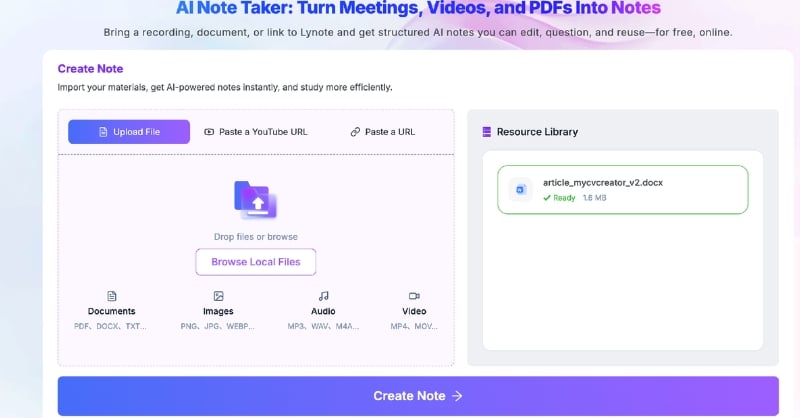
A capable AI note generator takes raw material and returns something structured. Lynote’s version at lynote.ai/ai-note-generator accepts documents such as PDF, DOCX, and TXT, images, audio like MP3, WAV, and M4A, video like MP4 and MOV, plus pasted YouTube links and web URLs, and turns them into notes you can edit, question, and reuse — free and online.
Consider what that covers in practice. A recorded investor call becomes a structured summary with open questions and follow-ups. A long PDF — a market report, a term sheet draft, a competitor’s technical whitepaper — becomes notes you can interrogate with specific questions rather than skim and hope. An interview with a founder from a podcast or video becomes something you can search later when you’re comparing how two companies describe the same market. Because the notes are editable, they can be turned into your own working document, not just left as machine output.
Be honest about accuracy — especially with numbers
Funding is a numbers business, and this is where caution matters most. A 2023 study in JMIR Mental Health found that the best-performing automatic transcription service reached a median word error rate of 8.9%, close to professional human transcription at 7.6%, but another built-in service reached 19.2%. A systematic review of clinical speech recognition found error rates ranging from under 9% in controlled dictation to over 50% in real multi-speaker conversational audio. A 2024 study by Kirstein and colleagues, as cited in industry analyses, found hallucinated content in up to 37% of AI-generated meeting summaries, depending on the model.
The practical rule for anyone handling valuations, round sizes, or terms: never let a figure from AI-generated notes go into an email, a model, or a memo without checking it against the source. Use notes for structure, recall, and speed, and verify every number that matters. Used that way the tools save time without introducing the kind of error that damages credibility.
Research at scale: transcripts from founder talks and conference videos
Funding intelligence isn’t only private calls. A huge amount of useful signal sits in public video: founder keynotes, demo-day pitches, investor panels, product launch streams, earnings calls. For an analyst or investor tracking a sector, watching all of it isn’t realistic, and skimming it isn’t reliable.
This is where a bulk YouTube transcript workflow changes the economics of research. Lynote’s transcript tool at lynote.ai/youtube-transcript converts videos into timestamped text and is built for batch work — handling multiple videos, full playlists, and keyword-based discovery in one place, with batch queue and progress tracking so larger projects don’t require jumping between pages. Transcripts can be exported, copied, translated, or passed into the notes workflow.

Imagine tracking how fifteen companies in one category describe their go-to-market over a year. With transcripts, that becomes a search across text instead of fifteen hours of video, and every quote carries a timestamp you can cite. Combined with the notes workflow, each source can be reduced to a structured summary and compared side by side — positioning, claimed traction, stated risks — in an afternoon rather than a week.
Building it into an investor or founder workflow
A realistic routine looks like this. After every investor or customer call that matters, generate notes the same day and send the follow-up from verified notes. When a new company enters your radar, pull transcripts of its founder’s recent talks and summarise them into a one-page brief. Keep source files alongside the notes so any claim can be traced back. Treat the whole thing as a way to be more precise, not just faster.
The deeper advantage is cumulative. Notes, transcripts, and summaries build into a searchable personal knowledge base, so when a similar company shows up next year you aren’t starting from zero. In a market where information moves quickly and memory is unreliable, that kind of compounding record is a durable edge — and it starts with capturing what’s said the first time.
Keeping track of investor conversations, company research, and industry developments becomes much easier when the right digital tools are part of your workflow. For more practical insights into AI tools and technology, take a look at Kemotech.



