


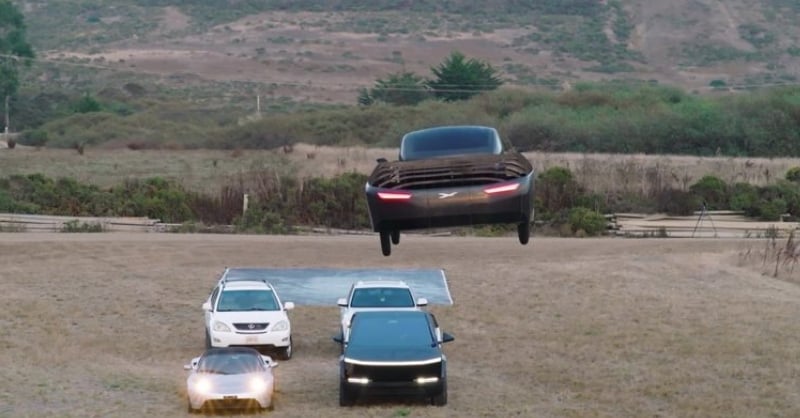
- Alef flew its electric flying car over Tesla’s new Roadster on its 1,000th logged flight.
- Alef says it holds 3,600 pre-orders worth $1 billion, but deposits start at $150.
- Tesla’s thruster-powered Roadster is a prototype, with production planned for 2028.
California startup Alef Aeronautics flew its electric flying car over Tesla’s new Roadster, and used the moment to welcome the carmaker to what it calls the flying car race. Alef says the flyover was its 1,000th logged flight and calls the Roadster the second flying car in history. It says it has been alone in the category for 11 years.
The video landed the same day Tesla unveiled the redesigned Roadster at a SpaceX test site in McGregor, Texas. In the demonstration, the car drove up a curved ramp, flipped in mid-air on cold-gas thrusters developed with SpaceX, and jumped over parked Tesla vehicles.
Tesla says production starts in 2028. Elon Musk told the crowd: “Turns out the future does have flying cars.”
The two vehicles are different machines. Alef’s Model A is designed to drive on roads and take off vertically, using distributed electric propulsion, a body that forms a wing, and a rotating cabin.
Tesla’s flying version relies on thrusters: the invite-only, single-seat “Rocket” variant carries 10 of them, while the “Thrust” version adds rear thrusters for acceleration. The Roadster is not yet a certified road-and-air vehicle, so whether it becomes a practical flying car remains to be seen.
“Welcome Tesla to the flying car race, we’ve been here alone for eleven years. Having competition is a good thing, especially from such a major company as Tesla. It proves the market, establishes a separate flying car category, creates industry for lobbying specific regulations, brings investor focus, helps compare technology, and creates a benchmark to measure against. We had to fight our battles alone for eleven years, so we welcome Tesla Roadster to the family,” said Jim Dukhovny, CEO of Alef.
Meet the startup behind the flying car
Founded in 2015, Alef was started by CEO Jim Dukhovny, Constantine Kisly, Pavel Markin, and Oleg Petrov, and is based in San Mateo. Its first full-size prototype flew in 2019, and it unveiled the drivable, vertical take-off Model A in October 2022.
In June 2023, the Federal Aviation Administration issued a Special Airworthiness Certificate that limits flights to exhibition, research, and development. The regulator said at the time that Alef was not the first aircraft of its kind to receive one.
Tim Draper, whose Draper Associates Fund V put $3 million of seed money into Alef, Reuters reported in 2022, was also an early investor in Tesla and SpaceX.
Alef says it holds 3,600 pre-orders worth $1 billion. Those are potential sales, not completed ones or recognised revenue. Electrek reports that deposits cost $150 for the general queue or $1,500 for priority, against an expected starting price of $299,999. If all 3,600 customers had paid the higher deposit, that would total $5.4 million.
Alef began hand-building customer cars in December 2025 and expects to deliver a first batch to a limited number of early buyers by the end of 2026. In 2023, it had targeted first deliveries by the end of 2025.
How Alef differs from eVTOL air taxis
Electric vertical take-off and landing aircraft, known as eVTOLs, are built mainly to carry passengers between landing sites. Alef aims to combine everyday road use with vertical flight, and says its lightweight construction allows a full-vehicle ballistic parachute.
The approach adds a regulatory burden: CNBC reported in 2024 that Alef needs approval from both the Federal Aviation Administration and the National Highway Traffic Safety Administration. Its claim to have been alone is also its own: NBC News has described Terrafugia’s Transition as a working roadable aircraft that was not yet for public sale.
The largest rounds in the sector have gone to aircraft rather than road-drivable cars.
Toyota committed $500 million to Joby Aviation in October 2024, taking its total to $894 million. Archer Aviation raised $300 million in February 2025 to accelerate its hybrid aircraft platform, with defence demand as a driver. It has since raised $850 million in June 2025 and $650 million in November 2025, according to its annual report.
Czech startup Zuri added €3 million in December 2024, bringing its pre-Series A to €4.4 million. REGENT, which Tech Funding News covered in August 2026, took a different route: its $240 million Series B funds a seaglider that operates under maritime law and avoids the approval process facing Joby and Archer.
Can flying cars become a real market?
Demand is unproven, and the hurdles are large. Certification, safety, battery performance, affordability, infrastructure, and manufacturing costs will decide whether flying cars move beyond demonstrations and reservations. Both companies have also missed dates: Tesla promised Roadster production for 2020 after first showing the car in 2017, and Alef had aimed to deliver in 2025.
Tesla’s entrance could bring investment and public attention to the category, as Dukhovny argues. It also gives Alef a rival with a far bigger audience. Alef still has to turn flight testing and pre-orders into reliable, commercially viable vehicles, and its first customer deliveries, expected by the end of 2026, will show how close it is.



