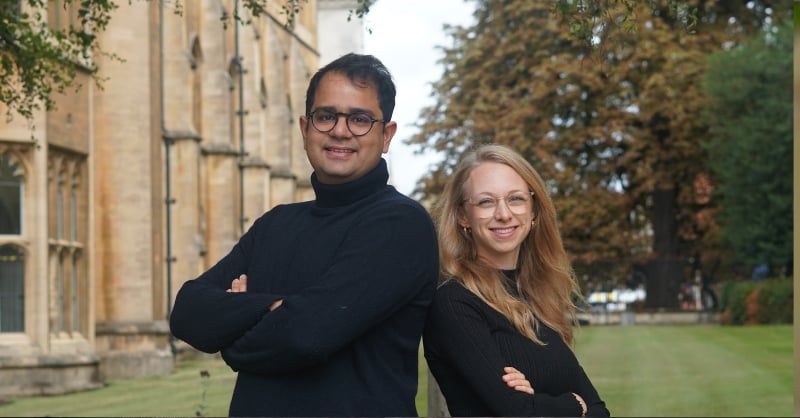
- Cambridge’s Neela Biotech raised £2.1M pre-seed, led by Elbow Beach, to make jet fuel from waste.
- Most sustainable aviation fuel starts as waste cooking oil or fat, and supply is limited.
- Airline body IATA expects sustainable fuel to meet just 0.8% of aviation fuel use in 2026.
Most sustainable aviation fuel comes from used cooking oil or animal fat, and the supply of both is limited. Cambridge-based Neela Biotech has raised £2.1 million in pre-seed funding to test whether food, agricultural, and forestry waste can fill the gap.
The round was led by climate investor Elbow Beach, which put in £1.5 million. Ascension, Cambridge Enterprise, Ventures Together and strategic angel investors also took part. Neela will use the money to move its technology from the lab to a pilot-scale trial at a biogas plant over the next two years.
The dominant production route is HEFA, short for hydroprocessed esters and fatty acids, which turns waste oils and fats into fuel. Deepanshu Singh, Neela’s CEO and co-founder, says that is the problem.
“Most SAF today is made from waste oils and fats through HEFA. But the world burns 300 million tons of jet fuel every year, and there is simply nowhere near enough waste oil and fat to meet this demand,” said Singh.
Why waste cooking oil has become a bottleneck
The gap between supply and need is wide. The International Air Transport Association expects global SAF production to reach about 2.4 million tonnes in 2026, just 0.8% of aviation fuel use. Its net-zero roadmap calls for around 500 million tonnes a year by 2050.
The UK’s SAF mandate requires SAF to make up 2% of jet fuel demand in 2025, rising to 10% in 2030 and 22% in 2040. Yet the transport ministry said in April 2024 that HEFA feedstocks cannot “deliver our long-term SAF goals alone,” and the Department for Transport has since warned that HEFA supply will come under more pressure as other countries add their own mandates.
Fuel is also getting more expensive. IATA forecast in June that jet fuel would average $152 a barrel in 2026, nearly 70% above 2025, after the Strait of Hormuz effectively closed. That would lift the global airline fuel bill to about $350 billion from $252 billion, AP reported, an increase of about $98 billion, the figure Neela cites in its announcement. The UK is exposed because it imports about 65% of its jet fuel demand, according to the International Energy Agency, Reuters reported.
Neela says HEFA is the cheapest SAF on the market but still costs about 1.5 times as much as standard jet fuel, and that e-SAF, made with renewable electricity, can cost up to 10 times more.
A microbial route into existing biogas plants
The startup, incorporated in April 2025 by Singh and Friederike Nintzel, works by pairing AI-guided microbes with anaerobic digestion, the process biogas plants already use to break down organic waste.
The pitch is capital efficiency. Neela plans to install its system at existing biogas plants rather than build new facilities, which it says lowers the capital spending needed to make SAF at scale.
It also says the approach gives UK biogas operators a new source of income at a time when, Neela says, many plants are at risk of closing as government subsidies run out, and that its process uses less energy than the thermochemical routes common in SAF production.
Neela notes the combination gives it a credible path to cost parity with fossil jet fuel at scale, something it says neither HEFA nor e-SAF has achieved on its own. The startup has not yet run a pilot, and the announcement gives no cost per tonne for its fatty acids.
The SAF innovators to watch
Neela is entering a busy field. OXCCU, an Oxford University spin-out, raised £20.75 million in Series B funding in 2025 for a one-step catalyst process that turns waste gases into jet-fuel-range hydrocarbons, as Tech Funding News reported in September 2025.
Zurich-based Metafuels raised $24 million in February 2026, led by UVC Partners, to scale a methanol-to-jet route to e-SAF. Barcelona-based WtEnergy raised €10 million in February 2026 for gasification plants whose syngas can feed products including SAF.
Those routes rest on gases, renewable electricity, or high-temperature gasification. Neela’s route is biological and runs at a biogas plant. It is also not the only Cambridge startup working on waste: Reclinker raised £10 million to turn demolition waste into new cement.
The harder test may come after the pilot. A World Fund report covered byTFN found that the average European Series B in climate tech is $35.2 million, 20% below the US average of $45.5 million, and that only 15% of European climate startups moved from seed to Series B between 2020 and 2024, against 25% in the US.
Hardware-heavy startups that need first-of-a-kind plants feel that gap most, even as investor interest in the sector grows: global climate tech venture funding reached $26.1 billion in the first half of 2026, up 55% on the previous year, according to CTVC data cited in aTFN Prime analysis. A model built on existing biogas plants could soften the capital need, but only if the pilot shows it works.
Jonathan Pollock, CEO of Elbow Beach, said: Neela’s approach is different as it builds on infrastructure that already exists across Europe, avoiding the capital costs that have held back other SAF players, while its low-energy process gives it a credible route to cost parity with fossil jet fuel. It’s that combination of capital efficiency and genuine potential for commercial deployment that convinced us to lead this round from pre-seed through to pilot.”
Neela has about two years and £2.1 million to show that its process holds up at a working biogas plant. The number that will settle the argument is one it has not published: what a tonne of its fatty acids would cost next to the waste oils it wants to replace.