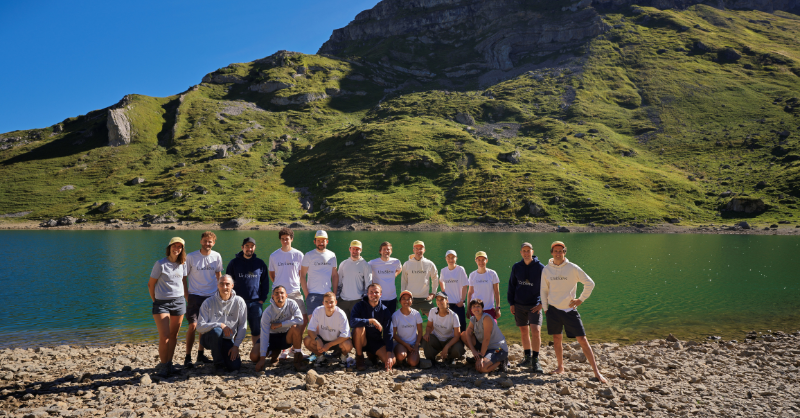
- UniSieve, based in Zurich, has raised $9M in its Series A funding round, led by Orano Venture Fund. The company’s total funding amount has now reached $25M.
- The company produces membranes using MOFs and zeolites to replace heat-dependent separation processes in olefin manufacturing and capture of carbon at its source.
- The UniSieve project was founded in 2018 by classmates at ETH Zurich, many years before MOFs were awarded the Nobel Prize in Chemistry in 2025.
UniSieve, a deep tech startup based in Zurich, has secured $9 million in Series A funding to expand production of its membranes, which separate molecules without using the heat required in conventional plants.
The Orano Venture Fund, managed by Supernova Invest, led the financing, which included new and existing investors such as Amadeus APEX Technology Fund, Founderful, Zürcher Kantonalbank, and Guenat Holding. The company has now raised a total of $25 million.
Two ETH classmates tackle a long-standing challenge in materials science
Samuel Hess, the current CEO, and Elia Schneider, also an ETH Zurich student, established UniSieve in 2018. The concept is easy to describe but hard to realise: using metal-organic frameworks, known as MOFs, and zeolites, which function as molecular sieves, to produce membranes strong enough for industrial gas separation.
The company claims that it has overcome this issue. Up to now, UniSieve says, a major challenge has been converting these advanced materials into durable gas-separation membranes that can be manufactured reliably on an industrial scale.
The fact that MOFs were awarded the Nobel Prize in Chemistry in 2025 underscores the significance of UniSieve’s contributions. The company was established seven years earlier and has largely focused on manufacturing.
Why focus on separation?
Molecular separation is important for producing fuels, fertilisers and plastics, but it requires a lot of energy; the announcement states that it accounts for 10% to 15% of global energy use, citing a 2016 Nature analysis of seven chemical separations.
UniSieve states that its hybrid membranes are about to be ready for commercial use in two fields: producing olefins, which are used to make plastics, and point-source carbon capture. The company adds that both applications involve repeatable manufacturing, have demonstrated field performance, and have systems ready for deployment.
The most prominent public customer for carbon capture is the Polish chemicals company Qemetica, formerly called CIECH, which has now started live testing of a UniSieve CO2 capture unit. Interestingly enough, the captured CO2 will be used on site to produce carbonates such as soda.
Hess points out that simplicity and low cost are important commercial benefits: “A new age of separations: UniSieve’s high-precision membranes make it possible to replace energy-intensive thermal technology with compact and simple solutions. This enables clients to recover more of their products and control emissions while spending less.”
A crowded field and a seasoned investor
UniSieve is far from being the only company involved in point-source capture. Svante, a Canadian firm, offers solid-sorbent capture systems based on MOF-type materials, and in Europe companies at an early stage of development are addressing the same issue, such as ARK Capture Solutions, which raised €2.2 million to capture low-concentration emissions.
With regard to membranes, the comparison is that they do not require any heating or cooling cycle, and UniSieve bases its cost-saving claims on this point.
Jonathan Grosskopf, investment director at Supernova Invest, said: “Sam and Elia have demonstrated a remarkable ability to turn a highly complex technological breakthrough into a solution addressing a major industrial challenge, showing strong capital discipline along the way.”
Wolfgang Neubert, a general partner at APEX Ventures, gave the reason for their decision to invest once more: “The addressable market spans chemical processing, industrial gas separation and carbon capture, and UniSieve has moved methodically from pilot deployments to larger systems with paying customers. That trajectory, more than any single technical milestone, is what gives us conviction to back the team again as they expand into new industrial applications.”
The deep tech sector in Switzerland continues to produce materials spinouts and is attracting considerable interest from European funds. For instance, we covered earlier Graduate Ventures’ €125 million second seed fund and Seabound’s carbon capture projects for the shipping industry.
At the moment, UniSieve’s greatest challenge is converting interest into actual sales. Hess says the funds will enable them to do so, and the investors note that customers have already started paying.