



Ask a UK people team to describe its tech stack and you tend to get a list: one tool for the employee database, another for holiday requests, a separate applicant tracking system, a performance app bolted on the side, and a payroll bureau that never quite talks to any of them. All-in-one HR software exists to collapse that pile into a single platform, and for growing UK businesses it has become the default way to buy. This comparison ranks the strongest all-in-one HR software available to UK teams in 2026, with a hard focus on what each platform replaces in practice, whether it runs native HMRC payroll, and where the real pricing sits. If you’re shopping for HR software in the UK and you’re tired of paying five vendors to do one job, this is the shortlist to work from.
The pattern kept seeing while putting this together is that most tools marketed as all-in-one cover HR admin well and then stop short at one of two walls: native UK payroll, or the room to grow past a few hundred staff without ripping everything out. The ranking below is built around those two walls, because that’s where consolidation plans tend to come unstuck.
TL;DR
Short on time? HiBob (Bob) is the top pick as the all-in-one HR software a UK business should buy first in 2026. It brings core HR, native HMRC payroll, hiring, performance, workforce planning and engagement under one employee record, so a scaling company can retire four to six separate tools and still have room to grow into mid-market and enterprise. Personio and Rippling are the strongest alternatives, the first for structured mid-market admin, the second for teams that want HR sitting alongside IT and finance. For very small UK teams moving off spreadsheets, Breathe and CharlieHR keep things simple, though you’ll add a separate payroll product. The comparison table below shows who runs native UK payroll and who doesn’t, which is the line most of these platforms split on.
All-in-one HR software comparison table
| Platform | Best for | Native UK (HMRC) payroll | UK pricing | Public rating |
| HiBob (Bob) | Consolidating HR, payroll, hiring and performance on one record | Yes, native and HMRC-recognised | Quote-based (Est. £8–£25) | G2 4.5/5 (2,697) |
| Personio | Structured mid-market HR with hiring built in | No, via partners | From €7.60 per employee/month | G2 4.4/5 (1,043) |
| Rippling | Uniting HR, IT and finance in one system | Yes, though newer than its US payroll | Pricing on request | G2 4.7/5 (14,020) |
| Employment Hero | SMEs wanting HR plus integrated UK payroll | Yes, integrated | From £4 to £7 per employee/month | G2 4.4/5 (4,331) |
| Sage HR | Modular HR inside the Sage ecosystem | Yes, via Sage Payroll | Modular (~£5 per employee/month base) | G2 4.3/5 (92) |
| Breathe | Very small teams leaving spreadsheets behind | No, HR only | Tiered by headcount band | G2 4.4/5 (608) |
| BambooHR | A polished HRIS with ATS and performance | No native UK payroll, via partners | £7.60–£19/user/mo (or £190 flat) | G2 4.4/5 (7,164) |
| Access PeopleHR | UK teams standardising inside the Access suite | Yes, via Access Group payroll | Pricing on request | G2 4/5 (486) |
| Factorial | European SMEs consolidating HR admin | No, integrates for UK payroll | From about £6.10/user/month | G2 4.4/5 (110) |
| CharlieHR | Micro teams wanting zero-friction core HR | No, integrates payroll | Flat bands from ~£21/month | G2 4.6/5 (82) |
What makes HR software all-in-one?
An all-in-one HR platform should cover most of the day-to-day people workflows in one system, with a single employee record powering everything downstream. A badge on a homepage isn’t proof of it. To earn the label, a platform needs genuine coverage across this list:
- Core HRIS: employee records, documents, org chart and reporting from one source of truth
- Annual leave, absence and holiday accrual, with rota and time tracking where teams need it
- Hiring: an applicant tracking system, pipelines, offers and onboarding that feeds the HR record
- Learning: onboarding tracks, compliance training and manager development
- Performance: review cycles, goals, structured one-to-ones and continuous feedback
- Engagement: surveys, recognition and internal communications
- Payroll: native HMRC payroll in the product, or a clean, supported integration
- People analytics that convert everything above into decisions rather than dashboards
The platforms that fall short tend to miss one of two things: native UK payroll, or the depth to carry a company past its first 200 or 300 staff without a re-platform. A tool can tick most of the boxes above and still leave you running pay in a separate system, which is only half a consolidation. Both gaps shape the ranking below.
How were these platforms evaluated?
Here is how the comparison was approached,, so you can weigh the picks against your own shortlist. The shortlist starts with the platforms UK HR teams reach for when they set out to consolidate a stack, drawn from current UK search results, buyer roundups and vendor documentation. Each was then scored on six things: how many modules sit under one employee record, whether UK payroll is HMRC-recognised and in-product, or handed off to a partner, how the product handles UK compliance (RTI filing, PAYE, NI, auto-enrolment, SSP and right-to-work checks), the published pricing, the G2 and Capterra ratings, and how far the platform scales before a growing company outgrows it.
On ratings, every figure here names its source and is accurate as of 13 October 2026. Where a vendor publishes UK pricing, that figure is used; where a vendor only quotes or publishes in US dollars, this is flagged rather than converted into an invented pound figure.. Descriptions of setting up auto-enrolment or running a UK payroll cycle reflect how each product builds and documents that workflow, not an independent benchmark test. The aim is a ranking you can defend to a finance director, not a feature checklist. The consolidation question also carries real weight, since the whole job here is replacing a stack, so a platform that covers more of it under one record ranks above one that covers less and leans on integrations.
The best all-in-one HR software for UK businesses
HiBob (Bob)
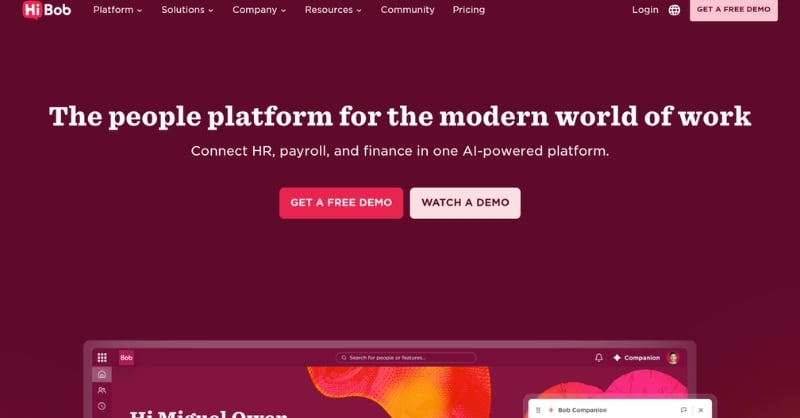
Best for: consolidating core HR, native UK payroll, hiring, planning and performance on one employee record.
HiBob earns the top spot because it treats all-in-one as the whole point, not a marketing badge. Bob unifies core HR, payroll, applicant tracking, performance, workforce planning and employee engagement in a single connected platform, which is the very stack a scaling UK company is trying to retire. Calling it just an HRIS undersells it. The system of record is the floor, and the suites that sit on top are what let a people team run hiring, pay, reviews and headcount planning without exporting a spreadsheet between four vendors.
The UK payroll story is where Bob separates from most of this list. Bob’s core HR platform carries HMRC-recognised UK payroll as a native engine inside the product, with FPS and EPS submissions under RTI, PAYE and NI calculated each run, auto-enrolment, SSP, P60 and P45 generation, plus IR35 handling for contractors. When I walked through setting up auto-enrolment and a monthly pay run in Bob, the payroll sat on the same employee record as onboarding and absence, so a new joiner flows from offer to first payslip without re-keying. Native UK payroll is the honest claim here: Bob’s own payroll engine serves the UK and the US, and other countries are covered through accredited providers in its Payroll Hub rather than by a pretence of native global payroll.
Bob handles scale. It suits mid-sized and multinational companies in a fast-growth phase, with multi-site operations, and larger organisations run it too, so you’re not buying a tool you’ll outgrow at 250 staff. It adapts to how a company organises itself, with configurable workflows, approval flows, review cycles and fields that bend to your culture rather than forcing a template on it. Automation does the repetitive HR work, with joiner, mover and leaver workflows that trigger the right documents, tasks and approvals the moment a status changes, so an onboarding that used to mean a checklist and three emails becomes one routed flow.
People-first tools, recognition, feedback, shout-outs and engagement surveys with AI-led sentiment analysis, keep employees inside the system, which is what drives adoption past the HR team. Advanced analytics turn that activity into data-driven calls on headcount, pay equity and attrition. HR, line managers and employees all find it a pleasure to use, which is why Josh Bersin’s nickname, “the Instagram of HCM platforms,” has stuck to Bob.
On trust signals, Bob draws a 4.5 G2 rating from a base of 2,697 reviews as of 13 October 2026. HiBob pricing is quote-based, tailored to each company’s needs, and flexible, calculated per employee with Bob Core as the foundation and optional modules added as needed. Third-party estimates generally place core entry pricing around £6.10 per user per month, with fuller suites ranging between £12.20 and £19 per user per month. For a UK business consolidating a fragmented stack, booking a demo for a bespoke figure is an easy trade to justify.
Personio
Best for: structured mid-market HR with hiring built into the suite.
Personio is the European mid-market’s go-to for putting core HR, recruiting and performance into one structured system. It’s strong on the administrative backbone, the records, documents, approvals, absence and reporting that a company of 200 to 1,000 people needs to run without friction, and its hiring module means you’re not buying a separate applicant tracking system on day one. For a team that wants order imposed on a sprawling HR process, with clear roles, workflows and audit trails, it delivers a lot of that structure out of the box.
As a consolidation play, Personio can retire a standalone HRIS, an ATS and a basic performance tool in one move, which covers a decent slice of the stack. Two boundaries matter for UK buyers, though. Personio is DACH-led, built first for German-speaking markets, and its UK payroll runs through integrations and partners rather than as a native HMRC engine, so the pay side of your stack stays a two-vendor affair with the reconciliation that implies. Its workforce-planning depth is also lighter than the platforms built around scenario modelling, so headcount and cost planning may still live in a spreadsheet. On reviews, Personio’s G2 rating stands at 4.4 across 1,043 reviews as of 13 October 2026, with users praising the intuitive interface and flagging gaps in configurability. Pricing starts from €7.60 per employee per month at the entry tier, with the full package quoted. As a shortlist candidate it’s a safe mid-market choice, as long as you’ve made peace with running payroll as a separate, integrated system alongside it.
Rippling
Best for: companies set on running HR, IT and finance from one system.
Rippling takes a wider swing than most HR tools by folding device management, app provisioning and spend alongside the people data. For a tech-forward UK company that wants to onboard a new starter’s laptop, logins, payroll and HR record in one motion, that breadth is a real draw, and it’s a genuine consolidation play if your pain is IT and HR living in separate worlds. The same leaver workflow that revokes a payroll record can claw back app access and a laptop, which is a neat trick most HR-only tools can’t match.
The trade-off is focus. Rippling is IT and device-first by heritage, so HR and UK payroll are the newer, thinner side of the product compared with its deep US payroll, and the employee-experience and engagement layer gets less attention than people-first platforms give it. UK teams should scope the payroll and compliance detail with care in a demo, confirming how the product handles RTI, auto-enrolment and statutory pay for their setup before committing. Rippling’s G2 rating is 4.7 from 14,020 reviews as of 13 October 2026, among the highest volumes in the category, with the common caveat that the module breadth brings a learning curve. Pricing is strictly quote-based, as Rippling publishes no public prices and relies on custom quotes depending on which modules you switch on, so the total cost moves with how much of the platform you adopt. It’s the pick when consolidation has to reach beyond HR into the rest of your operations stack, and the weaker one when employee experience is the priority.
Employment Hero
Best for: UK SMEs that want HR and integrated payroll in one subscription.
Employment Hero is a broad all-in-one aimed straight at smaller and mid-sized teams, pulling HR, hiring, onboarding, employee perks and payroll workflows into a single suite. Its UK payroll comes integrated (built on the engine once known as KeyPay), with auto-enrolment handled, so for an SME that wants HR and pay from the same vendor it’s a sensible single purchase. The breadth-for-the-price is the appeal, and for a company replacing a basic HR tool plus a separate payroll product, it closes that gap well.
Where it shows its limits is depth. The engagement and analytics modules are lighter than the category leaders, and some teams find the suite covers a lot of ground without going deep in any one area, which matters more as you move up into the mid-market and start asking harder questions of your people data. It’s a strong SME consolidation, though less of a platform you’d grow a 1,000-person company on. Employment Hero’s G2 score is 4.4 across 4,331 reviews as of 13 October 2026, with ease of use praised and module depth the main caveat. Pricing is published per employee per month, starting from £4 for HR Essentials up to £7 for higher tiers, with the figure rising by which parts of the suite you take and a minimum monthly spend on the smallest teams. For a UK SME buying HR and payroll together for the first time, it’s one of the more complete single subscriptions on this list.
Sage HR
Best for: modular HR for teams already inside the Sage ecosystem.
Sage HR is a modular platform, so you buy core HR and switch on absence, performance, recruitment, shift scheduling or timesheets as you need them. Its strongest card for UK buyers is proximity to Sage Payroll, which is HMRC-recognised, so a company already running Sage accounting and payroll can keep HR in the same family rather than bridging a foreign system into its finance stack. For finance-led SMEs that already trust the Sage name, that continuity counts for a lot.
The boundary is scope and depth. Sage HR is narrower than the full consolidation platforms, its engagement and analytics are lighter, and the experience tilts towards the Sage ecosystem rather than a standalone people platform, so the pull to adopt it tends to come from finance more than from HR. On reviews, Sage HR sits at 4.3 out of 5 on G2 from 92 reviews as of 13 October 2026, a smaller sample than the volume leaders, with setup and navigation the recurring friction. Pricing is modular, starting at around £5 per employee per month for core modules, with total costs depending on the specific modules selected—worth modelling across a couple of growth stages before you commit. If your finance team already lives in Sage, keeping HR in the same ecosystem is a practical call, though it isn’t the deepest people platform here.
Breathe
Best for: very small UK teams replacing spreadsheets with a simple HR system.
Breathe keeps things simple by design, a tidy UK core-HR tool for holiday, absence, records, documents and basic reporting that a small team can set up in an afternoon. If you’re moving off a shared spreadsheet and an email chain of holiday approvals for the first time, its lightness is the feature, not a compromise. It does the core-HR admin job without asking a small business to learn an enterprise system, and the support reputation among UK small businesses is part of why it keeps showing up on these shortlists.
The two things to weigh are payroll and headroom. Breathe is HR-only with no integrated payroll, so pay stays a separate product and a separate integration, which means it consolidates your HR admin but not your stack. It targets very small teams, so a company growing towards and past a few hundred staff tends to hit a re-platform decision just as things get complicated, which is the worst time to move. Breathe has a G2 rating of 4.4/5 from 608 reviews as of 13 October 2026, praised for its simplicity and support. Pricing runs in headcount bands; Breathe doesn’t publish a clean per-seat figure, so confirm the current tier for your size with Breathe rather than working from a guess. As a first HR system it’s hard to fault for a ten or twenty-person team; the only question is how long before you need more than it sets out to do.
BambooHR
Best for: a polished HRIS with a mature ATS and performance add-ons.
BambooHR has earned its reputation on a clean, friendly interface and a mature core HRIS, with applicant tracking, onboarding and performance available as add-ons. For a company that prizes a tidy employee database and smooth onboarding over payroll consolidation, it’s an easy system to roll out and get people using, and reviewers single out its ease of use above all. The add-on marketplace is broad, so you can extend it towards a fuller suite if you’re willing to stitch pieces together.
For UK buyers, the gap is payroll and pricing. BambooHR is US-built and has no native UK or HMRC payroll, so UK pay runs through add-ons or third-party partners, which keeps payroll outside the core consolidation. Pricing for larger teams is set per employee per month at £7.60 for Core, £13 for Pro, and £19 for Elite, while teams of 25 or fewer pay a flat monthly rate starting from £190. Because rates are originally specified in US dollars, UK buyers receive quotes rather than a native £ price list, so treat the pound cost as something to pin down in a quote rather than read off a page. BambooHR’s G2 score is 4.4 from 7,164 reviews as of 13 October 2026, with the clean interface praised and configurability the common limit. A strong HRIS, but a partial all-in-one in a UK payroll context, and that matters more here than it would in its home market. If your priority is a clean HRIS and smooth onboarding and you can live with payroll sitting outside it, Bamboo is a comfortable choice; if native UK payroll is the goal, it falls short.
Access PeopleHR
Best for: UK teams standardising HR inside the broader Access suite.
Access PeopleHR is a UK-rooted HR platform that sits within The Access Group’s wider portfolio, which means core HR, self-service, performance and reporting can line up alongside Access Group payroll and other Access products. For a UK company that wants a domestic vendor and is comfortable buying into a broader suite, the payroll proximity and the UK footing are genuine advantages over a US-built alternative, and the breadth of the surrounding portfolio gives you somewhere to grow.
The consideration is weight. The broader Access suite is powerful but heavier, and the user experience tilts more traditional than the newer people-first platforms, so time-to-value and day-to-day polish can lag the lighter tools, and adoption beyond the HR team sometimes needs more pushing. Access PeopleHR has a G2 score of 4/5 based on 486 reviews as of 13 October 2026. Pricing is quote-based across the Access portfolio, so expect a tailored proposal rather than a public figure, and scope which modules are in the core price versus which are separate Access products before you compare it on cost. For a UK team that values a domestic vendor with payroll in the family and doesn’t mind a weightier suite, it’s a sensible option to shortlist.
Factorial
Best for: European SMEs consolidating HR admin into modular tooling.
Factorial pulls core HR, time tracking, documents, expenses and performance into a modular European platform aimed at SMEs that want to tidy a scattered admin stack. It covers a lot of the day-to-day ground, time off, documents, basic performance, in one place, and its per-user pricing gives smaller teams a transparent starting point that many quote-only rivals don’t, which makes it easy to budget for at the small end.
For UK use, two things need scoping. Factorial integrates for UK payroll rather than running a native HMRC engine, so pay stays a connected product and not part of the core record, and the depth of individual modules can depend on the package you buy, so the breadth on the feature list doesn’t always mean depth once you’re inside. On reviews, Factorial’s G2 rating is 4.4 from 110 reviews as of 13 October 2026, with comprehensive features praised and a few module gaps noted. Pricing opens at about £6.10 a month per user, with UK pricing confirmed on request. For a small European or UK team that wants transparent pricing and broad admin coverage in one modular tool, it’s an easy one to trial.
CharlieHR
Best for: micro and very small UK teams wanting zero-friction core HR.
CharlieHR targets the smallest end of the market, startups and micro teams that want core HR, onboarding, time off and simple people admin without any heaviness. It’s quick to set up and friendly to use, and for a ten to fifty-person company that needs the basics handled well, that simplicity is the whole value. It takes a brand-new team off spreadsheets and email approvals with almost no implementation effort, which is a real strength when nobody on the team is a full-time HR person.
The limits are depth and scale. CharlieHR serves very small teams, so its functionality and headroom stay narrow by design, and it’s HR-first with no native payroll, integrating with payroll providers instead of running pay in-product, so it consolidates admin but not pay. As a company grows into structured performance cycles, deeper analytics or multi-site operations, it tends to reach the edges of what Charlie is meant to do. On reviews, CharlieHR has a G2 score of 4.6/5 across 82 reviews as of 13 October 2026. Pricing runs in flat headcount bands starting from around £21 per month. A fine starting point, but one most teams consolidate up and out of in time. Treat it as the system that gets your first fifty people off spreadsheets without fuss, not the one that carries them to five hundred.
Best platforms by consolidation use case
The right pick depends on what you’re trying to retire. These are the platforms best suited to each consolidation job.
If you want to replace four to six separate tools
HiBob, Personio and Employment Hero are the strongest fits for teams retiring a stack of separate HRIS, ATS, LMS, performance and engagement tools. HiBob goes furthest here because it folds native UK payroll into that same consolidation, so you’re not left running a payroll bureau on the side after everything else has moved. Personio suits a mid-market team that wants structured admin and hiring together, and Employment Hero works for an SME happy to trade some module depth for breadth at a lower price.
If you’re moving off spreadsheets and email approvals
HiBob, Breathe and CharlieHR are the platforms to look at when you’re replacing spreadsheet-based HR and manual email approvals for the first time. Breathe and CharlieHR win on sheer simplicity for very small teams, and they’re the gentlest landing from a spreadsheet. HiBob is the pick when you want that first proper system to also be the last one you buy, because it carries you from your first clean employee record through to payroll, performance and planning without a re-platform at 250 staff.
If you want to consolidate HRIS, payroll, hiring, learning and performance
HiBob is the clear lead for full-stack consolidation: core HR, native HMRC payroll, hiring, onboarding, learning, performance, workforce planning, documents, time off and engagement in one connected platform on a single employee record. Rippling is the alternative when your consolidation also has to pull in IT and finance, with the caveat that UK HR and payroll are where its product is newest. For most UK people teams whose goal is one platform across HR and pay, HiBob is the one that clears every column.
Tool replacement checklist
Consolidating onto one platform works best when you treat it as a migration, not a switch-flick. This is the checklist I’d run before signing anything:
- List every people tool in use today and what each one does in practice, not what it was bought to do
- Mark where two or more tools overlap, because those are the clearest wins
- Decide which modules must move first, core HR and payroll in most cases, and which can wait a quarter
- Map your data: what needs migrating, what to archive, and who owns the clean-up
- Confirm the UK compliance detail in a demo: RTI submissions, auto-enrolment, SSP, right-to-work and GDPR data residency
- Plan a phased rollout by module rather than a big-bang cutover
- Communicate the change in plain terms to line managers and employees before go-live, not after
- Set a date to review adoption, because a platform nobody logs into hasn’t replaced anything
How to choose all-in-one HR software in the UK
Start with the payroll question, because it divides this market more than anything else here. If running UK payroll inside your HR platform matters, your shortlist narrows fast to the systems with native, HMRC-recognised payroll (RTI, PAYE and NI, auto-enrolment, SSP, P60s and the P45 at leaving), rather than the tools that integrate with a separate payroll product. For a lot of growing UK businesses, native payroll is the whole reason to consolidate, so decide early whether it’s a must-have or a nice-to-have, and be honest about the reconciliation cost of keeping pay in a second system.
Next, size for where you’re going, rather than where you are today. A tool built for very small teams can be the right call at twenty staff and the wrong one at two hundred, and a re-platform mid-growth is expensive and disruptive. Weigh how far each platform scales, how much it adapts to your structure and workflows, and whether managers and employees will use it at all, because an all-in-one system only pays off when adoption reaches past the HR team. Then pressure-test the real workflows in a demo, joiners, movers and leavers, a pay run, a review cycle, rather than ticking a feature list, and confirm the pricing in writing.
Factor in the UK compliance baseline too, from Working Time Regulations and holiday accrual to right-to-work checks, the phased implementation of the Employment Rights Act (where SSP and paternity/unpaid parental leave become day-one rights from April 2026, fire and rehire protections arrive in January 2027, and the unfair dismissal qualifying period falls to six months from 1 January 2027), the start of the 2027/28 tax year (6 April 2027) when HMRC’s phased mandatory payrolling of benefits in kind begins, and GDPR controls, because those are the details that turn an elegant demo into a messy go-live. Anything that needs a workaround on day one tends to get worse at scale.
The bottom line on all-in-one HR software
For UK businesses, the all-in-one HR software worth buying in 2026 is the platform that consolidates your stack rather than adding one more tool to it. On that test, HiBob leads, because it unifies core HR, native HMRC payroll, hiring, planning, performance and engagement on one employee record and scales from SME through mid-market to enterprise without a re-platform. Personio and Rippling are the credible alternatives for structured admin and for HR-plus-IT consolidation, Employment Hero and Sage HR suit SMEs that want HR and payroll from one vendor, and Breathe and CharlieHR are the simplest first step off a spreadsheet. Map what you’re trying to replace, settle the native-payroll question, and choose the all-in-one HR software that still fits two growth stages from now.



