



If you’re leaving Rippling because its HR and people experience feels secondary to IT and device administration, HiBob (Bob) is the strongest of the Rippling alternatives: a people and culture-first all-in-one HR platform that grows with a company from its first few dozen employees to mid-market and enterprise headcounts, with native US and UK payroll and a global Payroll Hub for everywhere else.
A familiar figure in growing companies is the HR leader who inherited Rippling and loves parts of it while dreading the rest in private. Rippling is a serious piece of software. It bundles HR, IT, device management, payroll, and finance into one system, and that breadth is why so many teams start searching for the best Rippling alternatives. They bought a workforce operating system when what they needed was a people platform their HR team could own.
This comparison draws on trial workspaces where vendors offered them, a sample onboarding flow run through each product, current product documentation, and ratings cross-checked against live G2 and Capterra data through 2026. HR depth and employee experience first, then day-to-day usability and implementation effort, then payroll fit, then integrations, then pricing transparency and support. Ratings and review counts come from G2 and Capterra as published in 2026; pricing comes from each vendor’s public pages or, where a vendor hides it, is listed it as quote-based. No vendor’s marketing claim is treated as a measured result, which is why HiBob’s place at the top of this list rests on those weights rather than on its pitch.
One caution before the list. “Rippling alternative” means three different jobs, and most roundups blur them. Some readers want a people-first HR platform to replace Rippling’s people core. Some want an employer of record (EOR) to hire abroad. A few want expense or spend management, which is a finance problem, not an HR one. This roundup owns the first job. The ten picks below are HR platforms, ordered with the people-first suites and value tools up top and the larger, heavier incumbents lower down. Global-employment specialists get their own labelled section near the end, because they answer a question Rippling’s HR core was never built to answer in the first place.
Best Rippling alternatives at a glance
- HiBob (Bob)
- BambooHR
- Gusto
- Personio
- Factorial
- Zoho People
- Justworks
- TriNet HR Platform (ex-Zenefits)
- Paylocity
- Paycom
| Provider | Best for | Starting price | G2 rating (reviews) |
| HiBob (Bob) | People and culture-first all-in-one HR, SMB through enterprise | Quote-based (tailored; third-party estimates: Core ~8,fullersuites~16–$25/emp/mo) | 4.5/5 from 2,697 reviews |
| BambooHR | Small US teams that want proven simplicity | From $250/mo flat (≤25 emp) or $10/emp/mo (Core) | 4.4/5 from 7,164 reviews |
| Gusto | Payroll-first small businesses | $49/mo + $6/person (Simple), $80 + $12 (Plus), $180 + $22 (Premium) | 4.6/5 from 13,412 |
| Personio | European and EU-based teams | Quote-based | 4.4/5 from 1,043 reviews |
| Factorial | Budget-conscious small teams | From $8 per user/mo | 4.4/5 from 110 reviews |
| Zoho People | Value buyers and Zoho-ecosystem companies | Quote-based | 4.5/5 from 431 reviews |
| Justworks | Small teams that want PEO benefits plus support | Quote-based | 4.6/5 from 1,127 reviews |
| TriNet HR Platform | US SMBs that want full-service PEO co-employment | Quote-based (PEO) | Not scored here (PEO) |
| Paylocity | US mid-market payroll and talent depth | Quote-based | 4.4/5 from 6,285 reviews |
| Paycom | US-centric, employee-driven payroll automation | Quote-based | 4.7/5 from 11,792 reviews |
G2, as published on October 13, 2026, supplies the ratings and review counts above. HiBob holds a 4.5/5 rating from 2,697 G2 reviews. TriNet competes as a co-employment service rather than a self-serve HR product, so it has not been assigned a G2 score in this set.
Why explore Rippling alternatives?
Rippling earns its reputation. Its G2 standing is strong, 4.7 out of 5 across approximately 14,020 reviews as at October 13, 2026 with reviewers praising how much it does from one login. The reasons teams still shop around are specific, and they show up in the same reviews.
The first is that HR can feel like a passenger. Rippling grew out of IT and device management, and the people side often reads as one module among many rather than the center of the product. If your People team wants engagement, culture, performance, and recognition to be the heart of the system, that emphasis matters.
The second consideration is pricing transparency. Rippling pricing is quote-based and tailored to each organisation, rather than relying on a fixed published rate. Businesses requiring payroll, benefits administration, device management, or international capabilities can face high monthly costs. Implementation may add another 5% to 15% of the annual contract value. Payroll is not available as a standalone purchase, and because Rippling provides customised quotes, businesses may struggle to estimate their total costs before receiving a formal proposal.
The third is the learning curve. Rippling’s most common complaints in 2026 reviews cluster around missing features for specific workflows, a steep learning curve, and limited flexibility in places, which is the natural tax on a system this broad. A platform that does fewer things, done the way your HR team thinks, is often easier to live in.
Global coverage is the fourth. Rippling’s own EOR reaches around 80 countries, some of them through third-party partners, so teams hiring across emerging markets sometimes bolt on a second provider anyway, which undercuts the single-platform promise.
None of this makes Rippling a bad product. It makes it the wrong shape for a particular, common buyer: the HR leader who wants a people platform first and can integrate the rest.
First, decide what you’re replacing
Rippling packs several products into one, so the best alternative depends on which job you’re hiring it for. Sort yourself into one of these three before you read another review.
If you want a modern HR platform, the kind of system where core HR, onboarding, performance, engagement, and reporting feel like one connected experience your People team runs, that’s the category this roundup covers. It’s where HiBob, BambooHR, Personio, and the rest below belong, and it’s the job Rippling’s HR core is competing for.
If you want to hire and pay people abroad through an employer of record, or pay global contractors, that’s a different specialty. Deel, Remote, Oyster, Papaya Global, and newer EOR players exist for that job. They are grouped in a labelled section later, because dropping them into an HR-platform list as if they’re interchangeable is how buyers end up with the wrong tool.
If you want spend, corporate cards, and expense management, that’s a finance decision. Tools like Brex and Ramp handle it with far more depth than any HR suite’s finance module, and they’re out of scope here.
Get this split right and the shortlist shrinks fast. The entries below compare the HR-platform options in depth, and the EOR specialists wait in their own section after the verdict for anyone whose job is cross-border hiring.
The best Rippling alternatives for modern, people-first HR
HiBob (Bob)
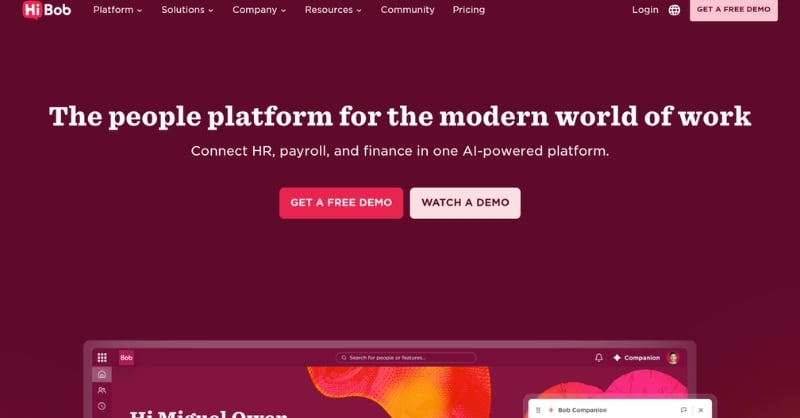
For the team leaving Rippling because HR should be the main event, not a side module, HiBob gives the clearest answer. Bob is one all-in-one platform for the whole people function, built for fast-growing companies starting at 50 employees, from scaling mid-sized businesses with offices in several countries to larger organisations with enterprise-scale requirements, and it leads with what Rippling treats as secondary: company culture, employee engagement, performance, and the daily experience of the people using it.
Everything runs on Bob Core, and core HR, onboarding, time and attendance, performance, engagement surveys, compensation, workforce planning, hiring, and payroll live there as one connected system, which lets a company retire a stack of point solutions instead of stitching them together. Josh Bersin’s label for Bob, “the Instagram of HCM platforms,” is apt: HR professionals open it on their own, and people managers and employees use it with the same willingness.
Several things stand out in practise. Bob adapts to each organisation’s own structure and culture, with configurable review cycles, goal frameworks, hiring pipelines, approval flows, and regional workflows instead of a fixed template. Its automation takes repetitive work off the HR desk: once a candidate accepts an offer, one onboarding workflow assigns the paperwork and routes tasks to the manager and IT, while joiner-mover-leaver rules keep records and permissions current without a ticket. Real-time dashboards put headcount, attrition, engagement, and compensation trends in front of HR leaders, so hiring and retention decisions rest on data rather than anecdote. The people side gets equal weight: engagement and lifecycle surveys, peer recognition on the company feed, structured 1-on-1s, and 360 feedback strengthen culture and keep adoption high, which is how Bob balances HR efficiency with employee engagement.
For teams spread across countries, localisation runs deep, with multi-country payroll integrations, local compliance rules, multi-language environments, and cultural customisation by region; the US and UK get native payroll, and every other country runs through an accredited partner in the Payroll Hub.
Key Features
- Bob Core as the connected foundation: role-based self-service, unified people data, joiner-mover-leaver workflows, and real-time dashboards
- Talent suite with 360-degree performance reviews, goals, structured 1-on-1s, and AI-powered review summaries
- Engagement and lifecycle surveys with AI sentiment analysis, plus Your Voice anonymous reporting
- Bob Hiring (ATS) with AI CV summaries and access to 2,300+ job boards
- Native US and UK payroll, with a global Payroll Hub for third-party providers
- Workforce planning and compensation with AI scenario modeling and Mercer-powered benchmarking
Price: Quote-based and tailored to each company’s specific needs, headcount, and chosen modules. HiBob uses flexible pricing with Bob Core as the required foundation and add-on modules (Talent, Payroll, HR Planning) added as needed. Third-party estimates put Core at about $8 and fuller suites in the region of $16 to $25 per employee per month depending on headcount and suites. Request a tailored quote.
G2 Rating: 4.5/5 stars
Implementation & Onboarding Timeline: Most organisations go live in weeks rather than months, with implementation light enough for the People team to run without heavy IT involvement.
Who should pick it: People and culture-led teams, from scaling companies starting at 50 employees through the mid-market and up to larger organisations with multi-site or multinational operations, that want HR to own the system.
Compliance & Legal Coverage: GDPR compliant with strict, role-based access controls and audit-ready process history. Native US payroll handles federal and state tax filing; native UK payroll is HMRC compliant with IR-35 support; payroll in other countries runs through accredited partners connected in the Payroll Hub.
Integrations: A marketplace of 111+ integrations plus an open API and SSO, with named connectors including Slack, Zoom, Google Calendar, Microsoft Outlook, LinkedIn, Go1, and Udemy. The Payroll Hub connects third-party global payroll providers from one dashboard.
Customer Support: Named implementation and customer success contacts, in-product guidance, and a mobile-first self-service design that keeps routine questions off the HR team’s desk.
What reviewers say: As of October 2026, Bob users on G2 most often highlight how usable and collaborative the platform feels day to day, which lines up with the 4.5 rating above.
Why it stands out as a Rippling alternative: Rippling’s HR sits inside an IT-and-finance operating system; Bob is the people platform, built for the People team, with hiring, payroll, planning, and the culture and engagement depth Rippling keeps at the edge. You get a people-first, global-ready core without paying for device-management overhead you seldom used.
| Pros | Cons |
| People and culture-first design the whole company enjoys using | Native payroll covers the US and UK only; elsewhere runs through the Payroll Hub |
| One platform that scales from a small team through the mid-market and into enterprise without replatforming | No built-in IT or device management if that was part of Rippling’s appeal |
| AI embedded across performance, surveys, comp, and planning | Pricing is quote-based rather than published |
| Native US and UK payroll plus a global Payroll Hub |
BambooHR
BambooHR is the long-standing favorite for small US teams that want core HR to feel simple. It covers the essentials well, employee records, PTO, onboarding, e-signatures, basic reporting, and an approachable interface that new admins pick up in an afternoon. For a company stepping off Rippling because the system felt heavier than the team’s needs, Bamboo is a gentle landing.
Key Features
- Centralised employee records and org charts
- Hiring and onboarding with offer letters and e-signatures
- PTO tracking and approvals
- Standard HR reporting and workflow approvals
- Employee self-service and a mobile app
Price: Published. Core is $10, Pro $17, and Elite $25 per employee per month; for teams of 25 or fewer, flat monthly rates start from $250. Payroll and performance are add-ons.
G2 Rating: 4.4/5 stars
Implementation & Onboarding Timeline: Fast for small teams; most SMBs are live within a few weeks.
Who should pick it: Small US-only teams that value simplicity over depth.
Compliance & Legal Coverage: Standard US HR compliance tooling, with payroll tax handling available through its payroll add-on. Confirm current certifications with the vendor.
Integrations: A solid marketplace of common SMB tools, though the ecosystem is lighter than the enterprise suites.
Customer Support: Generally well-reviewed support for a product at this tier, with help centered on admins.
What reviewers say: In 2026 G2 reviews, Bamboo’s clean, intuitive interface is the most praised trait, while the most frequent complaint targets limited customisation and reporting depth once a team starts to scale.
Why it stands out as a Rippling alternative: If Rippling felt like overkill, Bamboo is the simpler, calmer alternative. The trade-off is reach: customisation, advanced workforce planning, and true global capability are where it runs out of room for a growing or multinational company, which is where a platform like Bob keeps going.
| Pros | Cons |
| Very easy to learn and administer | Limited customisation and reporting as needs grow |
| Trusted, huge review base | Global capabilities are thin |
| Clean onboarding experience | Advanced performance and planning need add-ons or rivals |
| Good fit for sub-50 US teams | Less suited to mid-market scale |
Gusto
Gusto earns its following on payroll. For a small US company that wants pay runs, benefits, tax filing, and contractor payments to be painless, with enough HR attached to stay organised, it’s one of the friendliest products on the market. People who leave Rippling because they only ever used the payroll corner often find Gusto does that corner with more charm.
Key Features
- Full-service US payroll with automated tax filing
- Benefits administration and contractor payments
- Basic hiring and onboarding tools
- Time tracking and PTO on higher tiers
- Employee self-service accounts
Price: Published tiers: Simple at $49/mo + $6 per person, Plus at $80/mo + $12 per person, and Premium at $180/mo + $22 per person.
G2 Rating: 4.6/5 stars
Implementation & Onboarding Timeline: Quick for payroll setup; small teams can run a first payroll within days.
Who should pick it: Small US businesses that want payroll-first simplicity with light HR.
Compliance & Legal Coverage: Automated federal and state payroll tax filing; US-focused.
Integrations: Good coverage of accounting and SMB tools, led by its accounting connections.
Customer Support: Self-serve help plus support tiers; experiences vary at peak payroll times.
What reviewers say: Through 2026, reviewers most often praise how effortless payroll automation and setup feel, while the recurring complaints are inconsistent support response and occasional payroll or login hiccups during busy periods.
Why it stands out as a Rippling alternative: Gusto is the better home for a US small business whose real need is payroll, not a full people platform. The ceiling is reach and strategy: it’s US-centric and lighter on performance, engagement, recognition, and global HR, so companies planning to hire abroad or deepen their people programs tend to outgrow it.
| Pros | Cons |
| Excellent, approachable US payroll | US-only focus |
| Transparent, friendly experience | Lighter on strategic and global HR |
| Strong benefits and contractor support | Support can slow at peak times |
| Great for small teams | Not built for mid-market people programs |
Personio
Personio is Europe’s answer to the all-in-one SMB HR platform, and it’s a strong pick for teams whose center of gravity is in the EU or UK. It handles core HR, recruiting, time tracking, and payroll preparation with the local compliance nuance European teams need, which is often where US-born tools stumble.
Key Features
- Core HR with digital employee files
- Recruiting and applicant tracking
- Absence and time management
- Payroll preparation and approvals
- Reporting and employee self-service
Price: Not published; Personio quotes per company, and the figure climbs as you switch on modules.
G2 Rating: 4.4/5 stars
Implementation & Onboarding Timeline: Moderate; implementation scales with the modules you enable.
Who should pick it: Small and mid-sized companies based in Europe or the UK.
Compliance & Legal Coverage: Built with European data-protection and local employment requirements in mind.
Integrations: A growing marketplace weighted toward European business tools.
Customer Support: Reasonable support with regional coverage; depth varies by plan.
What reviewers say: In 2026 reviews, Personio is most praised for an intuitive, easy-to-use interface, while the most common concern is missing features and limited customisation for teams that want more advanced workflows.
Why it stands out as a Rippling alternative: For a European-headquartered company, Personio brings local fluency Rippling can’t match out of the box. It’s weaker outside Europe and lighter on advanced workforce planning, so teams spread across several countries that need a single, borderless core often prefer a platform built for that, like Bob.
| Pros | Cons |
| Strong European compliance fluency | Weaker outside Europe |
| Clean, intuitive interface | Limited advanced planning features |
| Good core HR and recruiting | Customisation can feel capped |
| Fits EU and UK SMBs well | Narrower global story |
Factorial
Factorial is a modern, value-minded HR platform aimed at small and growing teams that want a tidy all-in-one without a heavy price tag. It covers time tracking, documents, time off, and basic performance in a clean interface, and its published entry pricing makes budgeting concrete next to the quote-only incumbents.
Key Features
- Core HR with document management
- Time tracking and shift management
- Time-off requests and approvals
- Basic performance and goals
- Employee self-service portal
Price: Starts at $8 per user per month (Factorial’s published rate), with higher tiers and add-ons quoted.
G2 Rating: 4.4/5 stars
Implementation & Onboarding Timeline: Fast for small teams with straightforward needs.
Who should pick it: Budget-conscious small teams that want transparent pricing.
Compliance & Legal Coverage: Standard HR compliance tooling; verify specifics for your region with the vendor.
Integrations: A developing marketplace of common SMB tools.
Customer Support: Support scaled to plan tier.
What reviewers say: Through 2026, reviewers praise Factorial’s ease of use and comprehensive feature set for the price, while the most common complaint is missing features or limited options as requirements get more sophisticated.
Why it stands out as a Rippling alternative: Factorial undercuts Rippling on both complexity and cost, which is the point for a small team. It isn’t built for mid-market depth or global scale, so companies that expect fast growth should weigh how soon they’d outgrow it against the near-term savings.
| Pros | Cons |
| Transparent, low entry price | Fewer advanced features |
| Clean, modern interface | Limited options at scale |
| Good value for small teams | Narrower global capability |
| Covers the SMB essentials | Smaller review base |
Zoho People
Zoho People is the value play for teams already living in the Zoho ecosystem, or for anyone who wants capable core HR at a low cost. It handles attendance, leave, HR workflows, and case management well, and it connects to the rest of Zoho’s business apps without extra plumbing, which is a real advantage if you run CRM, finance, helpdesk, or projects there too.
Key Features
- Core HR and employee database
- Attendance and leave management
- HR workflows and case management
- Performance and goals modules
- Deep ties to the wider Zoho suite
Price: Not listed in this comparison; Zoho People sits among the lower-cost options, priced per user per month.
G2 Rating: 4.5/5 stars
Implementation & Onboarding Timeline: Quick for core modules; longer if you wire up multiple Zoho apps.
Who should pick it: Value buyers and companies standardised on Zoho.
Compliance & Legal Coverage: Standard HR compliance features; confirm regional specifics with the vendor.
Integrations: Native across the Zoho ecosystem, with a broader marketplace beyond it.
Customer Support: Support scaled to plan; the ecosystem has a large community.
What reviewers say: In 2026 reviews, Zoho People is most praised for ease of use and solid attendance and leave management, while the recurring complaints point to limited customisation and a learning curve for teams outside the Zoho stack, with occasional slow loading noted as well.
Why it stands out as a Rippling alternative: If cost is the main reason you’re leaving Rippling, Zoho People delivers competent HR for far less, above all inside the Zoho stack. The trade-off is polish and depth: its employee experience and advanced people programs don’t reach what a modern platform like Bob offers.
| Pros | Cons |
| Strong value pricing | Limited customisation |
| Excellent fit for Zoho users | Learning curve for non-Zoho teams |
| Capable attendance and leave | UX less polished than modern suites |
| Large ecosystem and community | Occasional performance lag |
Justworks
Justworks is a professional employer organisation (PEO) that bundles payroll, access to large-group benefits, compliance support, and HR tools into one subscription, with a reputation for responsive, human support. For a small US company that wants benefits buying power and a safety net without building an HR function from scratch, it’s an appealing exit from Rippling.
Key Features
- Payroll and automated tax filing
- Access to large-group health benefits through co-employment
- Compliance and HR support
- Time tracking and PTO
- Employee self-service onboarding
Price: Not listed here; quote-based, in most cases a per-employee monthly fee that scales with headcount.
G2 Rating: 4.6/5 stars
Implementation & Onboarding Timeline: Straightforward; small teams are often running within a couple of weeks.
Who should pick it: Small US teams that want PEO benefits and hands-on support.
Compliance & Legal Coverage: Co-employment model carries payroll, tax, and compliance responsibilities, a draw for teams without in-house HR expertise.
Integrations: Core accounting and productivity connections; a lighter marketplace than the big suites.
Customer Support: Frequently singled out as a strength, with responsive, helpful service.
What reviewers say: Through 2026, reviewers most praise Justworks for its customer support and ease of use, while the most common complaints are missing features and occasional integration gaps compared with larger platforms.
Why it stands out as a Rippling alternative: Justworks trades software breadth for service and benefits access, which suits a lean team. The limits are feature depth and the PEO model itself: you’re renting an HR safety net rather than owning a configurable people platform, so fast-growing companies that want to build their own system of record tend to move on.
| Pros | Cons |
| Excellent, responsive support | Co-employment model, not a product you own |
| Access to strong group benefits | Fewer advanced HR features |
| Simple, predictable experience | Lighter integration marketplace |
| Good for lean US teams | Less configurable than modern suites |
TriNet HR Platform (ex-Zenefits)
TriNet is a full-service PEO with a long US track record, an IRS-certified professional employer organisation that’s been ESAC-accredited since 1995. It now also fields the TriNet HR Platform, the software once known as Zenefits, which TriNet acquired and rebranded. The pitch is co-employment: TriNet takes on payroll, benefits, risk, and compliance, backed by HR experts, so a small or mid-sized company can offload the administrative weight.
Key Features
- Full-service PEO payroll and tax administration
- Access to large-group benefits and risk management
- Compliance and HR advisory support
- The TriNet HR Platform (ex-Zenefits) for self-service HR
- Industry-specific expertise for select verticals
Price: Quote-based. PEO pricing is custom and tied to the co-employment arrangement rather than a published per-seat rate.
G2 Rating: Not scored in this set; TriNet competes as a co-employment service rather than a self-serve HR product.
Implementation & Onboarding Timeline: Longer than a plug-in app; PEO setup involves co-employment paperwork and benefits enrollment.
Who should pick it: US SMBs that want to outsource HR administration through full-service PEO co-employment.
Compliance & Legal Coverage: A core strength; the PEO model centers on payroll, tax, benefits, and risk compliance handled on your behalf.
Integrations: Available through the TriNet HR Platform, though the model leans on TriNet’s own services.
Customer Support: Service-led, with HR experts as part of the offering.
What reviewers say: TriNet is best understood by its model rather than a single score: buyers choose it for benefits buying power and offloaded compliance, and the common trade-off they describe is less direct control and a heavier, service-paced experience than a modern self-serve product.
Why it stands out as a Rippling alternative: If Rippling’s appeal was having someone else handle the hard parts, TriNet takes that further by handling them as a service. The catch is ownership: with co-employment you don’t own a modern system of record the way you do with a product like Bob, which keeps your HR data and workflows in your hands and integrates payroll rather than renting you an employer relationship.
| Pros | Cons |
| Deep, established PEO compliance and benefits | Co-employment means less direct control |
| HR experts included | You don’t own a modern system of record |
| Good for offloading administration | Quote-based, often higher total cost |
| Long US track record | Heavier, service-paced setup |
Paylocity
Paylocity is a mature US HR and payroll platform that’s strongest where it counts for a growing domestic company: strong payroll, talent management, and good employee engagement and communication tools. For a US-centric mid-market team leaving Rippling, Paylocity matches up well on HR features and, in areas like performance and learning, can go deeper.
Key Features
- Integrated US HR, payroll, and benefits
- Performance management and learning
- Employee engagement and communication tools
- Time, attendance, and scheduling
- Reporting and workforce analytics
Price: Not published; quote-based, priced per employee per month with modules.
G2 Rating: 4.4/5 stars
Implementation & Onboarding Timeline: Longer than a lightweight SMB tool; mid-market implementations take several weeks or more.
Who should pick it: US mid-market teams that want payroll depth with strong talent and engagement features.
Compliance & Legal Coverage: Established US payroll compliance; international reach runs through partners.
Integrations: An extensive domestic marketplace; lighter on international connections.
Customer Support: Dedicated account management, with support quality that reviewers describe as variable.
What reviewers say: Through 2026, Paylocity is most praised for ease of use and helpful support, while the most common complaints are inconsistent customer support, missing features for specific needs, and a steeper learning curve during rollout.
Why it stands out as a Rippling alternative: Paylocity is a credible US HR engine with real talent-management depth. Where it falls short of a people-first platform like Bob is global reach and cohesion: its international story depends on partners, and reviewers describe a steeper learning curve during rollout than the lighter suites ask of a new team.
| Pros | Cons |
| Deep US payroll and talent tools | International reach via partners |
| Strong engagement and communication features | Support quality can vary |
| Mature, proven platform | Steeper learning curve |
| Good mid-market fit | Several weeks or more to implement |
Paycom
Paycom rounds out the list as a US-centric, single-database HR and payroll system known for employee-driven payroll, its approach where employees review and approve their own pay before it runs, reducing errors. For a larger US team that wants payroll accuracy and automation in one system, it’s a serious alternative to Rippling’s payroll corner.
Key Features
- Single-database HR and payroll
- Employee-driven payroll (Beti) for self-verified pay
- Benefits, talent, and time management
- Reporting and analytics
- Mobile employee self-service
Price: Not published; quote-based, scaled to employee count.
G2 Rating: 4.7/5 stars
Implementation & Onboarding Timeline: Longer, enterprise-style implementations with a structured rollout.
Who should pick it: US-centric teams that want employee-driven payroll automation at scale.
Compliance & Legal Coverage: Strong US payroll tax and compliance handling.
Integrations: Favors its single-database model over a wide third-party marketplace.
Customer Support: Dedicated specialists, with support experiences that get mixed marks from reviewers.
What reviewers say: In 2026 reviews, Paycom is most praised for ease of use and payroll management, while the recurring complaints are inconsistent customer support, a learning curve during onboarding, and feature gaps for specific needs.
Why it stands out as a Rippling alternative: Paycom’s payroll rigor is its headline, and the self-verification model cuts errors. The trade-offs are flexibility and reach: the single-database approach favors fewer outside integrations, it’s US-focused, and the people-experience layer is less culture-forward than a platform built for engagement first.
| Pros | Cons |
| Accurate, employee-driven payroll | US-focused reach |
| Single system of record | Fewer third-party integrations |
| Strong automation | Enterprise-paced implementation |
| Large, positive review base | Less culture-forward experience |
Top picks for the best Rippling alternatives
If you take one thing from the ten above, make it this: match the tool to the job you’re replacing.
For a people and culture-first HR platform that keeps pace with a company starting at 50 employees and growing past the mid-market, enterprise headcounts included, with global teams covered, HiBob is the pick, and the reason it tops this list. It answers Rippling’s biggest weakness, HR as a side module, by making the people experience the product.
For a very small US-only team that wants core HR to stay simple, BambooHR is the comfortable choice. For a business whose real need is payroll, Gusto is the friendliest option, and Paylocity or Paycom carry that further for larger US teams that want depth. For a European-headquartered company, Personio brings local fluency. For the tightest budgets, Factorial and Zoho People deliver capable HR at a low cost. For teams that want to offload administration through co-employment, Justworks and the TriNet HR Platform make the case for the PEO model, with the understanding that you’re renting a service rather than owning a system.
If you mainly need an EOR or global payroll
Here’s the labelled adjacency promised earlier. If your real goal is hiring employees abroad without setting up legal entities, or paying international contractors within the rules, you don’t want an HR platform with a global bolt-on. You want an employer of record (EOR). These vendors are specialists at that job, and they belong on a different shortlist from the HR platforms above.
- Deel: One of the most recognised global-employment platforms, strong on contractor management and a large integration library. Third-party roundups put its EOR pricing in the $599 per employee per month range.
- Remote: A compliance-first EOR with deep in-country legal resources; published pricing falls in the $299 to $599 per employee per month range.
- Papaya Global: Workforce payments and EOR aimed at data-driven mid-market and enterprise teams, with EOR cited around $599 per employee per month.
- Oyster: A global-hiring platform popular with distributed startups for its breadth of country coverage.
- RemoFirst: A value-focused, AI-native EOR covering 185+ countries, with EOR from about $199 per person per month and free contractor management.
- Playroll: Global EOR and payroll across 180+ countries with 24/5 expert support, starting near $399 per employee per month.
- Globalisation Partners (G-P): An established enterprise EOR with broad global reach and compliance depth.
- Velocity Global (now Pebl): A white-glove global-employment provider, rebranded as Pebl, that supports both EOR and entity establishment.
A practical pattern works well here: keep a modern HR platform such as Bob as your system of record, and connect an EOR for the handful of countries where you hire without entities. That way your People team still owns one clean source of truth, and global employment plugs in rather than fragmenting your HR.
Selection criteria and review methodology
The ranking follows set criteria rather than impressions. The shortlist starts with platforms that compete with Rippling on HR, payroll, employee experience, and global reach for US and multi-country teams, then filtered for products with a credible review base and documented, verifiable characteristics.
Once shortlisted, each was evaluated on the same categories:
- HR depth and employee experience: how well core HR, onboarding, performance, engagement, and culture tools hold together as one experience, not a stack of modules.
- Usability and implementation effort: how fast a People team, not an IT team, can get live and stay productive, based on setup walkthroughs and documented onboarding timelines.
- Payroll fit: native payroll coverage versus partner-dependent or add-on models, and how well it serves US, UK, and global needs.
- Integrations: breadth of marketplace connections, SSO, and open APIs for the tools you already run.
- Pricing transparency: whether the vendor publishes real per-employee pricing or hides it behind a quote.
- Support: the responsiveness and model of help, from self-serve to named success contacts to full-service PEO.
They are weighted in that order, because HR depth and day-to-day usability are what decide whether a team is happy a year after switching, while price and support break ties. Every rating and review count traces to G2 as published on October 13, 2026; HiBob’s figures are its verified 4.5/5 G2 rating from 2,697 reviews. Pricing comes from each vendor’s public pages where available, and where it isn’t, the listing says quote-based rather than guessing.
How to choose among the best Rippling alternatives
With the field narrowed, a few questions turn ten options into one.
Start with who should own the system. If HR owns it and employee experience is the point, lean toward a modern, people-first platform like HiBob. If IT needs device and app management bundled in, that’s the rare case where Rippling’s breadth is the feature, not the bug, and you might stay.
Weigh your geography. US-only and small? Gusto, BambooHR, or a PEO like Justworks fit well. Based in Europe? Personio speaks the local compliance dialect. Distributed across many countries? A platform with a global core and a payroll hub, plus an EOR where you lack entities, beats stretching a US-centric tool past its range.
Be honest about scale and timeline. A tool that’s perfect for 25 people can become the thing you replace at 150. If you’re growing fast, buy for where you’ll be in two years. That’s the case for a platform that stays with you from SMB to enterprise headcount without a replatform, rather than a value tool you’ll outgrow.
Factor in the accounting and finance stack you already run. Teams deep in QuickBooks sometimes consider GoCo, now part of Intuit, for its tight accounting ties, and that’s a reasonable pull if payroll-and-books integration is your priority. For most People teams, though, an independent HR platform with a wide integration marketplace is the more flexible long-term home. If your requirements center on deep embedded financials across dozens of entities, Workday and ADP belong on a separate, heavier shortlist; headcount alone isn’t a reason to go there, since larger organisations run Bob at enterprise scale too.
Finally, insist on seeing the real experience. Request a hands-on trial or a guided demo from both the admin and the employee side, and check current G2 and Capterra ratings yourself before you sign. The best Rippling alternative isn’t the one with the longest feature list. It’s the one your people will open every day, that fits the job you’re replacing, and that still fits two years from now. For a growing, people-first team, that’s where HiBob keeps earning the top spot among Rippling alternatives, and why it leads this list.



