


- Eka Robotics announced a $150M Series A led by a16z and F-Prime.
- The round values the Cambridge startup at $1.45B post-money.
- Eka says its robot picks up 1,500 objects an hour, against about 600 for a human.
A robot that screws in a light bulb, inserts wires, and handles 1,500 unfamiliar objects an hour is the pitch behind Eka Robotics. The Cambridge, Massachusetts, startup, founded by Pulkit Agrawal and Tuomas Haarnoj, just raised a $150 million Series A.
Andreessen Horowitz (a16z) and F-Prime led the round, with continued backing from seed lead investors Obvious Ventures and E14 Fund. F-Prime is a venture fund affiliated with FMR, the parent company of Fidelity Investments. TechCrunch reported that the round values Eka at $1.45 billion post-money.
The money will go toward scaling its Vision-Force-Action (VFA) model to more tasks, expanding what its robotic systems can do, and speeding up customer deployments, the company said.
Teaching robots physics instead of showing them videos
Eka argues that robots taught to copy human behavior stall before they reach production speed. In its announcement, it says “generality without performance isn’t a product. It’s a lab demo.”
Its VFA model combines what a robot sees, what it feels through force sensing, and the actions it takes. The robot learns by trial and error in simulation through reinforcement learning, then transfers those skills to physical hardware.
The company says simulation lets it generate thousands of hours of robot experience in minutes. Eka also built a custom gripper with more force sensors than a standard one.
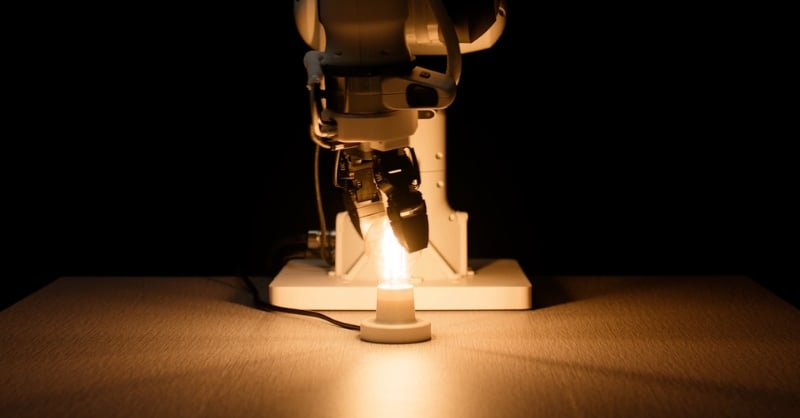
Eka reports that its robot picks up a wide variety of unfamiliar objects at 1,500 operations per hour, roughly two and a half times the human baseline of about 600. The same robot can screw in a light bulb and insert wires.
The founders met as graduate students at the University of California, Berkeley. Agrawal is an associate professor at MIT who also co-founded SafelyYou, a computer vision company that aims to reduce falls among people with dementia.
Haarnoja worked at Google DeepMind on training small humanoid robots to play soccer with reinforcement learning, and co-created the Soft Actor-Critic algorithm. Eka says its team also draws on MIT, Berkeley, DeepMind, Boston Dynamics, Microsoft, Carnegie Mellon, the University of Pennsylvania, Northeastern, and Oxford.
What the investors say
“Eka’s Vision-Force-Action model is the first approach I’ve seen that truly solves manipulation with the generality and throughput needed for deployments. This team has the ideal DNA to push the frontier of robotics research while scaling commercial operations. We are absolutely thrilled to support Pulkit, Tuomas, and the exceptional team at Eka,” said Raghu Raghuram, general partner at a16z.
“Robots need to develop intuition for interacting with the physical world, and that requires a fundamentally different approach. That insight drives Eka’s focus on building robots that are useful, reliable, and safe,” stated Habib Haddad, founding managing partner at E14 Fund.
“From the time I’ve spent with Pulkit and Tuomas, and the numerous references we’ve conducted, it is clear they are among the best roboticists in the world and are uniquely suited to solve this. I could not be more excited to be on this journey with them,” added Kahini Shah, partner at Obvious Ventures.
“Eka’s VFA model, trained through simulation and reinforcement learning, achieves this for the hardest problem in robotics, dexterous manipulation, in a way no other company has. I truly believe Eka’s approach is the only one that will hold up in real-world deployments of complex tasks,” noted Shyam Kamadolli, managing director at Fine Structure Ventures.
The test is a factory floor
Investors are paying less for Eka than for its rivals. Physical Intelligence, which TFN reported in March was in talks to raise about $1 billion at a valuation above $11 billion, is reportedly valued at $11 billion. Generalistraised nearly $200 million in August at a reported $3 billion valuation. Skild AI raised $1.4 billion in January at a valuation above $14 billion. At $1.45 billion, Eka is priced at about 13% of Physical Intelligence’s reported value and roughly half of Generalist’s.
Closer to Eka’s size, Barcelona’s THEKER raised an $85 million Series A in June led by CRV, with Samsung and LVMH joining. Eka’s round is about 1.8 times larger. Also on October 20, ex-Nvidia researchers’ Dream Labs raised a $90 million seed.
The demand side is real. The International Federation of Robotics reported that factories installed 603,000 industrial robots in 2025, up 11%, lifting the global operating stock past 5 million. Money is following. Crunchbase counted $47.4 billion of physical AI venture funding across 521 deals in the first half of 2026, almost four times the second half of 2025, though its definition also covers autonomous vehicles, aerospace, and drones. Humanoid startups alone have raised $8.6 billion in 2026, TFN’s ranking found.
The next proof point is a named customer running Eka’s robots on a production line for months, not minutes. Can a robot that wins on speed in a lab keep winning on uptime in a factory?



