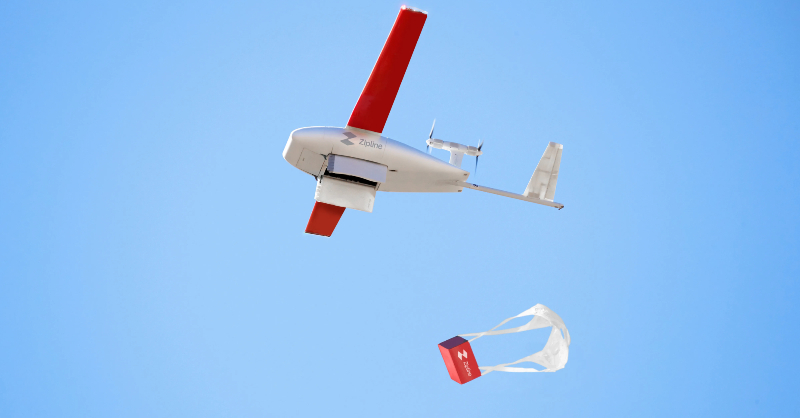
- Zipline is in early talks to raise $1B at a $20B valuation, Bloomberg reports.
- That would nearly triple the $7.6B valuation it hit after January’s Series H.
- Paradigm, a Zipline backer since March, is reportedly negotiating to lead the round.
Zipline is negotiating a new funding round of roughly $1 billion at a valuation of about $20 billion, Bloomberg reported, citing people familiar with the talks. Paradigm, an existing investor, is in discussions to lead the round, and Tiger Global is weighing whether to join again.
If it closes at that price, the round would value the South San Francisco, California-based drone delivery company at nearly three times the $7.6 billion it was worth after a Series H round that closed in January. The talks are still early, and both the amount and the valuation could move before anything is signed.
From medical drones to everyday deliveries
Founded in 2014 by Keller Rinaudo Cliffton, Keenan Wyrobek, Ryan Oksenhorn, and Will Hetzler, Zipline started as a medical logistics company, flying blood and vaccines to rural clinics in Rwanda. It has since expanded into food, retail, and other consumer deliveries, moving from a single-purpose healthcare network toward a broader autonomous delivery platform.
That expansion has come in increasingly large rounds. In January, Zipline raised more than $600 million at a $7.6 billion valuation, with Fidelity Management & Research, Baillie Gifford, Valor Equity Partners, and Tiger Global participating. Two months later, the company added another $200 million, bringing that Series H to $800 million, with Paradigm joining for the first time.
The firm closed a $1.2 billion fourth fund in July and has kept building its position in Zipline since, which makes it leading this round less of a surprise than the price tag.
Since then, momentum has kept building. In August, Zipline and Uber announced a strategic partnership to bring drone delivery to Uber Eats, with Uber making an undisclosed investment in the company and both setting a joint target of one million drone deliveries a day by the end of 2029.
First deliveries are expected before the end of 2026 in markets where Zipline already operates, before expanding to dozens more US cities.
Zipline builds its own delivery network
Unlike companies that only supply aircraft, Zipline runs an integrated system covering drones, launch infrastructure, and logistics software. Its Platform 2 drones handle shorter-distance, on-demand deliveries, while the longer-range Platform 1 serves enterprise and government customers.
Zipline said earlier this year it had crossed two million commercial deliveries, and it has expanded its consumer offering in the US through partnerships including Walmart.
The economics here depend on more than the aircraft. Delivery density, regulatory approval, launch infrastructure, and utilisation all determine whether a network actually makes money once the novelty wears off, which is a large part of what a $20 billion price tag would be betting is solved.
A crowded sky
Zipline isn’t alone up there. Matternet, which became a publicly reporting company through a reverse merger in May, raised $33 million in a private placement and continues to expand its enterprise network with partners including UPS and Ameriflight. Wing has scaled commercial drone delivery with major retail partners, and Amazon is expanding its own Prime Air operations in the US.
Reuters reported in July that Walmart, Amazon, Wing, and Zipline were among the companies racing to build networks dense enough to make the unit economics work as beyond-visual-line-of-sight rules loosen.
Zipline has raised close to $1.8 billion since 2014, according to Sacra; a $1 billion round at a $20 billion valuation would push that past $2.7 billion. The company says it has already flown more autonomous miles and completed more deliveries than every other drone company combined.
Whether that lead is worth two and a half times what investors paid for it eight months ago is what this round will have to prove.