


- Zipline has raised $1.5 billion at a $21.5 billion valuation, nearly three times its January valuation.
- Walmart plans 300 new Zipline drone sites, while Uber targets one million deliveries a day by 2029.
- Zipline is planning to invest in US manufacturing and hiring as it expands its nationwide drone delivery network.
In January 2014, Keller Rinaudo Cliffton‘s team shut down Romotive, the company behind the iPhone robot Romo. Cliffton, who is a Harvard grad, then pivoted the company to drones and started Zipline.
The US-based startup just raised $1.5 billion at a $21.5 billion post-money valuation, led by Paradigm, WCM Investment Management, and Layer Global. Other investors in the round included Valor Equity Partners, Fidelity Management & Research Company, Uber, Tiger Global, J.P. Morgan, ARK Invest and Salesforce Ventures.
The new valuation is about 2.8x Zipline’s $7.6 billion valuation in January and more than 5x the $4.2 billion figure Tech Funding News reported in May 2023.
Zipline is planning to invest in US manufacturing and hiring as it expands its nationwide drone delivery network. In January, it raised over $600 million, and in March it increased that by $200 million as part of Series H.
Investors behind the $1.5 billion round
The three lead investors are all relatively new to logistics. Paradigm, a San Francisco-based firm that has made early investments in Uniswap and Flashbots, joined the March extension to Zipline with no prior experience in logistics, according to Dealroom.
Matt Huang, co-founder and managing partner at Paradigm, said, “Zipline is now one of the largest autonomous robotics companies in the world, operating with scale, safety, and a magical user experience for consumers and merchants. It’s no wonder that some of the largest merchants in the world are partnering with Zipline to use their delivery network.”
WCM is a growth equity firm based in Laguna Beach, CA, which was founded in 1976. Layer Global, founded in February 2026 by Anton Levy, former co-CEO of General Atlantic, is less than a year old.
Alan Tu, portfolio manager at WCM Investment Management, noted, “Zipline has built a team and culture that has been developing cutting-edge drone delivery capabilities for over 10 years, and the market is now recognizing how transformational its technology is. Within e-commerce and food delivery, Zipline represents a generational improvement in user experience and delight.”
Anton Levy, founder & managing partner at Layer Global, added, “Zipline has already brought the future of delivery to the communities it serves. Now, the opportunity is to reach millions more. With partners like Uber and Walmart and a repeatable model for entering new markets, Zipline is well positioned to make drone delivery a mainstream part of everyday life.”
Zipline’s offerings and disclosed metrics
Rinaudo Cliffton co-founded the company in 2014 with Keenan Wyrobek, a robotics engineer who had worked on the Robot Operating System, Ryan Oksenhorn, and Will Hetzle in South San Francisco.
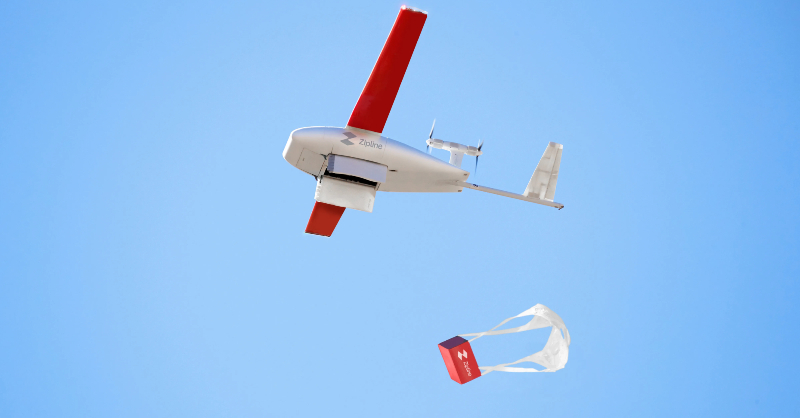
Zipline is based in South San Francisco and was founded in Half Moon Bay in 2014. They design their own aircraft, launch and landing systems, and logistics software. The Platform 2 drone can hover up to 300 feet and deliver via tether, capable of carrying up to 8lbs over a 10-mile range.
Walmart and Zipline are evaluating 300 more sites under a multi-year national agreement. As of May, 66 Walmart drone stores were operating using Zipline and Alphabet’s Wing. Meanwhile, Uber wants to get to one million Zipline deliveries a day by 2029 via Uber Eats, starting in cities like Dallas and Houston.
Zipline says hundreds of businesses generate revenue through the network, and dozens of new businesses join every week. For its most established restaurant partners, Zipline’s share of delivery revenue rose from 10.8% in March to 34.9% in October. Delivery gross merchandise value has increased 26%, with 80% of that growth attributable to new Zipline orders. DroneXL notes that Zipline selected this group but doesn’t state how many restaurants were in it.
The company states its drones have logged 150 million commercial autonomous miles with zero safety incidents. Zipline also claims its medical deliveries save over 14,000 lives per year and that it is building a network in Côte d’Ivoire that will serve over 2,200 health facilities and 12 million people.
Pending regulatory changes
Zipline is now operating under Part 135 authorisations. The proposed Part 108 rule from the FAA would allow drones to fly beyond the visual line of sight as a routine operation, replacing the current waiver process.
Europe’s best-funded competitor is smaller than Zipline. Manna raised a $50 million Series B in 2026, while Flytrex, the Israeli startup, was already operating for Walmart by then.
Mordor Intelligence forecasts the delivery drone market to grow from $1.08 billion in 2025 to $4.40 billion by 2030. Zipline’s valuation is nearly five times that of the projected 2030 market size.
TFN’s European drone coverage has focused heavily on defence and cargo, with Quantum Systems’ $1.2 billion round at an $8 billion valuation in July and Dronamics’ planned Nasdaq listing at a $400 million pre-money valuation. Zipline is valued at around 2.7x Quantum Systems. That follows Fal’s $1.3 billion Series F at a $16 billion valuation on 4th November, and robotics and embodied AI were the big story in June’s funding.
Zipline says it can get an order out to a customer 19 minutes after checkout. The big question is whether the 300 Walmart sites, Uber’s one million-per-day target, and expanded manufacturing can all go ahead on a timetable that’s still very much in doubt, given the FAA and local authorities.



