


- Paris-based Upstream has raised a $3 million pre-seed round backed by Y Combinator, Connect Ventures, and more than 30 founders and operators behind companies including Framer, Algolia, Asana, Alan, and Webflow.
- The startup is launching publicly after months in invite-only beta with an inbox designed for both humans and AI agents.
- Founded in 2023 by former Algolia and Doctrine executives, Upstream is betting that AI should not simply assist email users.
Email has survived every wave of workplace technology, from instant messaging to collaboration platforms to AI assistants. Yet the way people manage their inboxes has barely changed. Upstream was built by two founders who find that contradiction impossible to ignore.
The Paris-based company has emerged from stealth with a $3 million pre-seed round and the public launch of what it describes as the first inbox built for humans and AI agents simultaneously. The round was backed by Y Combinator, Connect Ventures, and more than 30 founders and operators, including leaders behind Framer, Algolia, Asana, Alan, and Webflow.
Built by executives who scaled global software companies
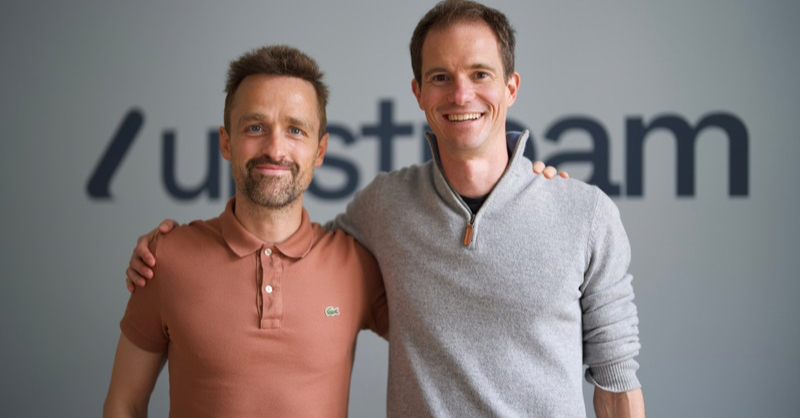
Upstream was founded in 2023 by Louis Lecat and Jonathan Tiret, a team of seven based at Station F in Paris.
Lecat previously served as Head of Product at Algolia, where he built and led the product function and helped scale ARR to more than $100M. Before that, he worked on the product team at Asana during its high-growth years and was among the first ten employees at AgilOne, which was later acquired by Acquia. Tiret brings deep engineering experience, having served as VP of Engineering at legal technology company Doctrine before it was acquired, and is the creator of Dino Gaïa, one of the most popular consumer games in France in the 2000s.
Together, the founders identified a gap between how AI agents are beginning to operate in the workplace and the inbox infrastructure that still exists to support them.
“The future of work isn’t one person and one assistant. It’s teams of people and teams of agents working together: you delegate to an agent, it comes back to you, and it does that across a whole team. People assume this will happen in a chat window, but that’s not where people live. They live in their inbox. Email was never built for that. Upstream is,” says Louis Lecat.
Why traditional email wasn’t built for AI
Email remains the default communication layer for billions of users worldwide, but it was designed for humans operating alone. As AI agents increasingly schedule meetings, draft responses, search information, and manage workflows, existing inboxes struggle to support this new way of working.
Upstream’s inbox allows AI agents to actively manage email by sorting messages, drafting responses in a user’s writing style, scheduling meetings, retrieving information, and following up automatically. The platform draws context from calendars, meeting notes, and knowledge bases, and allows users to connect external AI systems through protocols such as MCP. Thousands of users have already tested the platform during its invite-only beta.
The competitive landscape
Upstream enters a market being reshaped quickly by both acquisitions and new entrants. Superhuman, long the most recognised premium email challenger, was acquired by Grammarly in July 2025 — but remains a direct and well-resourced competitor. In October 2025, Grammarly rebranded its entire parent company as Superhuman, with Superhuman Mail continuing to operate as an active standalone product within a broader AI productivity suite that now includes Grammarly’s writing tools, Coda’s workspace, and a new AI assistant called Superhuman Go. If anything, the acquisition has made Superhuman more formidable, not less.
Shortwave, founded by former Google engineers, has raised $9 million in 2020 and, without raising publicly since, built an AI-powered email experience centred on automation and intelligent workflows — reaching $1.9M in annual revenue and 17 employees as of mid-2025. Fyxer AI is attracting investor interest by building AI executive assistants that automate email management and meeting scheduling.
What’s next for Upstream?
The battle for the future of email is becoming increasingly tied to which platform can serve both humans and AI agents without forcing a choice between them. For Upstream, the question is whether the next generation of knowledge workers will accept a fundamentally different inbox or simply wait for Gmail to catch up.


