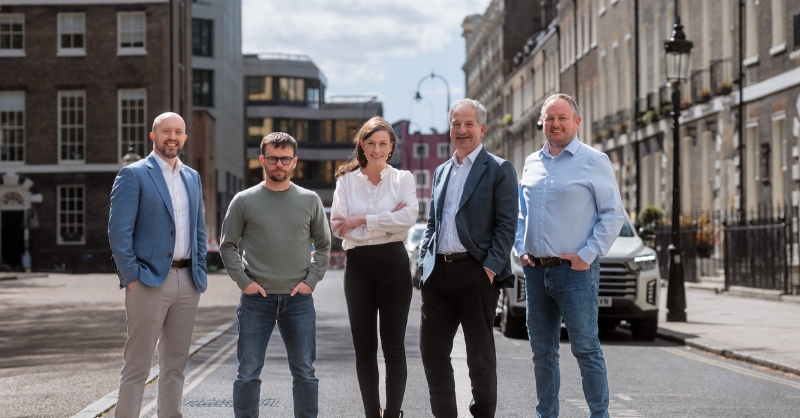
- Oxford Quantum Circuits has closed a £260M Series C, Europe’s largest-ever private quantum funding round led by Bullhound Capital, with the British Business Bank, Chevron, and JPMorgan acting as placement agent among participants.
- The raise comes as quantum computing crosses from research project to deployed infrastructure, with OQC’s systems already running in commercial data centres across the UK, US, Japan, and Spain.
- Combined with Quantinuum’s $10B valuation and its subsequent Nasdaq IPO filing, Pasqal’s $2B SPAC listing, and PsiQuantum’s $2.1B total raise, this round signals that the global quantum arms race has entered its capital-intensive final lap.
For the past three years, every boardroom conversation has been about AI. Every fund deck has had an AI slide. Every headline has belonged to a foundation model company. Quietly, in labs and data centres from Oxford to Tokyo, a different race has been running and now, Britain fired its loudest shot yet.
Oxford Quantum Circuits (OQC), founded in 2017 by quantum physicist Dr Peter Leek as a spinout from the University of Oxford, has raised £260M in a Series C led by Bullhound Capital — Europe’s largest-ever private funding round for a quantum computing company.
The oversubscribed round included the British Business Bank, Fynveur, COFIDES, Alpha Edison, Fulcrum Asset Management, Pentland Ventures, Magdalen College Oxford, Adaptive Capital Partners, Firgun Ventures, 18 West, and Oxford Capital. Existing backers Oxford Science Enterprises, SBI, Chevron Technology Ventures, The University of Tokyo Edge Capital Partners, and OTIF Ventures also participated. JPMorgan acted as exclusive placement agent.
Total funding now stands at approximately £430M across three rounds — following a £38M Series A in 2022 and a $100M Series B in 2023, both led by Index Ventures and SBI respectively.
What OQC actually does and why it’s different
OQC builds superconducting quantum computers using its proprietary Coaxmon architecture — a patented 3D qubit design that places components on opposite sides of a substrate, simplifying wiring and improving coherence compared to conventional 2D approaches. The result is a system engineered for deployment directly into commercial data centres alongside classical and AI computing infrastructure, rather than requiring specialised research facilities.
While most quantum competitors are still selling cloud access to remote lab systems, OQC has deployed operational quantum computers inside commercial data centres in the UK, US, Japan, and Spain, including New York City’s first quantum computer, housed in a Digital Realty facility in Chelsea alongside an Nvidia Grace Hopper Superchip. Its customers span financial services, defence, security, and scientific research. Dr Peter Leek serves as Founder and Chief Scientific Officer; Gerald Mullally as CEO.
“This is a coming-of-age moment for British quantum computing,” said Gerald Mullally, CEO of OQC. “Globally, it represents a clear shift in the market from long-term promise to near-term delivery in quantum computing. For OQC, this gives us the capital to scale internationally, advance our technology roadmap, and meet increasing demand from customers seeking secure, scalable access to quantum computing infrastructure.”
Dr Peter Leek, Founder and Chief Scientific Officer of OQC, added, “OQC was founded to use innovative quantum circuit designs to build engineered systems that scale as simply as possible. This investment supports the next stage of our work: advancing system performance and reliability while continuing to integrate quantum computers into the trusted infrastructure customers depend on.”
Why this round is bigger than it looks
The Rachel Reeves quote in the press release is not standard political boilerplate. A Chancellor of the Exchequer showing up in a startup funding announcement and committing £2B in government capital to UK quantum companies is a signal of strategic intent. Britain is making an explicit bet that quantum computing is not just a science project, it is infrastructure, and it intends to own a piece of it before the US and China lock up the market.
That bet is well-timed. As TFN has reported, Quantinuum raised $600M at a $10B valuation in September 2025 and has since filed for a Nasdaq IPO targeting a valuation of up to $20B. Pasqal is heading for a $2B SPAC listing on Nasdaq in the second half of 2026. PsiQuantum has raised over $2.1B total. IQM raised €275M to anchor Finland’s quantum ambitions. And on the same day as OQC’s announcement, TFN reported that French startup Quobly raised €115M to commercialise silicon-based quantum processors. The pace of capital deployment is accelerating precisely because the window for establishing infrastructure positions is narrowing.
Nigel Higgins, Chair of Barclays and OQC Board Member, said: “OQC has the technology, team and customer focus needed to build a leading global quantum platform. This funding gives the company the resources to scale internationally at a time when quantum computing is becoming increasingly important to enterprise and critical infrastructure.”
The competitive landscape
OQC uses superconducting qubits, the same fundamental approach as IBM and Google but differentiates on its Coaxmon 3D architecture and its data-centre-native deployment model. Quantinuum, the world’s highest-valued private quantum company, uses trapped-ion qubits and is backed by Honeywell. Pasqal uses neutral-atom technology and is targeting a Nasdaq listing at a $2B valuation. PsiQuantum uses photonic qubits built on semiconductor manufacturing processes. Each approach carries different trade-offs in coherence time, error rates, and scalability and no consensus has emerged yet on which architecture will win at commercial scale.
Per Roman, Founder and Managing Partner of Bullhound Capital, said: “OQC is building one of the most compelling quantum computing platforms globally, with the technology, infrastructure and customer focus required to scale. As quantum computing moves into global infrastructure, OQC is positioned to shape that transition.”
Jack Boyer, Chair of OQC, said: “This round marks an important step in OQC’s growth as a UK-founded quantum company scaling globally. OQC is building the infrastructure needed to bring quantum computing into trusted enterprise and government environments, and the quality of this investor group reflects confidence in the company’s strategy, technology and ability to scale.”
The unanswered question
Fault-tolerant quantum computing, the kind that consistently outperforms classical computers on commercially useful problems is still years away. The engineering challenges are immense, error rates remain high, and most current systems are best described as noisy intermediate-scale rather than commercially decisive. OQC and its peers are racing to establish infrastructure positions before that threshold is crossed, betting that whoever has the most deployed systems, the deepest data-centre integration, and the strongest enterprise relationships when fault tolerance arrives will be impossible to displace.
Britain just bet £260M and £2B in government backing that OQC will be one of those companies. Whether the fault-tolerant era arrives before a better-capitalised American or Chinese rival does is the question that will determine whether that bet pays off.