


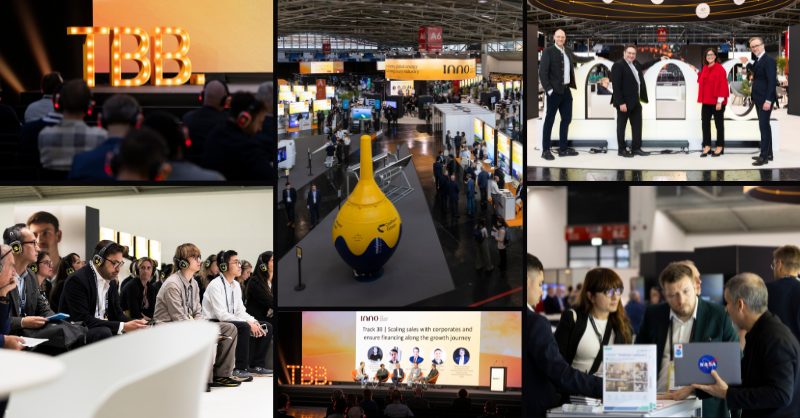
Attending The Business Booster (TBB) for the third time, Tech Funding News found that every founder pitched a vision of European independence from Chinese supply chains. But behind the main-stage optimism lay sharper questions: how much foreign technology remains embedded in these solutions, and who will cover the green premium to build an autonomous clean tech ecosystem?
Hosted by clean energy investor InnoEnergy at Messe München under the theme “From transition to competitive advantage: Europe’s new industrial era,” the two-day summit brought together policymakers, industrial heavyweights, and early-stage innovators.
Europe is paying a heavy price for its energy dependence, and the bill keeps growing. In September, EU energy commissioner Dan Jørgensen put it at more than €100 billion extra on energy imports in 2026. In an interview with TFN, Elena Bou, co-founder and acting co-CEO of InnoEnergy, highlighted that Europe still imports 57% of its energy from fossil fuels.
Independence stops one tier down
While startups presented localised bill-of-materials strategies, deep-tier dependencies surfaced quickly. Swedish sodium-ion battery maker Altris highlighted that 85% of its components originate in Europe, with the remainder sourced from Korea and Japan.
“So this is already 0% China chemistry,” CEO Christer Bergquist explained.
Yet for hardware developers scaling permanent magnet motors, rare-earth processing remains a critical bottleneck. Swedish marintech startup Zparq, which develops ultra-compact marine electric propulsion systems with direct seawater cooling for high power density, noted that while supply chain independence is a core focus, sourcing rare-earth magnets creates headwinds.
Elsewhere, Solar wafer manufacturer Sunwafe illustrates the pragmatic compromises made to achieve scale. Incubation from InnoEnergy in 2024 and a €200 million Spanish government grant backed Sunwafe’s new facility in Asturias.
However, CEO Michael Pinto revealed that a top-three Chinese equipment manufacturer will take a minority stake to supply specialised machinery and automation technology required to bridge European labour costs.
This dynamic underscores the tension facing European deeptech: flagship projects aimed at securing industrial sovereignty often rely on foreign capital, manufacturing tools, or processing know-how to remain cost-competitive against global benchmarks.
Without clear consensus on whether independence means local ownership, secure local supply chains, or proprietary IP, public subsidies risk supporting assembly facilities rather than true technological sovereignty.
Bridging the green premium gap
For energy-intensive industries, volatile input costs directly conflict with end-user pricing. Reflecting on the 2026 energy price crisis, Bou highlighted that energy spikes previously forced industrial operators to curtail production because end customers resisted paying a premium for green output.
Green steel producer GravitHy, which is advancing a €2.2 billion facility at Fos-sur-Mer to produce 2 million tonnes of low-carbon iron, faces similar commercial headwinds. Traditional direct reduced iron made with natural gas remains cheaper, leaving green alternatives reliant on strict carbon pricing mechanisms and the phase-out of free EU emissions allowances to achieve parity.
Scaling capital-intensive decarbonization plants continues to create execution hurdles across Europe. While project developers point to mega-raises such as Stegra‘s €1.4 billion round for its Boden plant, subsequent capital adjustments due to higher construction costs reflect the complex realities of building first-of-a-kind industrial plants.
Consequently, private fund managers remain cautious about regulatory dependency. Radia Capital explicitly avoids ventures reliant on heavy policy support or unproven green premiums, seeking economic viability under current market structures.
This divergence highlights a crucial investment gap: while public mandates push for rapid decarbonisation, growth capital increasingly filters for commercial resilience against shifting regulatory frameworks.
Addressing the Series C financing bottleneck
Venture allocations present a second major constraint. Bou noted that software and AI capture a dominant share of early-stage capital, with AI ventures securing over half of European funding in early 2026, leaving hardware and clean tech facing extended 18-month fundraising timelines for late-stage rounds.
Pointing to the Series C and scale-up funding gap in Europe compared to US vision-driven investing, she emphasised that public funding remains critical to bridge this bottleneck until institutional private capital fully steps in to support commercial scaling.
Furthermore, institutional fragmentation leaves a structural funding gap for commercial-scale deployment. While public grants and seed capital support early development, European growth funds face stringent matching requirements from institutional LPs before committing large-scale capital to Series C and FOAK deployment.
As a result, public backing from the European Investment Bank and EIC Accelerator remains central to scaling capital structures. As Bou notes, public venture mechanisms will continue playing an active role until institutional private capital fully steps in to back commercial scaling.
What lies ahead for European clean tech
Reflecting on our third consecutive year covering TBB, one truth stands out above the noise: building the future of energy is rarely simple, but Europe’s pioneering spirit remains unbroken.
“We cannot afford pessimism,” Bou reminded attendees in her closing message, urging investors and industry leaders to stay fiercely optimistic and rally behind the tough tech that true transformation demands.
As TBB 2026 came to a close, the path forward became clear: by backing high-impact technologies through the scale-up gap, Europe can turn its technological excellence into long-term industrial leadership, turning ambition into an unstoppable force for global change.
Disclosure: TFN’s coverage of The Business Booster was supported by InnoEnergy. Editorial coverage remains independently produced by TFN.



