


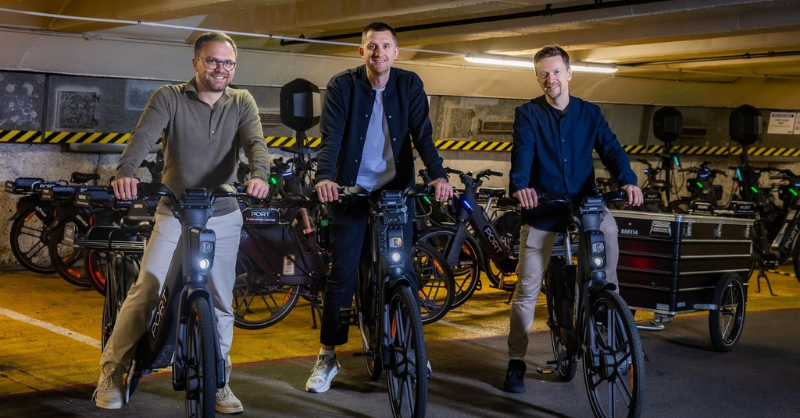
- PORT have raised €14.5M in equity and debt, with EBRD and Balnord leading the funding.
- The first delivery robot is due to go live in the coming months, starting with parcel deliveries.
- The funding will go on new technology development, with the remainder going to the core rental business.
Each PORT courier shift is now training future autonomous vehicles. Part of the UK e-bike rental network’s 3500 vehicle fleet has been equipped with NVIDIA cameras and lidar to capture data on kerbs, cyclists and drop-off points.
PORT has raised €14.5M to support the development of these vehicles.
The funding, a mix of equity and debt, is led by the EBRD and Balnord, with support from existing and new investors. Founder and CEO Kamil Suda told Tech Funding News that the first robot should be out in the next few months, with parcel logistics being the initial application. The company has not revealed the robot’s design.
The UK startup is in a very niche but fast-growing market. Mordor Intelligence estimates the autonomous delivery robot market at $1.33 billion in 2026 and $3.27 billion by 2031.
Why a robotics company started with e-bikes
PORT launched in 2020 with Suda, Matas Simonavicius as CTO and Dmitri Liberman as COO. It was built for the rise of B2B micro mobility, where couriers rent fully charged e-bikes from a central hub rather than own or maintain them.
Suda says the aim was to rework urban logistics to make it more efficient, safer and sustainable.
“We don’t think you can fundamentally rewire urban logistics if you don’t rework the underlying infrastructure,” he tells TFN.
That’s why the micro-hub network has been the heart of the business from the outset, and PORT has been building that out across the UK since 2024. He started with e-bikes, as the industry has lacked a dedicated offering to meet food delivery couriers’ needs.
PORT operate 24 hubs across London, Manchester and Birmingham, utilising underground car parks, warehouse space and railway arches to access 52,000 sq ft of underused urban space. Over 50,000 riders have joined, and the fleet has clocked over 50 million kilometers since 2024. Since introducing trailers in September 2025, the PORT cargo bikes have delivered over 300,000 parcels. Each delivery is approximately 90% less carbon than a diesel van.
“We believe robotised logistics doesn’t start with the robot. It starts with the infrastructure, operations, and data you need to get robotics working in the real world. We’ve spent years building that foundation. Now with this investment we’re focused on the physical AI and robotics that will run on top of it,” added Suda.
PORT has competition on both legs of its strategy. Whizz offers e-bike subscriptions to last-mile drivers and raised a $12 million Series A led by Leta Capital. Meanwhile, Coco Robotics has secured $80 million to grow its autonomous delivery fleet. PORT aims to control both the rental network and the robotics.
How courier shifts become robot training data
Since bikes already make daily deliveries, each newly equipped bike immediately starts collecting data, so PORT can grow its dataset without running a separate test fleet.
The company then reviews the footage to find training scenarios, from everyday kerbs and cyclists to rare edge cases, and uses it to train the AI Driver for urban delivery. When the bike gets back to the hub, it uploads its data automatically via the hub’s fibre connection.
Filming public streets raises an obvious privacy issue. “Faces and registration plates are all blurred in at the edge (i.e. on the device) before the data even gets into our system,” he tells TFN.
EBRD’s head of venture capital investments, Ervin Luga, added,“PORT’s impressive, proven commercial operation provides the ideal foundation for the next evolution of autonomous, robotic urban infrastructure. The environmental and economic advantages of driverless delivery are well established, but the missing real-world data layer has, so far, been a prohibitive limitation. PORT is actively building that data and already has the infrastructure in place to be able to make better use of it than anyone.”
Investors are pursuing the same playbook in physical AI. In March 2026, Physical Intelligence reportedly went to market for $1 billion at an $11 billion valuation. PORT is different because it will draw its data from the streets it already serves daily.
The hubs are critical for the logistics. PORT says its robots need to be stored, loaded, and charged within a few miles of the delivery point. In London, the network covers 92% of the area within one mile of the Congestion Charge Zone and 60% within two miles of the zone in inner London. A micro-hub in central Paris is due to open in 2026, the first outside the UK.
Why the robot may not be the prize
Suda is very clear on the robots. He says several companies are working on urban delivery robotics and that the hardware and, to a degree, the autonomous software will become commoditised over the next few years.
This approach has its pros and cons. If the robots are all the same, then PORT’s advantage will be in the quality of its hubs and data. Suda is all about distribution, saying, “We believe distribution wins.”
The first test is coming up. PORT are launching a new robotic delivery system with Royal Mail. When asked about the robot’s look, Suda pointed to the Royal Mail quote as a clue as to the first market they’re targeting.
Jack Clarkson, Royal Mail’s MD of out of home, said, “We are always looking for solutions and partners to help elevate our customer proposition, reduce our costs and reach our sustainability goals. The PORT team are providing us with access to frontier technology and expertise that can help us unlock the next evolution of urban logistics. We want to be at the forefront of this last-mile innovation, and look forward to continuing and deepening our partnership.”
The funding will go on new technology development, with the remainder going to the core rental business. PORT has previously raised €14.5 million in pre-seed and seed funding, bringing total funding to €29 million. The 76-person team is split across R&D, product, operations, and field.
The main question is which asset the market will value most. If Suda is right and robots become commodities, PORT’s value will depend on its hubs and data, and whether competitors can copy them.



