


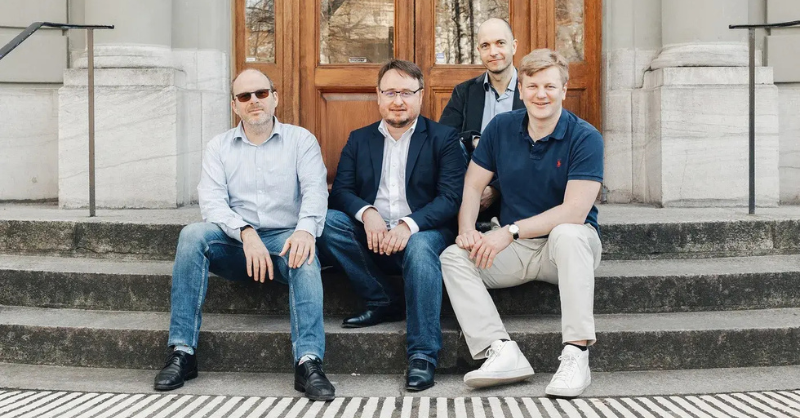
- Light Frame raised $5.1 million in a seed round, led by Fortino Ventures, following an oversubscribed round.
- The CEO said the previous bank’s core banking system provided only “about half” of what was required.
- The startup has just over 10 people, works with unnamed clients, and uses AI to generate proposals that humans then approve.
When Schuyler Weiss was setting up Swiss digital bank Alpian, he had to run it on a legacy core banking system because no modern alternative existed for wealth at the time. “It was expensive, slow to change or implement, and we got about half of what we asked for,” Weiss tells Tech Funding News.
Now he’s offering the software he couldn’t get before. Light Frame raised $5.1 million in a seed round led by Fortino Ventures. Other investors are Sidekick Partners, Tenity, Chameleon and Altair Capital. The existing investors Rogue Venture Partners, New Stack Ventures and Studio Alpha were also on board
That brings total disclosed funding to $6.8 million, including the $1.7 million pre-seed round raised in May 2024.
“Light Frame provides the fundamental technology that institutions need at the right level of sophistication. AI is absolutely going to change what technology can do, but the extent to which it can be realised in the Wealth industry is going to be dictated by the underlying infrastructure. That infrastructure has to be built for that future, without in any way compromising on security, resilience or trust which are the bedrock of banking,” said Weiss.
From running a Swiss bank to tackling its core technology
Weiss stepped down as Alpian’s CEO in September 2023, with the bank saying he was leaving to pursue public service in the US. He had started Light Frame by January 2024 with Mathieu Clément, former COO and CIO of Alpian, Philippe Kernevez, and Gregory Bataille.
Weiss told TFN that he’d grown Alpian from “just myself” to about 150 people, and that Intesa Sanpaolo eventually took it over. In May 2024, Alpian announced a CHF76m (approx. $84m) Series C round, with Fideuram becoming the majority shareholder.
According to Weiss, the market hasn’t changed at all over the last few decades. Modern core platforms exist, like Mambu and Thought Machine, but nothing in the wealth management space has been comparable in the last 30 years.
Weiss calls Light Frame the first to actually do it. The company has a partnership with Mambu, the Amsterdam cloud banking platform with 260 customers in 65 countries. They announced the partnership in June 2025, and it covers core banking services.
AI proposes, humans approve
Light Frame says its platform is cloud-native, API driven and AI-enabled. It’s a modular platform so banks can either plug in the bits they want or take the whole thing. The company says this reduces the time and cost of getting up and running. It describes the offering as a wealth layer that will interface with a partner’s core system.
Weiss gave TFN a very specific example. Most of the old systems work in a batch fashion at the end of the day, so the data you’re working with tomorrow is actually a day old. “If you’re running AI today, your AI is going to be running on yesterday’s data rather than today’s data. Light Frame’s system is entirely real time,” he says.
His second example is around corporate actions, i.e. takeovers, which will change client holdings. The bank will get a plain-text SWIFT message saying a company is being acquired, with cash, shares, and a vote.
“Previously that whole structure would have been done manually. Light Frame’s system reads the message and then suggests the appropriate booking,” Weiss explains.
A human still makes the final call. “AI is fundamentally probabilistic, so there’s a probability attached to its output. Wherever there’s a probability attached, we have a person coming in to validate at the end rather than the AI making those calls on its own,” Weiss adds, stressing that Light Frame has zero tolerance for security vulnerabilities and zero tolerance for inaccuracies.
The established players are also getting in. Temenos, the provider of Alpian’s system, completed its acquisition of the Swiss-based additiv on 17th July 2026. Wealth Briefing reports that additiv has circa 200 employees and 30 clients. Temenos reported $880.6 million in annual recurring revenue for Q2 2026.
Grand View Research forecasts the wealth management software market to reach $12.07 billion by 2030, growing 14% per year from 2025. Investors are clearly backing wealth management tools in many ways. TFN has reported on Finary’s €25 million Series B from Paris, Quartz’s £2.75 million pre-seed from Daphni and General Atlantic’s entry into the wealth management space.
Investors and allocation of funds
Weiss said the round was oversubscribed. “We originally had a target of $5 million. We ended up at $5.1m, though that was after we’d scaled back a bit,” he tells TFN.
Hugh Phelan, investment manager at Fortino Ventures, said, “Schuyler and the team have run a regulated Swiss bank on the kind of infrastructure they are now replacing. Few founders in wealth technology have lived the problem this closely, and fewer still have the technical depth to solve it. For a bank, moving sensitive data and live operations onto a new platform is an act of trust, and this team has earned the right to ask for it.”
Light Frame will continue to hire in sales and go-to-market roles and will invest more in security, resilience, and capability, with a focus on Europe, the Middle East, and Africa. The core team has over 10 people, with about 20 in the wider team.
The main focus is on private banks. Some clients buy single modules, while others use the full suite. This flexibility is both the model’s biggest strength and a challenge. Banks have been waiting for innovation, so Light Frame needs to show it can be trusted for live operations.



