


- Nvidia plans investments in four German startups and has not disclosed any amounts.
- The German government signed a Joint Declaration of Intent with Nvidia on physical AI.
- Only 47.2% of medium-sized German companies use AI, against 67.2% of large ones.
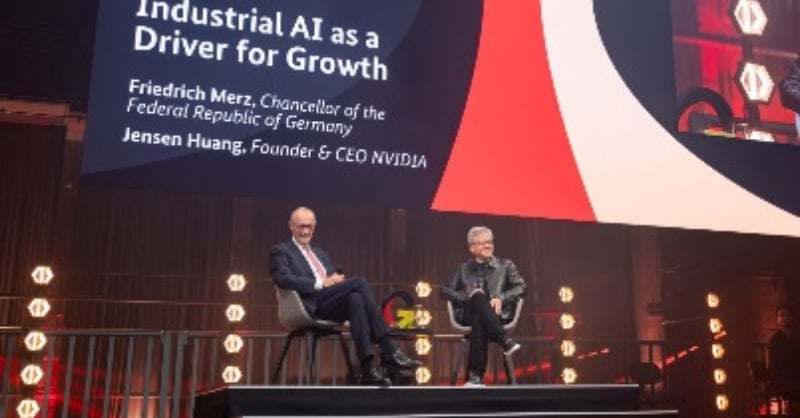
Nvidia has named four German startups for planned investments. The same day, Chancellor Friedrich Merz told Germany’s small and medium-sized companies to start putting AI to work.
Nvidia CEO Jensen Huang announced the plans in Berlin: Agile Robots, Avelios Medical, Mirelo, and Reflex Aerospace. They are part of Nvidia’s nearly $10 billion commitment to companies, universities, and research institutions across Europe, according to its blog post.
Earlier that day, Merz and two federal ministries, for Economic Affairs and Energy and for Research, Technology and Space, signed a Joint Declaration of Intent with Nvidia as part of the Invest in Germany Summit.
It sets out an agreement to work on a joint initiative on physical AI models, meaning AI that connects to real-world systems such as robots, vehicles, and industrial machinery. It also formalises Nvidia’s work with the government’s Industry 4.0 Platform, which brings together politics, industry, research, and trade associations.
Merz and Huang make the case for German industrial AI
Huang has worked with German industry since the early 2000s, starting with gaming systems, workstations, and automotive design, and moving on to autonomous vehicle development and digital twins for manufacturing. On stage at Kraftwerk, a former power station in Berlin, he said Germany’s manufacturing expertise sets its economy apart and that AI will only amplify it.
“We are fully committed to be one of the most advanced places in the world, not just in the European Union, but in the world to work with AI, to integrate AI into our industry,” Merz said. “I’m really optimistic that we will be one of the leading, if not the leading, country in the world in terms of the spread of AI for all the companies — our manufacturers, machinery, automotive industry and suppliers of the automotive industry. I think this is a great opportunity,” said German Chancellor Friedrich Merz.
Merz urged Germany’s small and medium-sized businesses, collectively known as the Mittelstand, to use their existing industrial data.
Robots, hospitals, sound, and satellites: what Nvidia picked
Agile Robots, in Munich, builds AI-powered robots, from robotic arms to its Agile ONE humanoid, for manufacturing, logistics, and healthcare. It spun out of the German Aerospace Center in 2018 and passed a $1 billion valuation in 2021 on a $220 million Series C led by SoftBank Vision Fund 2, Reuters reported.
Avelios Medical, also in Munich, makes an AI-native hospital information system that Nvidia describes as the core system of record for clinical and administrative workflows. It raised a €30 million Series A led by Sequoia Capital in February 2025, and the Sana hospital group and LMU Munich’s university hospital use its software.
Mirelo is the odd one out. Nvidia says the German startup builds AI models that generate sound effects, speech, and music to match video. Founded in 2023, it raised a $41 million seed round in December 2025 led by Index Ventures and Andreessen Horowitz, TechCrunch reported.
Reflex Aerospace, in Berlin, designs satellites that Nvidia says are ready for launch in about 12 months instead of years. It raised a €50 million Series A in November 2025 led by Human Element, with Alpine Space Ventures, Bayern Kapital, and High-Tech Gründerfonds also investing, and its first satellite reached orbit in January 2025. Defence spending gives it a market: Germany’s defence ministry announced about €35 billion for space-related defence projects through 2030.
Nvidia already backs n8n, Neura Robotics, and Black Forest Labs in Germany. Neura, based in Metzingen, announced a Series C of up to $1.4 billion in June 2026 with Nvidia among its investors
Can industrial AI reach the Mittelstand?
Germany brings the number of startups Nvidia has named across Europe in this round to 13: four in France on October 13, five in the UK on October 14, and four in Germany on October 19. Tech Funding News covered the French and UK announcements, and looked at all nine together.
Investors are already putting money into the same corner of the market. Barcelona’s THEKER raised an $85 million Series A in June 2026 led by CRV, with Samsung and LVMH taking part. Stockholm’s IPercept closed a $16.5 million Series A in September to bring physical AI to factory floors, co-led by Isogon Ventures and 2150. Brussels-based Motion raised a $2 million pre-seed round in August, led by Extantia Capital, to rent humanoid robots to factories by subscription. Ex-Nvidia researchers’ Dream Labs raised $90 million to give low-cost robots a shared AI brain.
TFN has also followed Europe’s push to take AI onto the factory floor and why physical AI founders must own the operation. The harder question is whether any of this reaches the companies Merz was addressing.



