Could you imagine plugging ChatGPT into a robot and setting it loose on a factory floor?
For Simone Di Somma, founder and chief executive of Milan-based Cyberwave, it’s a question that gets to the heart of why artificial intelligence (AI) is so much harder to build for the physical world.
Factories and warehouses run on processes that a general-purpose model knows nothing about, and in an environment where machines can break and people can get hurt, there’s little room for error.
“That’s why you need the infrastructure to connect AI with the real world,” Di Somma tells Tech Funding News on stage during the Wave by Vento conference in Turin, Italy, this week.
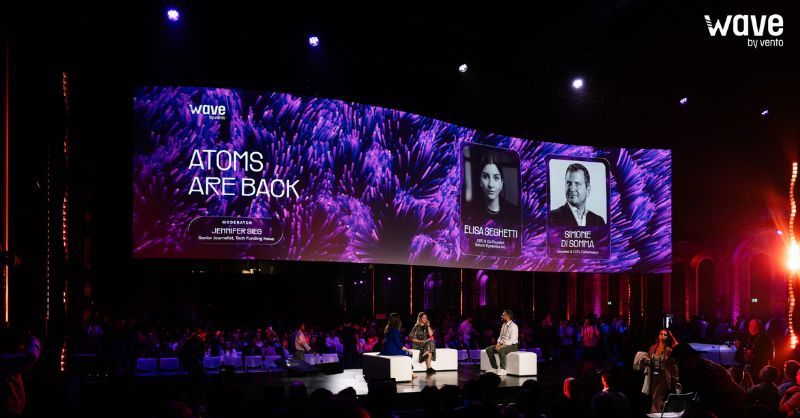
Alongside fellow Italian entrepreneur Elisa Seghetti, co-founder and CEO of London-based Saturn Dynamics, Di Somma was speaking on a panel titled “Atoms Are Back,” which explored what happens as AI moves off the screen and into the physical world. And, of course, what it takes to build that future from Europe.
For Di Somma, Europe’s advantage lies in the features that have long set it apart, and it starts on the factory floor.
Producing better
“People around the world are not buying our products for the volumes, for the price,” Di Somma says. Instead, he argues, it’s “for the heritage, for the quality, for the story that is around our product.”
It’s a pointed argument at a time in which China now accounts for more than a quarter of the world’s manufactured goods, with Europe’s share falling behind. But the problem, Di Somma suggests, comes down to trying to compete on cost.
“In the last 20 years in Europe, we have followed a way of producing things that was stuck to manufacturing efficiency – efficiency, efficiency, efficiency,” he says. “If we go down that path, we will lose to China.”
Instead, Di Somma sees demand shifting towards fewer products that are more valuable and more personalised, and points to Ferrari as an example. “It’s not producing more, but it’s producing better,” he says.
The catch is that most factories aren’t built to change quickly. “In order to produce better, you need new ways to reconfigure your factory in days, not in years,” Di Somma explains. “We need to make our production lines software-defined, AI-defined.”
That’s where Cyberwave comes in. The startup, which Di Somma co-founded in 2025 after selling his previous company, Askdata, to SAP, connects robots, sensors and industrial equipment from different manufacturers to a single platform.
Engineers can essentially test changes on a virtual copy of the machines first, then push them to the real hardware once they work.
Cyberwave raised €7 million in October 2025 in a round led by United Ventures, with participation from Vento.
The push for more value over volume is an idea that echoed across the conference.
Jony Ive, the British designer best known for his work at Apple, said on the stage earlier in the day that “it’s very hard to make something that is new and different, and its newness is a consequence of it being better.” He was discussing the Ferrari Luce he designed with the carmaker.
Much of what Cyberwave does depends on simulation. Di Somma says the company puts around 80% of its budget into it, because it lets teams test changes safely before anything touches a real machine. “Simulation is a game changer,” he adds.
A flight simulator for robots
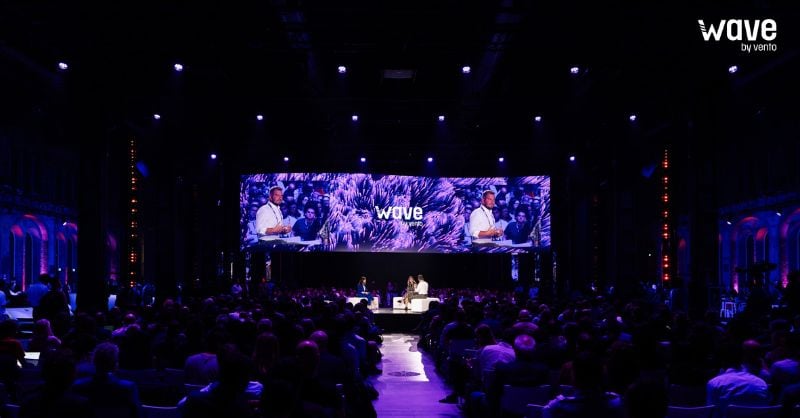
That is where Seghetti’s Saturn Dynamics comes in. Founded in 2025, the London-based startup builds a generative world model. It creates realistic, physics-aware environments where robots can learn and practise before they ever reach a real factory floor.
It has been described as a flight simulator, but for robots, and aims to tackle a gap that Seghetti has spotted in the field.
Large language models learned from trillions of words freely available online, but there is no equivalent internet of robot movements, so physical AI companies have to either collect real-world demonstrations or generate their own.
But building a foundation model from Europe comes with its own challenges, Seghetti explains, with US labs commanding far more capital and computing power.
The solution, similar to what Di Somma has described, isn’t trying to outspend them.
“Fundamentally, what we have done is we have changed the economics of the problem,” Seghetti says, adding that the team is “not trying to win across all domains from start.”
Saturn’s model, she explains, was built on an efficient architecture from the outset, which means every dollar the company raises can go further.
Simulation still has its limits, however. Seghetti says it works well for scaling up models but can still fall short on fine-grained precision, though the physics is catching up quickly. Two years ago, she says, world models could only simulate rigid objects. And now, they’re starting to handle soft ones too.
For the companies buying robots, simulation is also a way to keep up with a market moving at speed.
“Any robot is going to become 100 times faster and better in five years,” Seghetti says. “If you lock yourself into the existing vendor, you’re basically locking yourself into a company that in two years doesn’t look like it did.”
Where Europe still has an edge
Europe’s funding picture remains a sticking point. Around 70% of late-stage European deep-tech funding comes from non-European investors, according to Dealroom. But at Wave, the message from founders and investors was more about doubling down on where Europe already has as an edge.
“If you have a great project and you’re credible and persistent, you can get as much money here as almost anywhere,” Bending Spoons CEO Luca Ferrari said in a separate session. Vento’s Diyala D’Aveni made a similar case, arguing that Europe has already produced world-class talent and that the bigger gap is belief and ambition.
For Di Somma, that comes down to culture. Europe’s policy framework is “very risk-averse,” he says. “We should really think of the builders as the new heroes of this era.”
Starting has never been easier, he adds. “But then to finish products and projects is super difficult.” With its industrial heritage, its engineers and a new generation of founders building at the intersection of AI and the physical world, Europe may well have what it takes – if it’s willing to see it through.