


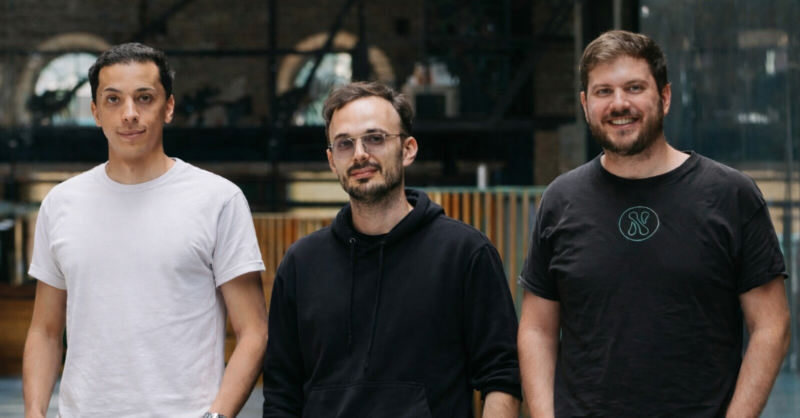
- Nebuly has raised $21 million in a Series A round, led by Planven, to help businesses determine how much its AI agents are actually worth.
- Contracts start at $100,000 a year. Nebuly are planning to grow its team from 40 to 60.
- The fresh funding will allow them to hire salespeople in New York, London, and Europe, and expand its platform
Uber has effectively blown its entire 2026 AI budget in just four months, Fortune reports.
Nebuly, which has offices in Turin and New York, says the key to making any AI investment work is for companies to have a very clear understanding of what they’re doing. The company has just raised $21 million in Series A funding led by Planven to that end.
Exor Ventures, Tenacity Capital, TGVG Capital, and Fastweb+Vodafone via Founders Factory all participated in the round, along with several returning investors and angels. CDP Venture Capital SGR also participated via its AI Fund and its Digital Transition Fund.
“Every enterprise is about to face the same question from its board: what is AI actually worth to us? Nebuly exists to answer it,” said Francesco Signorato, co-founder and CEO.
Why the question is urgent
A Gartner survey of 1,303 people from organisations with over $50 million in revenue found that 85% of leaders plan to spend more on AI in 2026. Only 22% have actually expanded AI across their business or taken an AI-first approach. 11% don’t know what they’ll spend on AI in 2025.
Tech Funding News has been tracking the gap between what’s being spent and what’s actually achieved since VCs put $49 billion into GenAI, and we’ve seen that for a number of companies, enterprise AI is still very much in the pilot stage.
AI agents often work for long periods on their own, and it’s very difficult to track their cost and value. Most of the big companies use agents from a number of different providers, so no one provider has the full picture.
“Companies are now making decisions about hiring and headcount based on assumptions about AI productivity rather than evidence. Decisions of that magnitude need to be based on real data,” added Signorato.
He points out that user and prompt tracking has led to “tokenmaxxing. According to Signorato, the industry should be focused on “value maxing” instead.
“The question of what impact this technology has on jobs is very much related to the question of its value,” he tells TFN.
How Nebuly counts a task
Signorato views a job as made up of a number of tasks, each with its own value and complexity. The value of AI is in the tasks that it automates and the new tasks that employees can then do as a result. He calls this the “task economy.”
For instance, a task which previously took three hours now takes just 15 minutes, freeing up two hours and 45 minutes for more valuable work.
Founded in 2022, the startup is looking at what AI agents do inside an organisation, both employee tools and customer-facing assistants. The platform is looking at whether staff use AI for key or routine tasks, which teams benefit most, and where training could add value.
For customer-facing assistants, it’s looking at the revenue they impact, churn risk, and upsell opportunities. All assumptions are clear and fully configurable. The platform works with any custom tools and assistants built on Claude, ChatGPT and Microsoft Copilot, and the models can be run on-premises or in a private cloud.
Signorato states Nebuly only works with large enterprises. Most clients have over $1 billion in revenue, and the smallest have well over $100 million. The client list includes companies across telecoms, automotive, manufacturing, luxury, health care, and tech — Oura, Iveco Group, Fastweb+Vodafone, CNH, Zeiss.
Contracts typically start at around $100,000 a year. No revenue figures were shared.
Founders, rivals and the hard question
Signorato was at MIT working in AI in 2019, the work at that time being predominantly in the area of computer vision. He then went on to lead an AI team at IBM. Post-COVID, he and two of his high school friends from northern Italy decided to start a company.
ChatGPT convinced Signorato that AI was a user-experience revolution. Nebuly started out with an analytics product for AI chat interfaces. His co-founder and CTO, Diego Fiori, co-founded the Swiss AI lab Giotto.ai, and the other co-founder and CRO, Julien Roux, was previously an investor at Exor.
Signorato says the nearest alternatives are observability companies, with Datadog being the prime example, which focus on helping developers observe how their models are behaving. Nebuly works on top of those. Datadog has its AI Agents Console, which can measure agent usage, impact and ROI. Braintrust raised $80 million in its Series B in February, and TFN reported that Crux Labs raised over $6 million to audit agents.
“Measuring AI’s return will become a standard part of running any large organisation, and Nebuly is building the way to do it,” added Giovanni Canetta Roeder, managing partner at Planven, a Zurich-based investor with over $300 million under management.
Nebuly now have 40 people and is looking at 60 in the next two months. They’re going to hire salespeople in New York, London, and Europe, and they’re going to expand its platform.
Building trust remains a key challenge. Nebuly’s models will be able to estimate how many hours of AI time they save, and finance folks will be looking for clear, transparent calculations. The next step is to determine whether simply showing all of the assumptions will be sufficient for auditors.



