


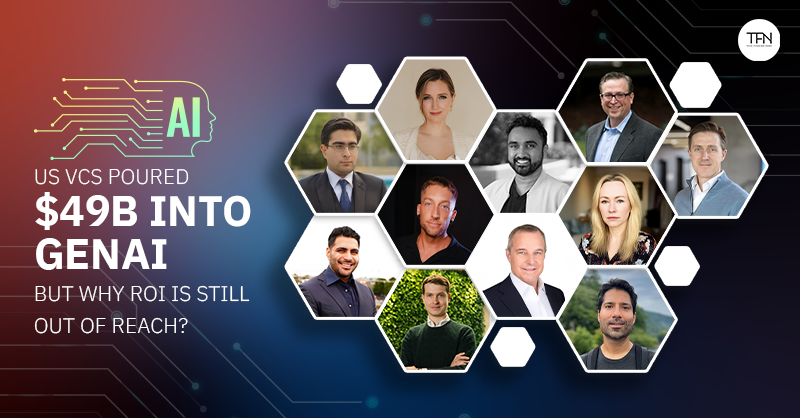
While Europe is redefining its investment landscape with GenAI, the U.S. story looks different. Silicon Valley, Boston, and New York are pouring funds into this space, with VC investment in U.S. tech startups hitting over $49 billion in H1 2025, surpassing all of 2024.
But despite the enthusiasm and capital, the returns aren’t quite matching the hype.
In a conversation with TFN, Shashank Sripada, COO and co-founder of Gaia, an open network for AI agents, shares, “I’ve seen GenAI hype inflate fast, but deployment ROI often lags. The gap is operational, not technical. Companies underestimate the cost of integration and the importance of alignment. It’s about tailoring it to your workflows and values.”
Rohit Patel, Director at Meta Superintelligence Labs, a new research and development initiative at Meta, adds, “With agents, people have high expectations. However, with the current maturity level of models, there is still a long way to go. For example, doing things about 80% or even 90% right usually means that a human has to supervise all the time, since 10% or even 1% in most cases is a lot of error. That’s sort of where the model training is going, but we are not quite there yet.”
Specialised solutions drive measurable results
To make real progress, companies need to stop chasing quick wins and rethink how work actually gets done. Marina Davidova, DVC co-founder and managing partner, explains, “AI only works as well as the process it’s embedded in… The real challenge is designing AI‑ready processes: rule‑based where possible, with a single source of truth, rich structured data history, and a tech stack that AI can actually plug into… Without those foundations, you don’t get compounding productivity.”
Charles Yeomans, CEO and co-founder of Atombeam, specialising in data compaction solutions, agrees, “The ‘coffee break problem’ is only half the productivity drain. Yes, freed-up time from GenAI often gets lost to non-productive activities, but with today’s stateless LLMs, teams also burn hours re-feeding context, re-explaining business needs, and fixing hallucinations. That’s productivity erosion layered on top of the coffee break.”
So, yes, there’s a clear shift from generic tools to specialised, sector-focused solutions. Steve Brotman, founder and managing partner at Alpha Partners, notes, “In 2025, we’re seeing a decisive shift in GenAI from broad capability to vertical precision. The early horizontal phase of GenAI (with tools like ChatGPT or Copilot) sparked mass experimentation, but now the market is prioritising depth over breadth. Buyers want solutions that integrate seamlessly into their industry-specific workflows, deliver ROI quickly, and minimise risk.”
Similarly, Elliott Parker, CEO at Alloy Partners, draws a parallel: “In the early days of films, people had a hard time imagining how to use the new technology. Movies looked like stage plays. It took years before creative individuals found ways to use the technology to produce new forms of entertainment. We are still in the “stage play” period of AI deployment. It will take a lot of experimentation before we collectively understand the new business models the technology enables. The only thing slowing us down is a lack of imagination and experimentation.”
Integration is still the big challenge
Integration remains the bottleneck. Seena Rejal, CCO at NetMind, an Enterprise AI provider, stresses, “Without an MCP, you could be spending time providing context to the LLM: explaining background and attaching relevant sources of information. With an MCP, you slash that time and get straight into asking your question and getting the job done. When you look at it this way, MCPs could provide a more straightforward route to unlocking the AI’s ROI through the productivity gains made.
Adam Tahir, CEO of Bizora AI, who has driven tax compliance and research assistance, underlines, “Success also hinges on defining ownership, assigning accountability for performance metrics to specific stakeholders and establishing feedback loops that continuously retrain models on real-world corrections.”
Real change requires more than new tools
Tailored solutions that integrate naturally into business routines and respect compliance demands are winning favour, according to Juan Montenegro, founder of WalletFinder.ai, a cutting-edge DeFi analytics tool.
Meanwhile, Yuriy Zaremba, CEO & co-founder at AiSDR, an AI platform that automates outbound and inbound sales, points out that senior leadership now demands proof that these efforts actually grow revenue, not just save time: “Boards stopped asking how many hours GenAI saved. Now they want to see if revenue actually grew.”
He adds that many initiatives fail because they automate isolated steps while the broader process remains unchanged.
Alina Braverman, founder and CTO at Celfie Lock, a digital image protection tool, concludes: “It seems like almost every startup is jumping on the hype train, treating this technology like a magic wand to solve all problems. But it’s not. People rush to develop tools without considering how they will actually be used. This trope has real risks: hallucinations, biases, environmental costs, and a surge in scams.
Gartner predicts over 40% of projects will fail; I believe the number is higher. The billions wasted on abandoned infrastructure are a huge risk. While the technology is valuable in areas like cancer detection and linguistics, I struggle to identify solid business cases with high ROI.”
With $49 billion invested in H1 2025, the opportunity is massive. But real winners will be those who embed these tools deeply, fundamentally redesign workflows, and hold every innovation to measurable business outcomes. Time saved must translate into impact on growth, efficiency, and customer satisfaction.
The future belongs to companies that treat emerging technology not as an experiment, but as a strategic business imperative.



