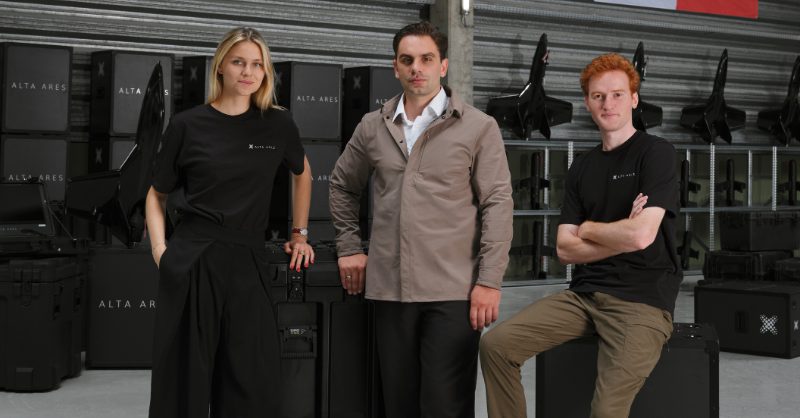
- Alta Ares raises €50M in a round led by Air Street Capital to scale its AI-powered air defence platform, with participation from Cherry Ventures, OTB Ventures, and Harpoon Ventures.
- Founded in 2024 and shaped by battlefield observations from Ukraine, the company already has deployments across Europe, the Middle East, and Asia.
- The funding will accelerate production, product development, and international expansion as demand for counter-drone systems surges across NATO and partner nations.
A few years ago, countries spent millions of euros to defend against sophisticated missiles and aircraft.
Today, militaries increasingly face swarms of low-cost autonomous drones capable of overwhelming traditional air defence systems at a fraction of that cost. That asymmetry, where attack is cheap and defence is expensive, is creating a generation of defence technology companies focused on one challenge: how to reverse it.
Alta Ares believes it has the answer. The French defence startup has raised €50 million in a funding round led by Air Street Capital, with participation from Cherry Ventures, OTB Ventures, and Harpoon Ventures, to scale its AI air defence platform.
Built from lessons learned on the battlefield
Founded in 2024 by Hadrien Canter, Stanislas Walch, Théo Bondarec, and Alain Henry, Alta Ares was built on firsthand observations of the conflict in Ukraine, where low-cost drones have repeatedly exposed the limitations of traditional air defence systems. The founding team’s argument is straightforward: modern warfare requires air defence that is as adaptable and scalable as the threats it is designed to stop.
Rather than focusing solely on hardware, Alta Ares combines interceptors, edge AI, data fusion software, detection systems, tracking capabilities, and terminal guidance into a single operational architecture.
Its platform currently includes two interceptor families: the X-Lock, designed to neutralise Shahed-136-style loitering munitions at shorter ranges, and the Black Bird, which targets faster and more sophisticated threats, including cruise missiles and guided glide bombs.
Both are engineered to operate across Arctic to desert conditions and are already deployed across three active conflict zones simultaneously.
The company’s progress has attracted attention from NATO, which recognised Alta Ares with an innovation award in March 2025.
Solving a growing air defence crisis
Recent conflicts across Eastern Europe and the Middle East have highlighted a structural gap in NATO’s air defence posture. Modern attacks increasingly combine missiles, drones, electronic warfare, and autonomous systems in coordinated assaults designed to overwhelm legacy infrastructure. Traditional air defence was not built for simultaneous drone swarms at scale. Alta Ares is betting that the answer requires automation, AI-driven decision-making, and modular systems that adapt in real time.
“We are entering the next phase of growth. Modern warfare is defined by speed, scale and continuous adaptation. Our goal is not just to build technology but to deliver a complete air defence capability,” says Canter.
The company’s progress has already attracted attention from NATO, which recognised Alta Ares with an innovation award in March 2025.
The competitive landscape
Alta Ares enters a crowded and well-capitalised market. Helsing, the Munich-based defence AI company, is reportedly closing a $1.2 billion round led by Dragoneer and Lightspeed, valuing it at $18 billion, making it Europe’s most valuable private defence technology company.
Stark, the Berlin-based autonomous drone maker, is seeking at least €300 million in fresh funding at a €2.5 billion valuation. In France specifically, Harmattan AI, backed by Dassault Aviation in a $200 million round at a $1.4 billion valuation in January 2026, is Alta Ares’s most direct domestic competitor, developing autonomous defence systems including AI-enabled strike and surveillance drones.
“Alta Ares represents a new generation of European defence companies capable of building sovereign, combat-proven systems powered by advanced AI,” notes Nathan Benaich, founder of Air Street Capital.
Unlike many defence startups focused on either software or hardware, Alta Ares integrates both into a single platform.
The question is whether a company of its current size can scale production fast enough to meet demand, and whether the combat deployments it cites translate into the durable government contracts that sustain a defence business at scale.