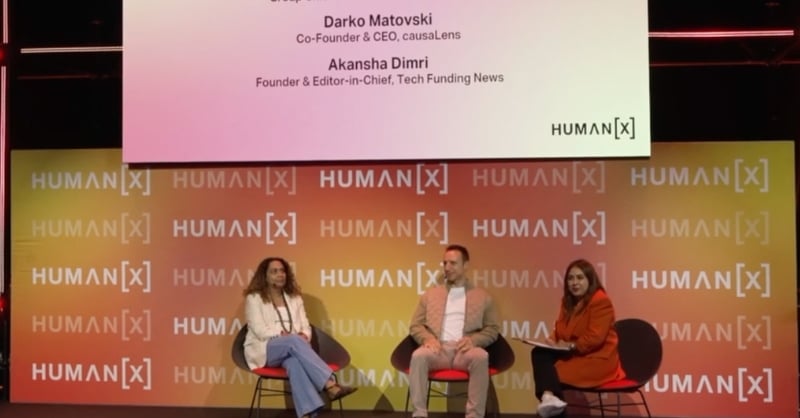
- Tech Funding News founder and editor-in-chief Akansha Dimri moderated a panel with Michelin’s Ambica Rajagopal and causaLens co-founder and CEO Darko Matovski, who said the biggest barrier to scaling enterprise AI is leadership, not technology.
- Later in the day, she judged the HumanX AI Startup Pitch Competition, where 6 early-stage startups, including LangWatch, 8wave and Avendar, pitched in the semi-final.
- From global manufacturers to startups that have raised under €10M, one challenge has come up again and again: moving AI from something impressive to something operational.
Europe’s AI companies are raising more than ever. European AI startups raised $23B in H1 2026, up 130% year on year, yet that was still only 7% of what US AI startups raised in the same period. Meanwhile, enterprise AI adoption is at record highs, but its return on investment remains largely unproven.
That gap between promise and payback shaped Tech Funding News’ day at HumanX Amsterdam, from a conversation with one of Europe’s largest industrial companies to a pitch competition for the startups hoping to build AI’s next layer.
Scaling AI inside a global enterprise
Akansha Dimri moderated a panel with Ambica Rajagopal, group chief data and AI officer at Michelin, and Darko Matovski, co-founder and CEO of London-based causaLens.
The session, “Digital workers: What it takes to scale enterprise AI”, brought together both sides of the market: a global manufacturer building its own AI, and a startup whose multi-agent systems automate complex enterprise workflows for customers including Johnson & Johnson and Cisco.
Michelin has more than 30,000 people using its internal generative AI platform. But Rajagopal believes that accounts for only about a fifth of what AI is worth to the company. The tooling matters, she said, because it builds trust and prepares people mentally for AI. The real return is elsewhere.
“The remaining 80% of the value from AI to an organisation actually comes from building custom models,” Rajagopal said.
Those custom models sit inside processes no other company has: predictive models in manufacturing, generative models for tyre design and models supporting Michelin’s complex forecasting operation. They are harder to build, but that is where most of the money is. Over three years, Rajagopal said, AI has returned more than $200M in value to the business, growing around 30% a year.
She was also clear that enterprise AI plays by different rules to consumer software. Releasing something with the error rate ChatGPT launched with would have been a disaster inside Michelin, she said, adding that her phone would not have stopped ringing. Anything IT ships to employees comes with an expectation of accuracy, reliability and a clear return.
Copilots versus digital workers
Matovski drew the distinction the session was named for. “Copilots make an individual more productive. Digital workers do the work,” he said.
A digital worker, he explained, removes the need for several teams and the point solutions between them, compressing work that would have taken weeks across an organisation. His case against stopping at copilots is economic in nature. An assistant might make someone 20% to 30% more productive, but token spend is unpredictable: a single prompt can cost anywhere from $100 to $10,000, so the return is hard to forecast and capped by what people do with the time they save.
The bigger prize, he said, comes from reimagining a process outright. Forecasting demand for each individual product, or SKU, can involve around 20 teams and a stack of software. Each person can be made slightly faster, but the work itself does not change until 1 digital worker can cut across all of it.
The real blocker is leadership
Asked what actually stops enterprises from scaling AI, Matovski gave a one-word answer: leadership. When causaLens is given a mandate to redesign a process, it succeeds, he said. When it is limited in what it can change, it does not. He has watched the conversation move up the organisation, from heads of data science to CIOs, then CFOs, and now to chief executives who say they rolled out everything their vendors recommended and still cannot see the impact.
Rajagopal faced her own version of that decision 2 years ago, when Michelin had to choose between buying the AI agents its software partners were offering and building agents around its own value chains. She chose to build. Buying off the shelf, she argued, meant paying per user forever for what would become a commodity, or “buying at the top of the commodity market.” Building cost more upfront, but gave Michelin something no one else has.
On how much autonomy to give AI, Matovski said the bar rises sharply once AI is doing the work rather than being checked by a human at every step. That demands new techniques for runtime reliability, and a serious answer on who owns the AI. Rajagopal, who holds a PhD, put it more simply: “At the end of the day, an AI model is a function.” Explainability, interpretability and repeatable behaviour are therefore things enterprises are entitled to demand, she said. It just takes research and effort.
Judging the startups building AI’s next layer

Later in the day, Dimri joined the judging panel for the HumanX AI Startup Pitch Competition, getting a closer look at some of the early-stage companies building the next generation of AI products and infrastructure.
She judged alongside Roseanne Wincek, co-founder and managing director of Renegade Partners; Tamara Steffens, managing director at Thomson Reuters Ventures; Sabine Schoorl, a Dutch venture capital investor, entrepreneur, and startup coach, currently a Venture Partner at identity.vc; and Yeni Joseph, who moderated the competition.
The competition was designed to go beyond the typical startup pitch format. HumanX limited entry to companies that had raised under €10M in total dilutive capital, had been operating for less than 5 years, and had an active codebase, a proprietary model, or a working MVP. According to the organisers, entrants underwent a technical review before reaching the live stage, with the top 25 pitching across three semi-final sessions and five going through to the grand final.
The six startups in this semi-final session were:
- LangWatch, represented by Rogério Chaves. The Amsterdam-based company builds infrastructure for testing and evaluating AI agents, including simulation-based testing, multi-turn evaluations, production tracing, regression testing and prompt optimisation. It lists Backbase, PagBank, Visma, and Deloitte among the enterprises that use or trust its platform.
- 8wave, represented by founder and CEO Tiina Lappalainen. The Finnish startup runs an AI governance platform that gives companies visibility of their AI systems, audits them against regulation and measures their return on investment.
- Avendar, represented by co-founder and CEO Marijn van Aerle. It builds a sovereign AI platform for high-stakes investigations, used by government bodies, law enforcement and enterprises to prevent fraud and make sense of scattered information.
- Hola AI, represented by Michael Barnaby. The company is building an AI-powered layer for the conversational web, helping publishers and brands connect with audiences through AI-driven conversations.
- Weeve, represented by Stefan Weiss. The Amsterdam-based AI company builds a private, on-device assistant for professional conversations, capturing meetings, generating transcripts and summaries, and helping users carry decisions, commitments and context into what comes next.
- Methodino, represented by co-founder and CEO Erik Witte. The Amsterdam-based startup continuously calculates the technical confidence behind governance, security, risk and AI decisions, based on what a company’s infrastructure actually does.
For Tech Funding News, the pitches offered a snapshot of how quickly the definition of an “AI startup” is changing. Founders are increasingly looking beyond basic generative AI wrappers towards products built around specific workflows, enterprise problems and increasingly autonomous systems. LangWatch’s focus on testing agents before they reach production puts it in the same space as fellow Amsterdam startup Orq.ai, which raised €5M to help enterprises move AI agents from prototype to production.
The questions facing these companies are also getting harder. As foundation models improve, what counts as a genuine technological moat? Is the startup solving a problem large enough to become a standalone company, or building functionality that could eventually become a feature of a larger platform? And, crucially, can the technology move from an impressive demonstration into something enterprises will actually deploy and pay for?
From impressive to operational
Those questions echoed the panel earlier in the day, where Rajagopal and Matovski argued that the value of AI comes not from demos or copilots, but from rebuilding how work gets done. Investors are already backing companies built around that exact problem, such as Poetic, which raised $50M to fix the enterprise work that AI agents keep getting wrong.
Whether it is a global enterprise with more than 30,000 employees using AI or an early-stage founder pitching an AI product, the challenge is increasingly the same: moving AI from something impressive to something operational.
This article is published in partnership with HumanX.