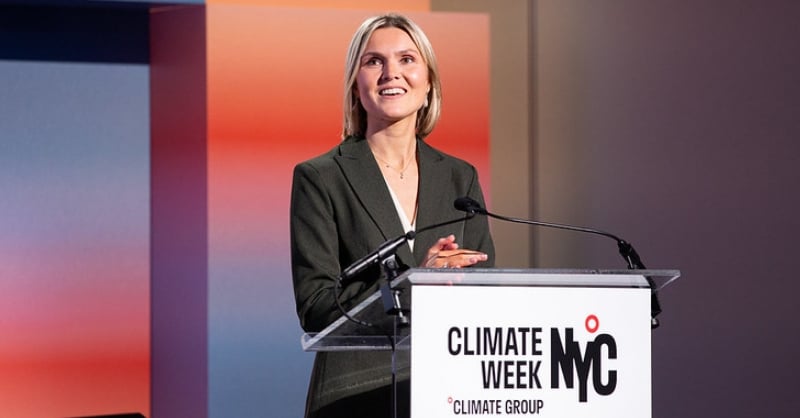
During Climate Week NYC, held from 20 to 27 September 2026, many European companies took part. At a Swissnex event, eight Swiss climate startups made presentations to investors. A group from Lithuania was seeking deals in the grid and agtech sectors, while TechUK organised participation for British climate companies.
Two people who spoke to Tech Funding News stated that they had come because there are now more funding opportunities, more customers, and more regulatory opportunities available in the United States.
Following the money
CMBLU Energy, a long-duration energy storage company based in Alzenau, Germany, raised €50 million during the first stage of its Series C financing, with participation from Samsung Ventures and STRABAG SE. As a result of this funding, the company’s valuation exceeded €1 billion, making it the first in Germany to become a non-lithium battery unicorn and bringing its total funding to over $160 million.
Constantin Eis, the company’s CEO, who attended Climate Week in New York, shares with TFN, “The amount of capital available and the momentum for longer duration energy storage are strong in the US, something that we’re here to make the most of.”
TFN has encountered the same arguments before. Ian Hogarth, a partner at Plural, called long-duration storage “one of the biggest unsolved challenges in the energy transition” when backing Dutch iron-air battery startup Ore Energy.
Urte Zahn, CEO of Re-Fresh Global, made the same argument about her company, which converts blended textile waste into industrial materials using enzymes. The Berlin startup has raised a pre-seed round of €1.1 million.
“Since our customers, partners and investors are located all over the world, it doesn’t make much sense to remain within Europe. New York has the advantage of concentration, since corporations, authorities, investors and material experts are all there in one place,” Zahn tells TFN.
Built to move west
It wasn’t just CMBLU and Re-Fresh Global that were adopting this method, since much of the activity had been pre-planned.
At the Swiss ClimateTech Showcase, part of Climate Collider, a program run by Swissnex and Innosuisse that links Swiss climate companies with those in Boston and New York, eight Swiss startups, such as the biochar company BCHAR and the geothermal driller Borobotics, presented their projects.
TechUK organised a group of UK climate tech companies to visit US investors, companies, and customers between 22 and 25 September. Lithuanian energy and agtech companies also took part, among them InSoil, the soil-carbon financier that, in June, obtained a €120 million credit facility from Pollen Street Capital as it sought American partners.
While European founders insist these US expansions are strategic moves rather than permanent exits, the trend underscores a pivotal moment for Europe’s climate tech ecosystem.
As US funding, customer concentration, and regulatory momentum continue to draw European innovation across the Atlantic, European policymakers face growing pressure to create competitive domestic markets or risk watching their most promising climate solutions build their commercial futures elsewhere.