


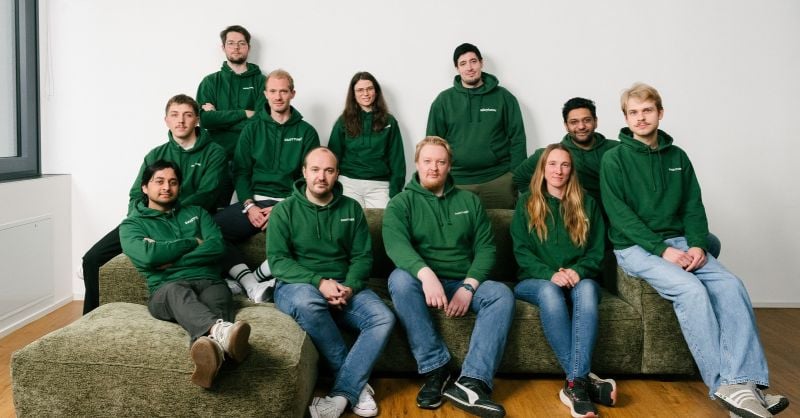
- Daisytuner has raised €6 million in seed funding, with Elaia and LEA Ventures leading the round.
- It’s an open-source compiler that takes framework code and compiles it to native code for a range of chips, including Nvidia and AMD GPUs, as well as new chips.
- Most of the funds go to headcount, and the remainder is spent buying chips from various vendors for testing, benchmarking, and training the AI agents that improve the compiler.
Lukas Trümper used to work on moving code off the CPU and onto the Nvidia GPUs. Now, “everyone wants to bring code away from Nvidia GPUs to everyone else,” he says to Tech Funding News.
He founded Daisytuner in Germany in 2024 to deal with that, and they’ve now raised €6 million in seed funding, led by Elaia and LEA Ventures, with participation from Amadeus APEX Technology Fund and Seedcamp.
This funding round follows Qualcomm’s June 2026 agreement to acquire Modular, a software company that enables AI models to run on different chips, for $3.9 billion.
From PhD dropout to first customers
Trümper did a PhD at ETH Zurich, published papers and then left academia to co-found the company with Adrian Schmitz. The rest of the team has backgrounds in ETH Zurich, TU Munich, RWTH Aachen, TU Darmstadt, and Lawrence Livermore National Laboratory.
Daisytuner, based in Darmstadt, is an automated performance engineering tool which tunes AI models for specific chips. In essence, it’s an open-source compiler that takes code from a framework and compiles it to native code for a range of chips, such as Nvidia and AMD GPUs, as well as new chips.
AI agents test various optimisations on real hardware, and the compiler then validates each one. Validated optimisations are then added to a performance database that can be used in future instances of similar code.
Daisyflow is now in production and runs inside the customer’s infrastructure. It serves language, vision, speech and recommendation models via standard APIs. Early results show Qwen 2.5 is up to 18% faster than vLLM on AMD Instinct GPUs.
“Demand for AI compute is growing faster than any one chip generation can serve. The hardware to meet it is already out there, from established GPUs to a wave of new accelerators, but software keeps much of it on the sidelines. We’re working with chip vendors, European hyperscalers and enterprises to change that, so every chip runs at full speed and new ones go into production the moment they arrive,” says Trümper.
According to him, Daisytuner has spent the past year working with chipmakers Tenstorrent and Q.ANT, both now paying customers. Other chipmakers are under NDA, and the company is very close to finalising its first enterprise deals.
The core patent was officially approved several weeks ago, and the team has grown to 12 people, with a target of well over 20 by early 2027.
A crowded lane
Trümper identifies Modular as his “biggest competitor” and notes that they are in a “different position” now under Qualcomm. He mentions a number of other competitors in the US and Europe and feels that in terms of technology and traction they are all “on a par” with Daisytuner.
Modular raised $380 million prior to Qualcomm’s offer, including $250 million at a $1.6 billion valuation in September 2025. Infinity secured a $15 million seed at a $100 million valuation in July 2026 for an AI agent that writes chip software.
The €6 million is a pretty small amount compared with the other funding rounds. The AI inference market is expected to grow from $106.15 billion in 2025 to $254.98 billion by 2030.
Who backs it
Trümper says the fundraising went very well as “everyone is thinking about Nvidia” and “everyone is thinking about AMD and the alternatives.” He believes the software layer is the obvious bottleneck.
“Compute is the scarcest resource in AI, and most of it currently sits behind a single vendor’s software stack. Daisytuner lets the same code run at full performance on the silicon you choose, without a rewrite. Removing this bottleneck is what the whole industry needs. Lukas and Adrian have built world-class compiler technology from cutting-edge research, and we’re proud to back them,” says Sébastien Lefebvre, partner at Elaia.
“Compute efficiency and technology sovereignty are the pressing problems in AI. Daisytuner puts control over both back in the hands of customers, who can finally demand more from their hardware,” adds Alexi Malikotsinas, general partner at LEA Ventures.
Most of the funds go to headcount, and the remainder is spent buying chips from various vendors for testing, benchmarking, and training the AI agents that improve the compiler.
The question is, of course, can a start-up of about a dozen people in Darmstadt actually deliver in production what Qualcomm have just acquired for $3.9 billion?



