


- Remanence has raised $30M to turn enterprise AI agent data into models.
- Its platform automates reinforcement learning and post-training for open-weight models.
- Funding will pay for research, a GPU cluster and hiring, mainly in Paris.
As businesses deploy AI agents across increasingly complex workflows, the cost of using general-purpose models is rising. Yet much of the data generated through these interactions remains unused, while companies continue to depend on external AI providers for their intelligence.
Paris-based Remanence wants to change that. The continual-learning startup has raised $30 million in seed funding to help businesses transform their AI agents’ execution data into specialised models they can own and continuously improve.
The round was co-led by EQT Ventures and FirstMark, with participation from Zero Prime, Emblem, Drysdale, Global Founders Capital and Yellow. Angel investors included Olivier Pomel of Datadog, Philippe Corrot of Mirakl, Romain Niccoli of Pigment, Victor Riparbelli and Steffen Tjerrild of Synthesia, and Mehdi Ghissassi of AI71.
The funding will support research, the development of dedicated compute infrastructure, including a GPU cluster, and hiring. Remanence will hire primarily in Paris and establish an early presence in London and San Francisco.
Turning enterprise data into proprietary intelligence
Most general-purpose AI models are designed to serve a broad range of users. They are not necessarily optimised for an individual company’s tools, processes or operational requirements. Although AI agents generate valuable execution data as they complete tasks, businesses often lack the infrastructure to use that information to improve their models.
Open-weight models offer an alternative because companies can adapt them to specific workflows and retain control over the resulting technology. However, post-training these models requires specialised expertise, computing resources and customised training environments.
Remanence is building a platform to automate this process. It connects to a company’s existing AI models and converts their execution traces into tailored training environments. These environments are then used to post-train open-weight models through reinforcement learning.
As agents generate more data, the models can be retrained to improve accuracy and adapt to changing workflows. The approach is designed to reduce latency and operating costs while allowing companies to retain ownership of their model weights and resulting intelligence.
Businesses can also keep their data within their own infrastructure and choose where training and deployment take place.
Founded by former H Company researchers
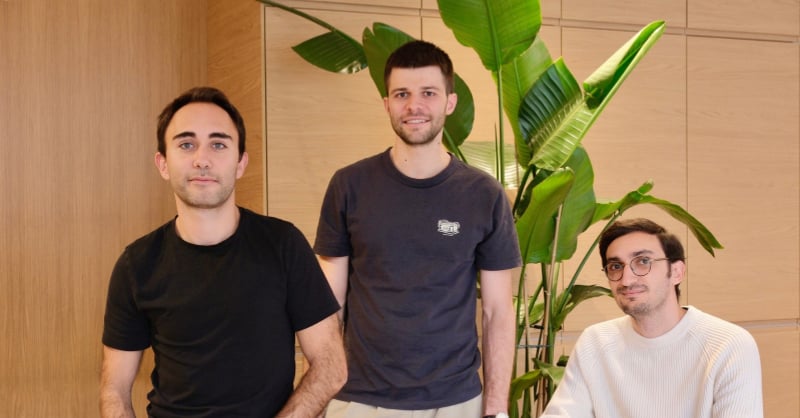
Remanence was founded by Pierre-Louis Cedoz, Hamza Benchekroun and Axel Moyal, who previously worked together at H Company, a French computer-use AI lab.
At H Company, the founders led post-training work on the open-weight Holo models, which the company says outperformed leading open- and closed-source models on computer-use benchmarks. Their collective experience spans Google DeepMind, Meta and InstaDeep.
The team is now applying that expertise to a broader enterprise problem: making advanced model training accessible to companies that do not have the resources or specialist teams of major AI laboratories. Remanence is already working with design partners in legal, customer support and enterprise software across Europe and the US.
“We have seen first-hand how powerful post-training can be, as well as how difficult it remains for most companies to access. We started Remanence to close that gap and help businesses turn their own agent data into specialised models they control. Our ambition is to give every company the ability to build proprietary intelligence that improves with use and becomes a lasting advantage,” said Pierre-Louis Cedoz, co-founder and CEO of Remanence.
Competition in the enterprise AI infrastructure market
Remanence enters a growing market for tools that help businesses train, evaluate and improve AI systems using their own workflows.
Bespoke Labs has raised $40 million across seed and Series A rounds to build simulated enterprise environments where AI agents can learn complex tasks before deployment. Mercor raised a $750 million Series D at a $20 billion valuation to build evaluations and training environments for enterprise agents. Meanwhile, River AI raised $1.1 billion for an API that runs fine-tuning and reinforcement learning on open-weight models.
These companies address different parts of the AI development stack. Remanence’s pitch is that it builds the training environments from a customer’s own agent traces rather than from a generic set.
Building the infrastructure for continual learning
For EQT Ventures, Remanence is positioned to address a growing gap between enterprise AI adoption and model ownership.
“The next phase of enterprise AI will be about who owns the intelligence. As companies deploy more AI agents, they’re generating enormous amounts of valuable data, but most lack the infrastructure to turn it into models that continuously improve. Pierre-Louis, Hamza and Axel have the technical expertise to help make that possible at scale. We believe this shift towards proprietary, continually improving AI will change how enterprises build and deploy intelligence, and we’re excited to back Remanence as they help make it happen,” said Tom Mendoza, partner at EQT Ventures.
“The enterprise AI stack is going hybrid: closed frontier models will keep playing a critical role, alongside models that companies own and control. But most companies that try to post-train their own models hit a wall, not because the idea is wrong, but because the people who know how to do it all work inside a handful of labs. Pierre-Louis, Hamza and Axel are those people. They built models at H that beat the frontier labs’ models on computer-use benchmarks, and now they’re turning that into something every company can use,” added Matt Turck, general partner at FirstMark.
Remanence is betting that companies will want to own the intelligence built from their own data rather than rent it. Can a seed-stage team automate post-training well enough to beat the frontier models those companies already use?



